293 posters, 56 videos, 24 topics, 13 sessions, 658 authors, 215 institutions
ePostersLive by SciGen Technologies S.A. All rights reserved.
ISMICS 2025 Annual Meeting
28 - 31 May, 2025 | Istanbul, Turkey

D155
Management Of Pulmonary Artery Laceration Using Suspension Suture Technique During Vats Right Middle Lobectomy
Poster Presenter
Authors
Part of Topic
Thoracic Surgery – Lung
Video
Management Of Pulmonary Artery Laceration Using Suspension Suture Technique During Vats Right Middle Lobectomy
Abstract
Pulmonary artery injury during video-assisted thoracoscopic surgery (VATS) poses a serious intraoperative challenge, particularly when caused by stapler malfunction. This report presents a case in which a vascular laceration was successfully managed using a suspension suture technique, avoiding conversion to thoracotomy. The technique improved exposure and allowed for controlled vascular clamping and suture repair, thereby maintaining the minimally invasive nature of the procedure.
Introduction
Minimally invasive techniques such as VATS have become standard in thoracic surgery due to their association with reduced postoperative pain, faster recovery, and shorter hospital stays. However, they require meticulous technique, especially during vascular dissection and division. Stapler malfunction is a rare but dangerous complication that may lead to life-threatening bleeding. Prompt and effective intraoperative strategies are essential to avoid open conversion and to maintain surgical safety. This case highlights the utility of the suspension suture technique as a rapid and reliable maneuver to gain control over vascular injuries during VATS.
Case Description
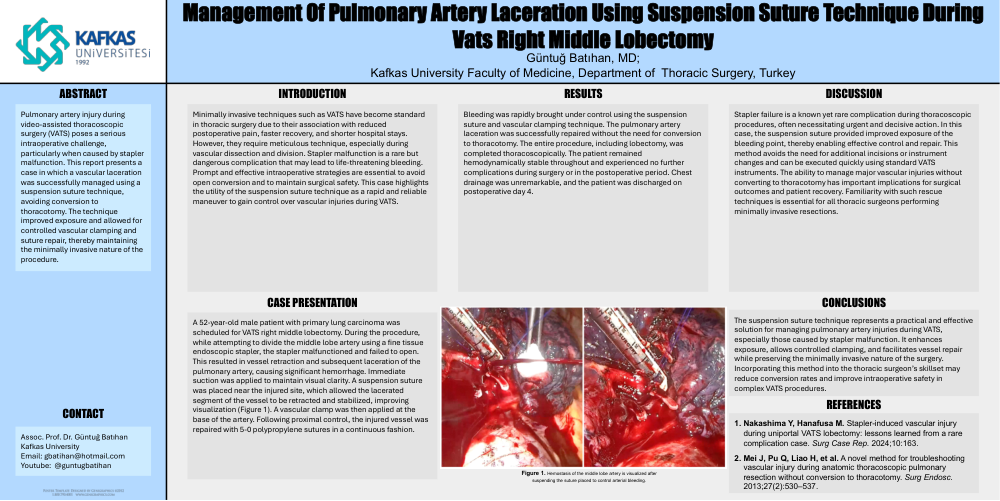
A 52-year-old male patient with primary lung carcinoma was scheduled for VATS right middle lobectomy. During the procedure, while attempting to divide the middle lobe artery using a fine tissue endoscopic stapler, the stapler malfunctioned and failed to open. This resulted in vessel retraction and subsequent laceration of the pulmonary artery, causing significant hemorrhage. Immediate suction was applied to maintain visual clarity. A suspension suture was placed near the injured site, which allowed the lacerated segment of the vessel to be retracted and stabilized, improving visualization. A vascular clamp was then applied at the base of the artery. Following proximal control, the injured vessel was repaired with 5-0 polypropylene sutures in a continuous fashion.
Results
Bleeding was rapidly brought under control using the suspension suture and vascular clamping technique. The pulmonary artery laceration was successfully repaired without the need for conversion to thoracotomy. The entire procedure, including lobectomy, was completed thoracoscopically. The patient remained hemodynamically stable throughout and experienced no further complications during surgery or in the postoperative period. Chest drainage was unremarkable, and the patient was discharged on postoperative day 4.
Discussion
Stapler failure is a known yet rare complication during thoracoscopic procedures, often necessitating urgent and decisive action. In this case, the suspension suture provided improved exposure of the bleeding point, thereby enabling effective control and repair. This method avoids the need for additional incisions or instrument changes and can be executed quickly using standard VATS instruments. The ability to manage major vascular injuries without converting to thoracotomy has important implications for surgical outcomes and patient recovery. Familiarity with such rescue techniques is essential for all thoracic surgeons performing minimally invasive resections.
Conclusions
The suspension suture technique represents a practical and effective solution for managing pulmonary artery injuries during VATS, especially those caused by stapler malfunction. It enhances exposure, allows controlled clamping, and facilitates vessel repair while preserving the minimally invasive nature of the surgery. Incorporating this method into the thoracic surgeon’s skillset may reduce conversion rates and improve intraoperative safety in complex VATS procedures.