293 posters, 56 videos, 24 topics, 13 sessions, 658 authors, 215 institutions
ePostersLive by SciGen Technologies S.A. All rights reserved.
ISMICS 2025 Annual Meeting
28 - 31 May, 2025 | Istanbul, Turkey
D142
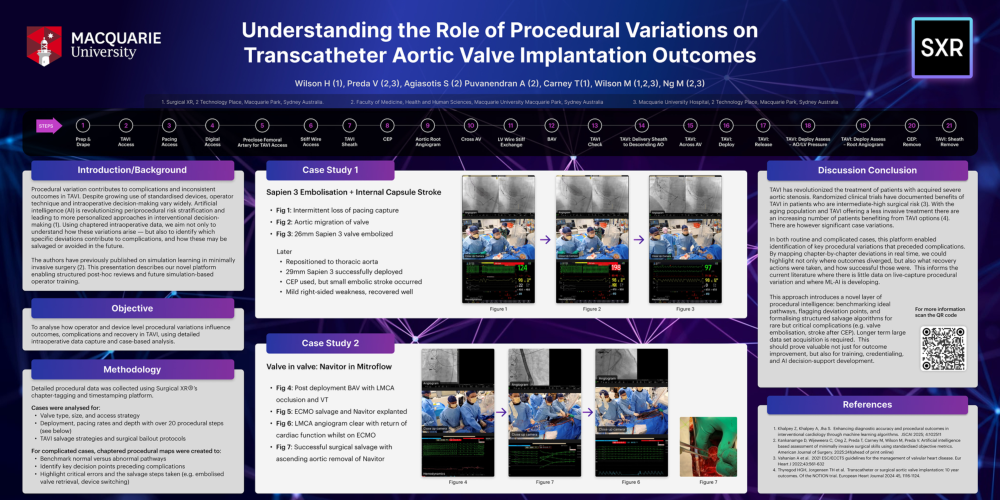
Understanding The Role Of Procedural Variations On Transcatheter Aortic Valve Implantation Outcomes: A Multi-factorial Analysis
Poster Presenter
Authors
Michael Wilson, Veronica Preda, Henry Wilson, Steven Agiasotis, Abirami Puvanendran, Terry Carney, Martin Ng
Affiliations
Surgical XR, 2 Technology Place, Macquarie Park, Sydney Australia., Faculty of Medicine, Health and Human Sciences, Macquarie University Macquarie Park, Sydney Australia and Macquarie University Hospital, 2 Technology Place, Macquarie Park, Sydney Australia, Faculty of Medicine, Health and Human Sciences, Macquarie University Macquarie Park, Sydney Australia, Surgical XR, 2 Technology Place, Macquarie Park. Faculty of Medicine, Health and Human Sciences, Macquarie University Macquarie Park, 2 Technology Place, Macquarie Park
Part of Topic
Valve - Transcatheter Therapies
Introduction/Background
Procedural variation contributes to complications and inconsistent outcomes in TAVI. Despite growing use of standardised devices, operator technique and intraoperative decision-making vary widely. Artificial intelligence (AI) is revolutionizing periprocedural risk stratification and leading to more personalized approaches in interventional decision-making (1). Using chaptered intraoperative data, we aim not only to understand how these variations arise — but also to identify which specific deviations contribute to complications, and how these may be salvaged or avoided in the future. The authors have previously published on simulation learning in minimally invasive surgery (2). This presentation describes our novel platform enabling structured post-hoc reviews and future simulation-based operator training.
Objective
To analyse how operator and device level procedural variations influence outcomes, complications and recovery in TAVI, using detailed intraoperative data capture and case-based analysis.
Methodology
Detailed procedural data was collected using Surgical XR®’s chapter-tagging and timestamping platform.
Cases were analysed for:
-
Valve type, size, and access strategy
-
Deployment, pacing rates and depth with over 20 procedural
steps (see below)
-
TAVI salvage strategies and surgical bailout protocols
-
Benchmark normal versus abnormal pathways
-
Identify key decision points preceding complications
-
Highlight critical errors and the salvage steps taken (e.g. embolised valve retrieval, device switching)
Case Study 1
Sapien 3 Embolisation + Internal Capsule Stroke
-
Fig 1: Intermitant loss of pacing capture
-
Fig 2: Aortic migration of valve
-
Fig 3: 26mm Sapien 3 valve embolized
-
Later
-
-
Repositioned to thoracic aorta
-
29mm Sapien 3 successfully deployed
-
CEP used, but small embolic stroke occurred
-
Mild right-sided weakness, recovered wel
-
-
Case Study 2
Valve in valve: Navitor in Mitroflow
• Fig 4: Post deployment BAV with LMCA occlusion and VT• Fig 5: ECMO salvage and Navitor explanted
• Fig 6: LMCA angiogram clear with return of cardiac function whilst on ECMO
• Fig 7: Successful surgical salvage with ascending aortic removal of Navitor
Discussion Conclusion
TAVI has revolutionized the treatment of patients with acquired severe aortic stenosis. Randomized clinical trials have documented benefits of TAVI in patients who are intermediate- high surgical risk (3). With the aging population and TAVI offering a less invasive treatment there are an increasing number of patients benefiting from TAVI options (4). There are however significant case variations. In both routine and complicated cases, this platform enabled identification of key procedural variations that preceded complications. By mapping chapter-by-chapter deviations in real time, we could highlight not only where outcomes diverged, but also what recovery actions were taken, and how successful those were. This informs the current literature where there is little data on live-capture procedural variation and where ML-AI is developing.
This approach introduces a novel layer of procedural intelligence: benchmarking ideal pathways, flagging deviation points, and formalising structured salvage algorithms for rare but critical complications (e.g. valve embolisation, stroke after CEP). Longer term large data set acquisition is required. This should prove valuable not just for outcome improvement, but also for training, credentialing, and AI decision-support development.
References
Khalpey Z, Khalpey A, Jha S. Enhancing diagnostic accuracy and procedural outcomes in interventional cardiology through machine learning algorithms. JSCAI 2025; 4:102511 Kankanamge D, Wijeweera C, Ong Z, Preda T, Carney M, Wilson M, Preda V. Artificial intelligence based assessment of minimally invasive surgical skills using standardised objective metrics. American Journal of Surgery. 2025:241(ahead of print online)
Vahanian A et al. 2021 ESC/ECCTS guidelines for the management of valvular heart disease. Eur Heart J 2022;43:561-632
Thyregod HGH, Jorgensen TH et al. Transcatheter or surgical aortic valve implantation: 10 year outcomes. Of the NOTION trial. European Heart Journal 2024 45, 1116-1124.