293 posters, 56 videos, 24 topics, 13 sessions, 658 authors, 215 institutions
ePostersLive by SciGen Technologies S.A. All rights reserved.
ISMICS 2025 Annual Meeting
28 - 31 May, 2025 | Istanbul, Turkey

D124
Transcatheter Aortic Valve-in-valve Within Early Degenerated Novel Bioprosthesis
Poster Presenter
Part of Topic
Valve - Transcatheter Therapies
AIMS
Patients undergoing aortic valve replacement chose increasingly bioprosthetic valves, due to a better quality of life and the availability of transcatheter valve-in-valve implantation as a reintervention option. The Edwards Inspiris Resilia aortic valve (INSPIRIS) (Edwards Lifesciences LLC, Irvine, USA) is a bovine pericardial bioprosthesis that promises longer durability due to a specific anti-calcification treatment, and the potential future option of a simplified valve-in-valve procedure due to fluoroscopically visible size markers and an expansion zone for a controlled, predictable, and uniform expansion. We report our experience on a transcatheter valve-in-valve procedure within an early degenerated Inspiris Resilia bioprosthesis.
METHODS AND RESULTS
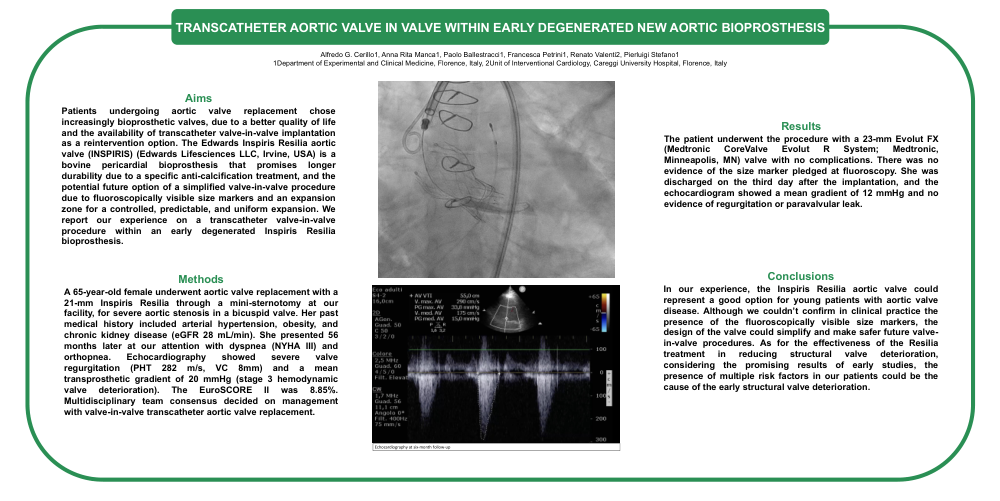
A 65-year-old female underwent aortic valve replacement with a 21-mm Inspiris Resiliathrough a mini-sternotomy at our facility, for severe aortic stenosis in a bicuspid valve. Her past medical history included arterial hypertension, obesity, and chronic kidney disease (eGFR 28 mL/min). She presented 56 months later at our attention with dyspnea (NYHA III) and orthopnea. Echocardiography showed severe valve regurgitation (PHT 282 m/s, VC 8mm) and a mean transprosthetic gradient of 20 mmHg (stage 3 hemodynamic valve deterioration). The EuroSCORE II was 8.85%. Multidisciplinary team consensus decided on management with valve-in-valve transcatheter aortic valve replacement. The patient underwent the procedure with a 23-mm Evolut FX (Medtronic CoreValve Evolut R System; Medtronic, Minneapolis, MN) valve with no complications. There was no evidence of the size marker pledged at fluoroscopy. She was discharged on the third day after the implantation, and the echocardiogram showed a mean gradient of 12 mmHg and no evidence of regurgitation or paravalvular leak.
CONCLUSIONS
In our experience, the Inspiris Resilia aortic valve could represent a good option for young patients with aortic valve disease. Although we couldn’t confirm in clinical practice the presence of the fluoroscopically visible size markers, the design of the valve could simplify and make safer future valve-in-valve procedures. As for the effectiveness of the Resiliatreatment in reducing structural valve deterioration, considering the promising results of early studies, the presence of multiple risk factors in our patients could be the cause of the early structural valve deterioration.