293 posters, 56 videos, 24 topics, 13 sessions, 658 authors, 215 institutions
ePostersLive by SciGen Technologies S.A. All rights reserved.
ISMICS 2025 Annual Meeting
28 - 31 May, 2025 | Istanbul, Turkey
D56
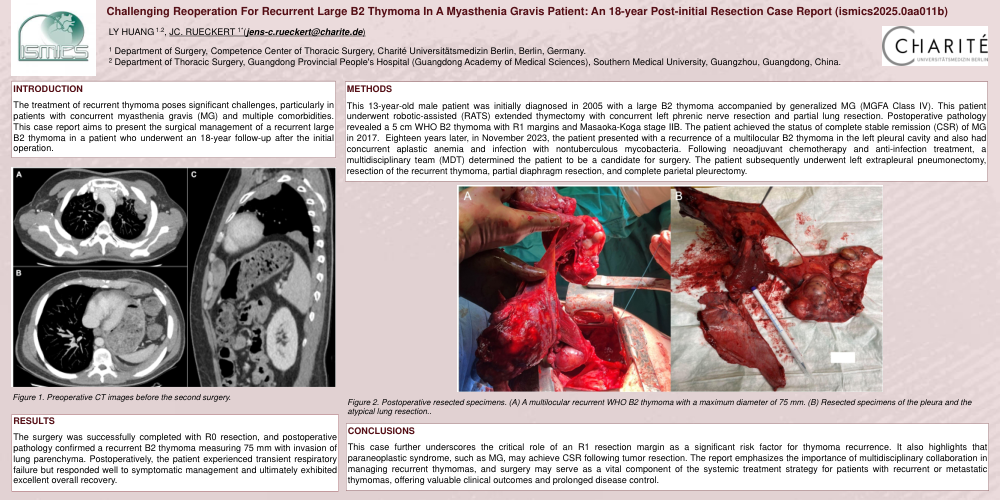
Challenging Reoperation For Recurrent Large B2 Thymoma In A Myasthenia Gravis Patient: An 18-year Post-initial Resection Case Report
Part of Topic
Thoracic Surgery – Mediastinum
Challenging Reoperation For Recurrent Large B2 Thymoma In A Myasthenia Gravis Patient: An 18-year Post-initial Resection Case Report
BACKGROUND: The treatment of recurrent thymoma poses significant challenges, particularly in patients with concurrent myasthenia gravis (MG) and multiple comorbidities. This case report aims to present the surgical management of a recurrent large B2 thymoma in a patient who underwent an 18-year follow-up after the initial operation.
METHODS: This 13-year-old male patient was initially diagnosed in 2005 with a large B2 thymoma accompanied by generalized MG (MGFA Class IV). This patient underwent robotic-assisted (RATS) extended thymectomy with concurrent left phrenic nerve resection and partial lung resection. Postoperative pathology revealed a 5 cm WHO B2 thymoma with R1 margins and Masaoka-Koga stage IIB. The patient achieved the status of complete stable remission (CSR) of MG in 2017. Eighteen years later, in November 2023, the patient presented with a recurrence of a multilocular B2 thymoma in the left pleural cavity and also had concurrent aplastic anemia and infection with nontuberculous mycobacteria. Following neoadjuvant chemotherapy and anti-infection treatment, a multidisciplinary team (MDT) determined the patient to be a candidate for surgery. The patient subsequently underwent left extrapleural pneumonectomy, resection of the recurrent thymoma, partial diaphragm resection, and complete parietal pleurectomy.
RESULTS: The surgery was successfully completed with R0 resection, and postoperative pathology confirmed a recurrent B2 thymoma measuring 75 mm with invasion of lung parenchyma. Postoperatively, the patient experienced transient respiratory failure but responded well to symptomatic management and ultimately exhibited excellent overall recovery.
CONCLUSIONS: This case further underscores the critical role of an R1 resection margin as a significant risk factor for thymoma recurrence. It also highlights that paraneoplastic syndrome, such as MG, may achieve CSR following tumor resection. The report emphasizes the importance of multidisciplinary collaboration in managing recurrent thymomas, and surgery may serve as a vital component of the systemic treatment strategy for patients with recurrent or metastatic thymomas, offering valuable clinical outcomes and prolonged disease control.