293 posters, 56 videos, 24 topics, 13 sessions, 658 authors, 215 institutions
ePostersLive by SciGen Technologies S.A. All rights reserved.
ISMICS 2025 Annual Meeting
28 - 31 May, 2025 | Istanbul, Turkey
D39
Video-assisted Thoracoscopic Surgery Vs. Conventional Surgery For Thymoma: Insights From A 10-year Single-center Study
Part of Topic
Thoracic Surgery – Mediastinum
Video-assistedThoracoscopicSurgery Vs. Conventional Surgery For Thymoma: Insights From A 10-year Single-center Study
BACKGROUND: To evaluate and compare the long-term outcomes of Video-Assisted Thoracoscopic Surgery (VATS) and open surgery for thymoma, focusing on survival rates and recurrence patterns.
METHODS: This retrospective cohort study evaluated the clinical outcomes of patients diagnosed with thymoma who underwent surgical resection via VATS, thoracotomy, or sternotomy between 2012 and 2022. The following information was included in the data: demographic data (age and gender), clinical data (tumour size, Masaoka stage and WHO classification), and treatment details (surgical procedure, postoperative complications and adjuvant therapy).The primary outcomes were disease-free survival (DFS) and overall survival (OS). Recurrence and survival status were recorded during a follow-up period spanning 12 to 161 months. Subgroup analyses were conducted to examine survival patterns based on Masaoka stage, WHO classification, and surgical approach.
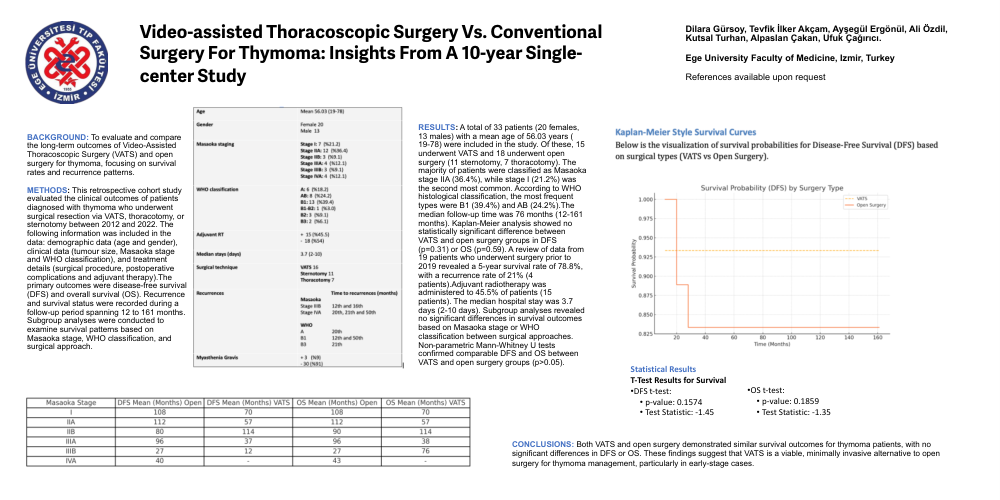
RESULTS: A total of 33 patients (20 females, 13 males) with a mean age of 56.03 years ( 19-78) were included in the study. Of these, 15 underwent VATS and 18 underwent open surgery (11 sternotomy, 7 thoracotomy). The majority of patients were classified as Masaoka stage IIA (36.4%), while stage I (21.2%) was the second most common. According to WHO histological classification, the most frequent types were B1 (39.4%) and AB (24.2%).The median follow-up time was 76 months (12-161 months). Kaplan-Meier analysis showed no statistically significant difference between VATS and open surgery groups in DFS (p=0.31) or OS (p=0.59). A review of data from 19 patients who underwent surgery prior to 2019 revealed a 5-year survival rate of 78.8%, with a recurrence rate of 21% (4 patients).Adjuvant radiotherapy was administered to 45.5% of patients (15 patients). The median hospital stay was 3.7 days (2-10 days). Subgroup analyses revealed no significant differences in survival outcomes based on Masaoka stage or WHO classification between surgical approaches. Non-parametric Mann-Whitney U tests confirmed comparable DFS and OS between VATS and open surgery groups (p>0.05).
CONCLUSIONS: Both VATS and open surgery demonstrated similar survival outcomes for thymoma patients, with no significant differences in DFS or OS. These findings suggest that VATS is a viable, minimally invasive alternative to open surgery for thymoma management, particularly in early-stage cases.