293 posters, 56 videos, 24 topics, 13 sessions, 658 authors, 215 institutions
ePostersLive by SciGen Technologies S.A. All rights reserved.
ISMICS 2025 Annual Meeting
28 - 31 May, 2025 | Istanbul, Turkey
D23
Changes Of Costoclavicular Space After Minimally Invasive Repair Of Pectus Excavatum
Poster Presenter
Authors
Affiliations
Department of Thoracic and Cardiovascular Surgery, Incheon St. Mary’s Hospital, College of Medicine, The Catholic University of Korea, Seoul, Republic of Korea, Department of Plastic and Reconstructive Surgery, Eunpyeong St. Mary’s Hospital, College of Medicine, The Catholic University of Korea, Seoul, Republic of Korea
Part of Topic
Thoracic Surgery – Miscellaneous
Changes of Costoclavicular Space after Minimally Invasive Repair of Pectus Excavatum
Jin Yong Jeong1, Eun Young Rha2
1Department of Thoracic and Cardiovascular Surgery, Incheon St. Mary’s Hospital, College of Medicine, The Catholic University of Korea, Seoul, Republic of Korea
2Department of Plastic and Reconstructive Surgery, Eunpyeong St. Mary’s Hospital, College of Medicine, The Catholic University of Korea, Seoul, Republic of Korea
Objective:
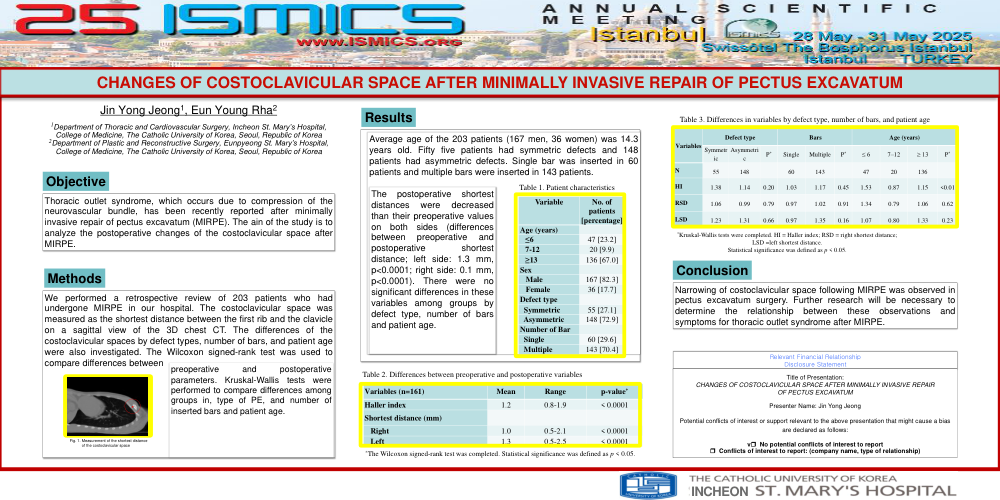
Thoracic outlet syndrome, which occurs due to compression of the neurovascular bundle, has been recently reported after minimally invasive repair of pectus excavatum (MIRPE). The aim of the study is to analyze the postoperative changes of the costoclavicular space after MIRPE.
Methods:
We performed a retrospective review of 203 patients who had undergone MIRPE in our hospital. The costoclavicular space was measured as the shortest distance between the first rib and the clavicle on a sagittal view of the 3D chest CT. The differences of the costoclavicular spaces by defect types, number of bars, and patient age were also investigated. The Wilcoxon signed-rank test was used to compare differences between preoperative and postoperative parameters. Kruskal-Wallis and Man Whitney tests were performed to compare differences among groups in, type of PE, and number of inserted bars and patient age.
Results:
Average age of the 203 patients (167 men, 36 women) was 14.3 years old. Fifty five patients had symmetric defects and 148 patients had asymmetric defects. Single bar was inserted in 60 patients and multiple bars were inserted in 143 patients. The postoperative shortest distances were decreased than their preoperative values on both sides (differences between preoperative and postoperative shortest distance; left side: 1.3 mm, p<0.0001; right side: 1.0 mm, p<0.0001). There were no significant differences in these variables among groups by defect type, number of bars and patient age.
Conclusions:
Narrowing of costoclavicular space following MIRPE was observed in pectus excavatum surgery. Further research will be necessary to determine the relationship between these observations and symptoms for thoracic outlet syndrome after MIRPE.