225 posters, 34 videos, 18 topics, 14 sessions, 251 authors, 55 institutions
ePostersLive by SciGen Technologies S.A. All rights reserved.
ISMICS 2024 Annual Meeting
29 May - 1 June, 2024 | Athens, Greece

PC.93
Hybrid Coronary Artery Revascularization: 23 Years Of Single Institution Data
Poster Presenter
Authors
Part of Topic
TECAB and MIDCAB
A Retrospective Analysis Of 23 Years Single Institution Data Of Hybrid Coronary Artery Revascularization
Maria Cannoletta, Richard Trimlett, Rashmi Yadav, Anthony De Souza
Royal Brompton & Harefield NHS Foundation Trust, London, United Kingdom
BACKGROUND: Endoscopic atraumatic coronary artery bypass surgery (EndoACAB) is a now established procedure performed in specialist centers. In our institution, this technique is often combined with percutaneous coronary intervention as part of a "hybrid" coronary revascularization approach to achieve complete revascularization for multivessel coronary artery disease. Here, we report our institution results of hybrid coronary revascularization.
METHODS: Retrospective review of single center cardiac surgery database over a period of 22 years and 10 months. Patient characteristics, post-operative complications and in hospital mortality are reported.
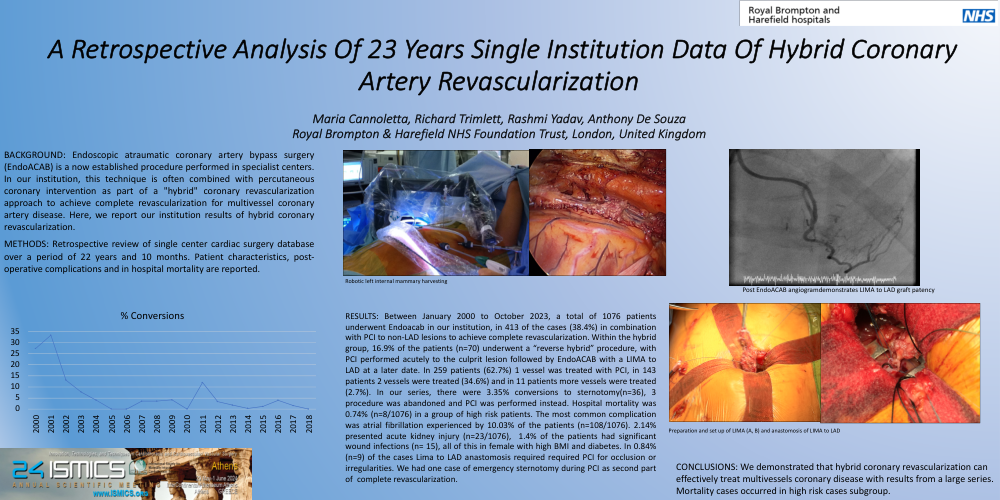
RESULTS: Between January 2000 to October 2023, a total of 1076 patients underwent Endoacab in our institution, in 413 of the cases (38.4%) in combination with PCI to non-LAD lesions to achieve complete revascularization. Within the hybrid group, 16.9% of the patients (n=70) underwent a “reverse hybrid” procedure, with PCI performed acutely to the culprit lesion followed by EndoACAB with a LIMA to LAD at a later date. In 259 patients (62.7%) 1 vessel was treated with PCI, in 143 patients 2 vessels were treated (34.6%) and in 11 patients more vessels were treated (2.7%). In our series, there were 3.35% conversions to sternotomy(n=36), 3 procedure was abandoned and PCI was performed instead. Hospital mortality was 0.74% (n=8/1076) in a group of high risk patients. The most common complication was atrial fibrillation experienced by 10.03% of the patients (n=108/1076). 2.14% presented acute kidney injury (n=23/1076), 1.4% of the patients had significant wound infections (n= 15), all of this in female with high BMI and diabetes. In 0.84% (n=9) of the cases Lima to LAD anastomosis required required PCI for occlusion or irregularities. We had one case of emergency sternotomy during PCI as second part of complete revascularization.
CONCLUSIONS: We demonstrated that hybrid coronary revascularization can effectively treat multivessels coronary disease with results from a large series. Mortality cases occurred in high risk cases subgroup.