225 posters, 34 videos, 18 topics, 14 sessions, 251 authors, 55 institutions
ePostersLive by SciGen Technologies S.A. All rights reserved.
ISMICS 2024 Annual Meeting
29 May - 1 June, 2024 | Athens, Greece
PC.86
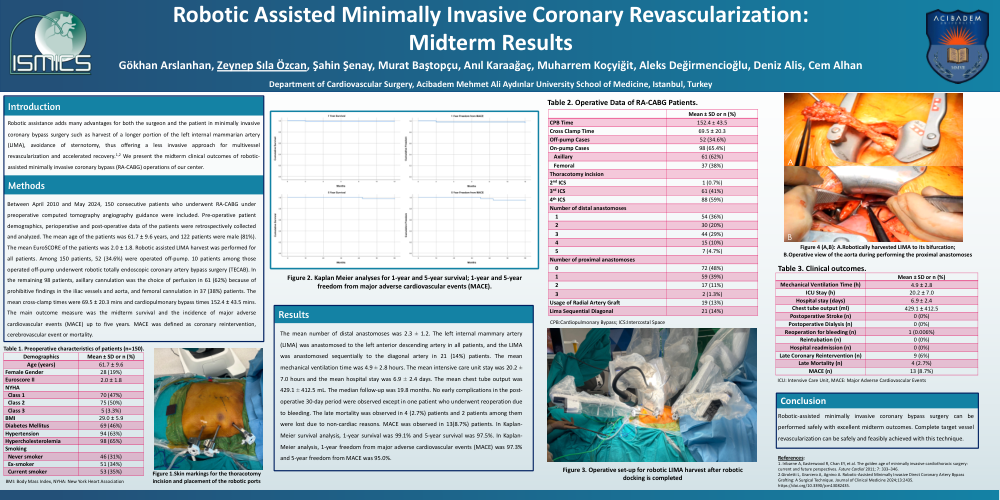
Robotic Assisted Minimally Invasive Coronary Revascularization: Midterm Results
Part of Topic
TECAB and MIDCAB
Introduction:
Robotic assistance adds many advantages for both the surgeon and the patient in minimally invasive coronary bypass surgery such as harvest of a longer portion of the left internal mammarian artery (LIMA), avoidance of sternotomy, thus offering a less invasive approach for multivessel revascularization and accelerated recovery.1,2 We present the midterm clinical outcomes of robotic- assisted minimally invasive coronary bypass (RA-CABG) operations of our center.
Methods:
Between April 2010 and May 2024, 150 consecutive patients who underwent RA-CABG under preoperative computed tomography angiography guidance were included. Pre-operative patient demographics, perioperative and post-operative data of the patients were retrospectively collected and analyzed. The mean age of the patients was 61.7 ± 9.6 years, and 122 patients were male (81%). The mean EuroSCORE of the patients was 2.0 ± 1.8. Robotic assisted LIMA harvest was performed for all patients. Among 150 patients, 52 (34.6%) were operated off-pump. 10 patients among those operated off-pump underwent robotic totally endoscopic coronary artery bypass surgery (TECAB). In the remaining 98 patients, axillary cannulation was the choice of perfusion in 61 (62%) because of prohibitive findings in the iliac vessels and aorta, and femoral cannulation in 37 (38%) patients. The mean cross-clamp times were 69.5 ± 20.3 mins and cardiopulmonary bypass times 152.4 ± 43.5 mins. The main outcome measure was the midterm survival and the incidence of major adverse cardiovascular events (MACE) up to five years. MACE was defined as coronary reintervention, cerebrovascular event or mortality.
Results:
The mean number of distal anastomoses was 2.3 ± 1.2. The left internal mammary artery (LIMA) was anastomosed to the left anterior descending artery in all patients, and the LIMA was anastomosed sequentially to the diagonal artery in 21 (14%) patients. The mean mechanical ventilation time was 4.9 ± 2.8 hours. The mean intensive care unit stay was 20.2 ± 7.0 hours and the mean hospital stay was 6.9 ± 2.4 days. The mean chest tube output was 429.1 ± 412.5 mL. The median follow-up was 19.8 months. No early complications in the post- operative 30-day period were observed except in one patient who underwent reoperation due to bleeding. The late mortality was observed in 4 (2.7%) patients and 2 patients among them were lost due to non-cardiac reasons. MACE was observed in 13(8.7%) patients. In Kaplan- Meier survival analysis, 1-year survival was 99.1% and 5-year survival was 97.5%. In Kaplan- Meier analysis, 1-year freedom from major adverse cardiovascular events (MACE) was 97.3% and 5-year freedom from MACE was 95.0%.
Conclusion:
Robotic-assisted minimally invasive coronary bypass surgery can be performed safely with excellent midterm outcomes. Complete target vessel revascularization can be safely and feasibly achieved with this technique.
References:
1. Iribarne A, Easterwood R, Chan EY, et al. The golden age of minimally invasive cardiothoracic surgery: current and future perspectives. Future Cardiol 2011; 7: 333–346.
2.Giroletti L, Graniero A, Agnino A. Robotic-Assisted Minimally Invasive Direct Coronary Artery Bypass Grafting: A Surgical Technique. Journal of Clinical Medicine 2024;13:2435. https://doi.org/10.3390/jcm13082435.