225 posters, 34 videos, 18 topics, 14 sessions, 251 authors, 55 institutions
ePostersLive by SciGen Technologies S.A. All rights reserved.
ISMICS 2024 Annual Meeting
29 May - 1 June, 2024 | Athens, Greece
PC.91
Clinical Outcomes Of Octogenarians After Robotic-assisted Coronary Artery Bypass Grafting
Poster Presenter
Authors
Part of Topic
TECAB and MIDCAB
Clinical Outcomes Of Octogenarians After Robotic-assisted Coronary Artery Bypass Grafting
Gianluca Torregrossa1, Massimo Baudo2, Serge Sicouri2, Basel Ramlawi1, Leila Hosseinian1, Courtney Murray1, MaryAnn Wertan1, Stephanie Kjelstrom2, Francis Sutter1
1. Lankenau Heart Institute, Main Line Health, Wynnewood, PA, USA ; 2. Lankenau Institute for Medical Research, Main Line Health, Wynnewood, PA, USA.
Introduction
Given the heightened susceptibility to myocardial infarctions among octogenarians, it's plausible to consider that CABG could offer a more effective approach due to the surgical “collateralization”. Yet, for many of these patients, the perceived risks associated with surgery are deemed excessively high, leading to a more frequent selection of PCI. Presently, there isn't a definitive guideline recommending the best invasive treatment for octogenarians with coronary artery disease. Hence, the aim of the current analysis was to to assess the short and mid-term outcomes of a large octogenarian population who underwent robotic-assisted CABG.
Methods
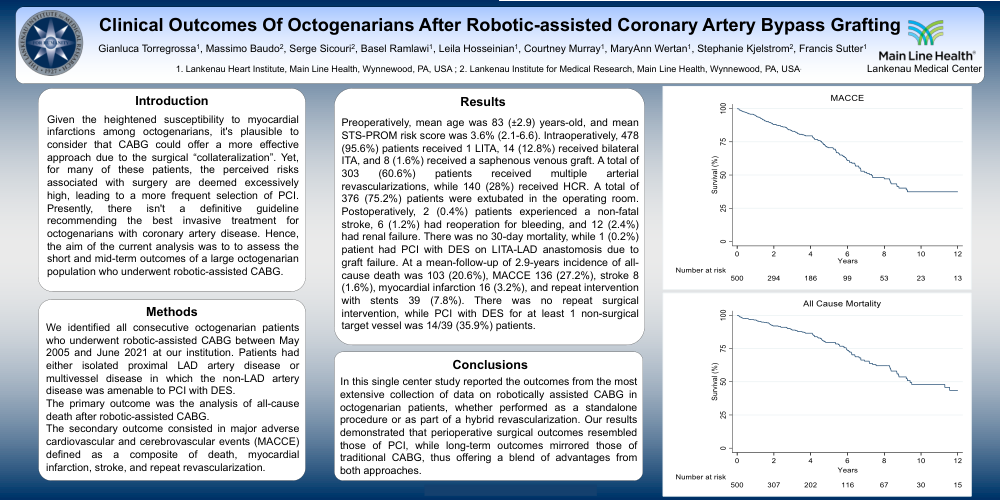
We identified all consecutive octogenarian patients who underwent robotic-assisted CABG between May 2005 and June 2021 at our institution. Patients had either isolated proximal LAD artery disease or multivessel disease in which the non-LAD artery disease was amenable to PCI with DES. The primary outcome was the analysis of all-cause death after robotic-assisted CABG. The secondary outcome consisted in major adverse cardiovascular and cerebrovascular events (MACCE) defined as a composite of death, myocardial infarction, stroke, and repeat revascularization.
Results
Preoperatively, mean age was 83 (±2.9) years-old, and mean STS-PROM risk score was 3.6% (2.1-6.6). Intraoperatively, 478 (95.6%) patients received 1 LITA, 14 (12.8%) received bilateral ITA, and 8 (1.6%) received a saphenous venous graft. A total of 303 (60.6%) patients received multiple arterial revascularizations, while 140 (28%) received HCR. A total of 376 (75.2%) patients were extubated in the operating room. Postoperatively, 2 (0.4%) patients experienced a non-fatal stroke, 6 (1.2%) had reoperation for bleeding, and 12 (2.4%) had renal failure. There was no 30-day mortality, while 1 (0.2%) patient had PCI with DES on LITA-LAD anastomosis due to graft failure. At a mean-follow-up of 2.9-years incidence of all-cause death was 103 (20.6%), MACCE 136 (27.2%), stroke 8 (1.6%), myocardial infarction 16 (3.2%), and repeat intervention with stents 39 (7.8%). There was no repeat surgical intervention, while PCI with DES for at least 1 non-surgical target vessel was 14/39 (35.9%) patients.
Conclusions
In this single center study reported the outcomes from the most extensive collection of data on robotically assisted CABG in octogenarian patients, whether performed as a standalone procedure or as part of a hybrid revascularization. Our results demonstrated that perioperative surgical outcomes resembled those of PCI, while long-term outcomes mirrored those of traditional CABG, thus offering a blend of advantages from both approaches.