225 posters, 34 videos, 18 topics, 14 sessions, 251 authors, 55 institutions
ePostersLive by SciGen Technologies S.A. All rights reserved.
ISMICS 2024 Annual Meeting
29 May - 1 June, 2024 | Athens, Greece

PC.67
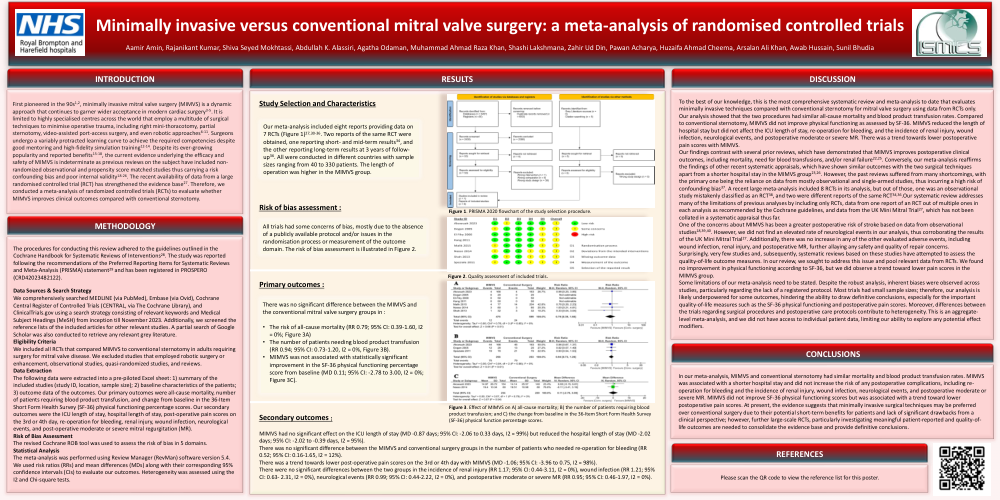
Minimally Invasive Versus Conventional Mitral Valve Surgery : A Meta-analysis Of Randomized Controlled Trials
Poster Presenter
Part of Topic
Mitral Surgery: MICS Robotic and Open
INTRODUCTION
First pioneered in the 90s1,2, minimally invasive mitral valve surgery (MIMVS) is a dynamic approach that continues to garner wider acceptance in modern cardiac surgery3-5. It is limited to highly specialised centres across the world that employ a multitude of surgical techniques to minimise operative trauma, including right mini-thoracotomy, partial sternotomy, video-assisted port-access surgery, and even robotic approaches6-11. Surgeons undergo a variably protracted learning curve to achieve the required competencies despite good mentoring and high-fidelity simulation training12-14. Despite its ever-growing popularity and reported benefits15-18, the current evidence underlying the efficacy and safety of MIMVS is indeterminate as previous reviews on the subject have included non-randomized observational and propensity score matched studies thus carrying a risk confounding bias and poor internal validity18-26. The recent availability of data from a large randomised controlled trial (RCT) has strengthened the evidence base27. Therefore, we conducted a meta-analysis of randomized controlled trials (RCTs) to evaluate whether MIMVS improves clinical outcomes compared with conventional sternotomy.
The procedures for conducting this review adhered to the guidelines outlined in the Cochrane Handbook for Systematic Reviews of Interventions28. The study was reported following the recommendations of the Preferred Reporting Items for Systematic Reviews and Meta-Analysis (PRISMA) statement29 and has been registered in PROSPERO (CRD42023482122).
METHODS
Data Sources & Search Strategy
We comprehensively searched MEDLINE (via PubMed), Embase (via Ovid), Cochrane Central Register of Controlled Trials (CENTRAL, via The Cochrane Library), and ClinicalTrials.gov using a search strategy consisting of relevant keywords and Medical Subject Headings (MeSH) from inception till November 2023. Additionally, we screened the reference lists of the included articles for other relevant studies. A partial search of Google Scholar was also conducted to retrieve any relevant grey literature.
Eligibility Criteria
We included all RCTs that compared MIMVS to conventional sternotomy in adults requiring surgery for mitral valve disease. We excluded studies that employed robotic surgery or enhancement, observational studies, quasi-randomized studies, and reviews.
Data Extraction
The following data were extracted into a pre-piloted Excel sheet: 1) summary of the included studies (study ID, location, sample size); 2) baseline characteristics of the patients; 3) outcome data of the outcomes. Our primary outcomes were all-cause mortality, number of patients requiring blood product transfusion, and change from baseline in the 36-Item Short Form Health Survey (SF-36) physical functioning percentage scores. Our secondary outcomes were the ICU length of stay, hospital length of stay, post-operative pain scores on the 3rd or 4th day, re-operation for bleeding, renal injury, wound infection, neurological events, and post-operative moderate or severe mitral regurgitation (MR).
Risk of Bias Assessment
The revised Cochrane ROB tool was used to assess the risk of bias in 5 domains.
Statistical Analysis
The meta-analysis was performed using Review Manager (RevMan) software version 5.4. We used risk ratios (RRs) and mean differences (MDs) along with their corresponding 95% confidence intervals (CIs) to evaluate our outcomes. Heterogeneity was assessed using the I2 and Chi-square tests.
RESULTS
Study Selection and Characteristics
Our meta-analysis included eight reports providing data on 7 RCTs (Figure 1)27,30-36. Two reports of the same RCT were obtained, one reporting short- and mid-term results34, and the other reporting long-term results at 3 years of follow-up36. All were conducted in different countries with sample sizes ranging from 40 to 330 patients. The length of operation was higher in the MIMVS group.
Risk of bias assessment :
All trials had some concerns of bias, mostly due to the absence of a publicly available protocol and/or issues in the randomisation process or measurement of the outcome domain. The risk of bias assessment is illustrated in Figure 2.
Primary outcomes :
There was no significant difference between the MIMVS and the conventional mitral valve surgery groups in :
Secondary outcomes :
MIMVS had no significant effect on the ICU length of stay (MD -0.87 days; 95% CI: -2.06 to 0.33 days, I2 = 99%) but reduced the hospital length of stay (MD -2.02 days; 95% CI: -2.02 to -0.39 days, I2 = 95%).
There was no significant difference between the MIMVS and conventional surgery groups in the number of patients who needed re-operation for bleeding (RR 0.52; 95% CI: 0.16-1.65, I2 = 12%).
There was a trend towards lower post-operative pain scores on the 3rd or 4th day with MIMVS (MD -1.06; 95% CI: -3.96 to 0.75, I2 = 98%).
There were no significant differences between the two groups in the incidence of renal injury (RR 1.17; 95% CI: 0.44-3.11, I2 = 0%), wound infection (RR 1.21; 95% CI: 0.63- 2.31, I2 = 0%), neurological events (RR 0.99; 95% CI: 0.44-2.22, I2 = 0%), and postoperative moderate or severe MR (RR 0.95; 95% CI: 0.46-1.97, I2 = 0%).
DISCUSSION
To the best of our knowledge, this is the most comprehensive systematic review and meta‐analysis to date that evaluates minimally invasive techniques compared with conventional sternotomy for mitral valve surgery using data from RCTs only. Our analysis showed that the two procedures had similar all-cause mortality and blood product transfusion rates. Compared to conventional sternotomy, MIMVS did not improve physical functioning as assessed by SF-36. MIMVS reduced the length of hospital stay but did not affect the ICU length of stay, re-operation for bleeding, and the incidence of renal injury, wound infection, neurological events, and postoperative moderate or severe MR. There was a trend towards lower postoperative pain scores with MIMVS.
Our findings contrast with several prior reviews, which have demonstrated that MIMVS improves postoperative clinical outcomes, including mortality, need for blood transfusions, and/or renal failure22,25. Conversely, our meta-analysis reaffirms the findings of other recent systematic appraisals, which have shown similar outcomes with the two surgical techniques apart from a shorter hospital stay in the MIMVS group23,26. However, the past reviews suffered from many shortcomings, with the primary one being the reliance on data from mostly observational and single-armed studies, thus incurring a high risk of confounding bias37. A recent large meta-analysis included 8 RCTs in its analysis, but out of those, one was an observational study mistakenly classified as an RCT38, and two were different reports of the same RCT34,36.Our systematic review addresses many of the limitations of previous analyses by including only RCTs, data from one report of an RCT out of multiple ones in each analysis as recommended by the Cochrane guidelines, and data from the UK Mini Mitral Trial27, which has not been collated in a systematic appraisal thus far.
One of the concerns about MIMVS has been a greater postoperative risk of stroke based on data from observational studies18,39,40. However, we did not find an elevated rate of neurological events in our analysis, thus corroborating the results of the UK Mini Mitral Trial27. Additionally, there was no increase in any of the other evaluated adverse events, including wound infection, renal injury, and postoperative MR, further allaying any safety and quality of repair concerns.
Surprisingly, very few studies and, subsequently, systematic reviews based on these studies have attempted to assess the quality-of-life outcome measures. In our review, we sought to address this issue and pool relevant data from RCTs. We found no improvement in physical functioning according to SF-36, but we did observe a trend toward lower pain scores in the MIMVS group.
Some limitations of our meta-analysis need to be stated. Despite the robust analysis, inherent biases were observed across studies, particularly regarding the lack of a registered protocol. Most trials had small sample sizes; therefore, our analysis is likely underpowered for some outcomes, hindering the ability to draw definitive conclusions, especially for the important quality-of-life measures such as the SF-36 physical functioning and postoperative pain scores. Moreover, differences between the trials regarding surgical procedures and postoperative care protocols contribute to heterogeneity. This is an aggregate-level meta-analysis, and we did not have access to individual patient data, limiting our ability to explore any potential effect modifiers.
CONCLUSION
In our meta-analysis, MIMVS and conventional sternotomy had similar mortality and blood product transfusion rates. MIMVS was associated with a shorter hospital stay and did not increase the risk of any postoperative complications, including re-operation for bleeding and the incidence of renal injury, wound infection, neurological events, and postoperative moderate or severe MR. MIMVS did not improve SF-36 physical functioning scores but was associated with a trend toward lower postoperative pain scores. At present, the evidence suggests that minimally invasive surgical techniques may be preferred over conventional surgery due to their potential short-term benefits for patients and lack of significant drawbacks from a clinical perspective; however, further large-scale RCTs, particularly investigating meaningful patient-reported and quality-of-life outcomes are needed to consolidate the evidence base and provide definitive conclusions