225 posters, 34 videos, 18 topics, 14 sessions, 251 authors, 55 institutions
ePostersLive by SciGen Technologies S.A. All rights reserved.
ISMICS 2024 Annual Meeting
29 May - 1 June, 2024 | Athens, Greece

PC.62
Factors Associated With Incision Length In Robotic Cardiac Surgery
Poster Presenter
Authors
Affiliations
Part of Topic
Mitral Surgery: MICS Robotic and Open
Factors Associated With Incision Length In Robotic Cardiac Surgery
Robotic cardiac surgery claims to reduce surgical trauma. However, definitive quantitative evidence on the length of incisions for primary access ports and cannulation for cardiopulmonary bypass (CPB) is lacking or underestimated in literature. Our study aimed to assess these incision lengths precisely and identify factors that influence their size.
From July 2021 to June 2023, 107 patients underwent robotic mitral or coronary bypass surgery at UPMC Presbyterian or UPMC Passavant. Median age: 63 (27 – 85) years; 76.6% male. Median STS risk of mortality: 0.5 (0.1 - 4.5)%. Procedures: Robotic MVR (53.3%), MIDCAB (18.7%), TECAB (28.0%). All used a four-armed surgical robot. Total incision length (TIL) was measured post-closure.
Surgical challenges included: cannulation problems, bleeding, revisions, and conversions to sternotomy. Median TILs compared across pre-, intra-, and postoperative variables; non-parametric correlations for continuous variables; SPSS for analysis.
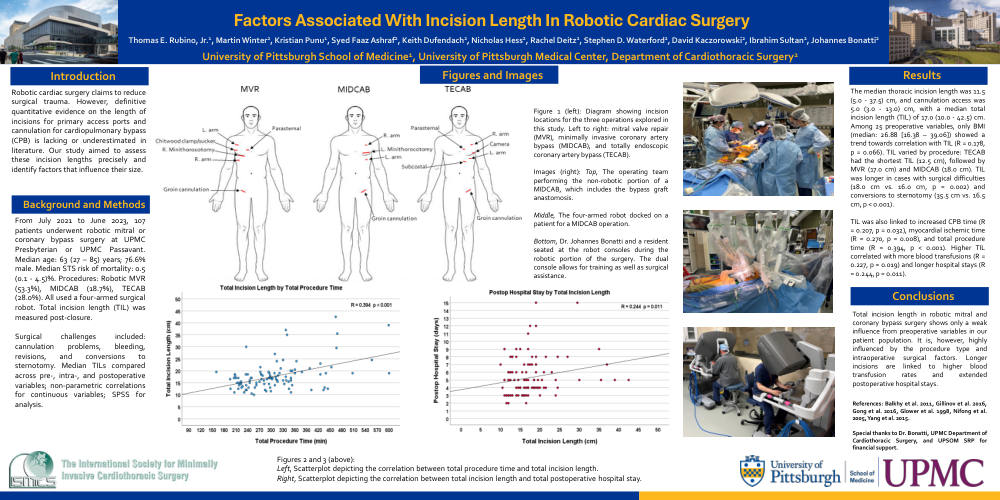
Figure 1 (left): Diagram showing incision locations for the three operations explored in this study. Left to right: mitral valve repair (MVR), minimally invasive coronary artery bypass (MIDCAB), and totally endoscopic coronary artery bypass (TECAB).
Images (right): Top, The operating team performing the non-robotic portion of a MIDCAB, which includes the bypass graft anastomosis.
Middle, The four-armed robot docked on a patient for a MIDCAB operation.
Bottom, Dr. Johannes Bonatti and a resident seated at the robot consoles during the robotic portion of the surgery. The dual console allows for training as well as surgical assistance.
The median thoracic incision length was 11.5 (5.0 - 37.5) cm, and cannulation access was 5.0 (3.0 - 13.0) cm, with a median total incision length (TIL) of 17.0 (10.0 - 42.5) cm. Among 25 preoperative variables, only BMI (median: 26.88 [16.38 – 39.06]) showed a trend towards correlation with TIL (R = 0.178, p = 0.066). TIL varied by procedure: TECAB had the shortest TIL (12.5 cm), followed by MVR (17.0 cm) and MIDCAB (18.0 cm). TIL was longer in cases with surgical difficulties (18.0 cm vs. 16.0 cm, p = 0.002) and conversions to sternotomy (35.5 cm vs. 16.5 cm, p < 0.001).
TIL was also linked to increased CPB time (R = 0.207, p = 0.032), myocardial ischemic time (R = 0.270, p = 0.008), and total procedure time (R = 0.394, p < 0.001). Higher TIL correlated with more blood transfusions (R = 0.227, p = 0.019) and longer hospital stays (R = 0.244, p = 0.011).
Total incision length in robotic mitral and coronary bypass surgery shows only a weak influence from preoperative variables in our patient population. It is, however, highly influenced by the procedure type and intraoperative surgical factors. Longer incisions are linked to higher blood transfusion rates and extended postoperative hospital stays.
References: Balkhy et al. 2011, Gillinov et al. 2016, Gong et al. 2016, Glower et al. 1998, Nifong et al. 2005, Yang et al. 2015.
Special thanks to Dr. Bonatti, UPMC Department of Cardiothoracic Surgery, and UPSOM SRP for financial support.
Figures 2 and 3 (above):
Left, Scatterplot depicting the correlation between total procedure time and total incision length.
Right, Scatterplot depicting the correlation between total incision length and total postoperative hospital stay.