225 posters, 34 videos, 18 topics, 14 sessions, 251 authors, 55 institutions
ePostersLive by SciGen Technologies S.A. All rights reserved.
ISMICS 2024 Annual Meeting
29 May - 1 June, 2024 | Athens, Greece

PC.38
Feasibility Of Micro Automated Suture Fastener Application On Coronary Artery Bypass Grafting. Single Surgeon Experience
Poster Presenter
Authors
Part of Topic
Coronary Revascularization
Feasibility Of Micro Automated Suture Fastener Application On Coronary Artery Bypass Grafting. Single Surgeon Experience
Gianluca Torregrossa1, Massimo Baudo2, Serge Sicouri2, MaryAnn Wertan1, Courtney Murray1, Leila Hosseinian1, Basel Ramlawi1, Francis Sutter1
Lankenau Heart Institute, Main Line Health, Wynnewood, PA, USA ; 2. Lankenau Institute for Medical Research, Main Line Health, Wynnewood, PA, USA.
Introduction
The COR-KNOT MICRO (LSI SOLUTIONS, Victor, NY, USA) used to secure 6-0, 7-0, or 8-0 polypropylene suture has been clinically available since 2021. Our established practice of robotic-assisted minimally invasive direct coronary artery bypass (RA-MIDCAB) with postoperative angiographic visualization of left internal thoracic artery to left anterior descending artery (LITA–LAD) anastomoses has been ideal to test the safety, efficacy, and overall functionality of this device. This study investigated the use of the COR-KNOT MICRO by evaluating the clinical and angiographic outcomes over a short-term follow-up period.
Methods
This retrospective cohort study examined patients who underwent RA-MIDCAB at our institution from July 2021 to November 2023. Some patients (28/58) also underwent planned postoperative percutaneous coronary intervention (PCI) with drug-eluting stents for non-LAD coronaries, allowing for angiographic visualization of the LITA-LAD anastomosis. The primary outcome was analysis of angiographic findings in the COR-KNOT MICRO study patients. Secondary outcomes included overall death, cardiac death, cardiac readmission, stroke, myocardial infarction, and repeat revascularization.
Results
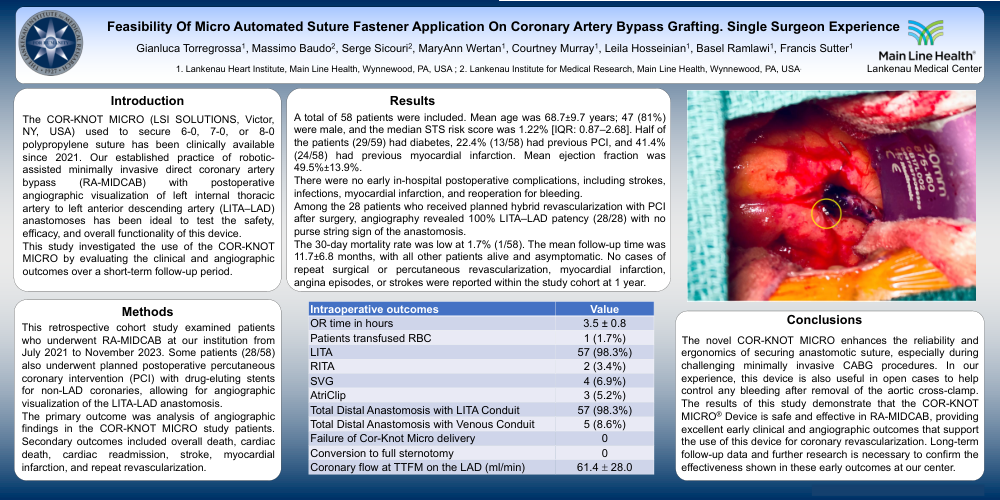
A total of 58 patients were included. Mean age was 68.7±9.7 years; 47 (81%) were male, and the median STS risk score was 1.22% [IQR: 0.87–2.68]. Half of the patients (29/59) had diabetes, 22.4% (13/58) had previous PCI, and 41.4% (24/58) had previous myocardial infarction. Mean ejection fraction was 49.5%±13.9%. There were no early in-hospital postoperative complications, including strokes, infections, myocardial infarction, and reoperation for bleeding. Among the 28 patients who received planned hybrid revascularization with PCI after surgery, angiography revealed 100% LITA–LAD patency (28/28) with no purse string sign of the anastomosis. The 30-day mortality rate was low at 1.7% (1/58). The mean follow-up time was 11.7±6.8 months, with all other patients alive and asymptomatic. No cases of repeat surgical or percutaneous revascularization, myocardial infarction, angina episodes, or strokes were reported within the study cohort at 1 year.
Conclusions
The novel COR-KNOT MICRO enhances the reliability and ergonomics of securing anastomotic suture, especially during challenging minimally invasive CABG procedures. In our experience, this device is also useful in open cases to help control any bleeding after removal of the aortic cross-clamp. The results of this study demonstrate that the COR-KNOT MICRO® Device is safe and effective in RA-MIDCAB, providing excellent early clinical and angiographic outcomes that support the use of this device for coronary revascularization. Long-term follow-up data and further research is necessary to confirm the effectiveness shown in these early outcomes at our center.