225 posters, 34 videos, 18 topics, 14 sessions, 251 authors, 55 institutions
ePostersLive by SciGen Technologies S.A. All rights reserved.
ISMICS 2024 Annual Meeting
29 May - 1 June, 2024 | Athens, Greece
D.25
Quality Of Life After Robotic Hybrid Coronary Revascularization Versus Conventional Coronary Artery Bypass Grafting
Poster Presenter
Authors
Part of Topic
Coronary Revascularization
Background
Coronary artery bypass grafting (CABG) is a common surgical intervention for
coronary artery disease, and advancements in technology have led to the
introduction of robotic-assisted CABG (R-CABG) as an alternative to
traditional CABG. While R-CABG has shown similar outcomes to CABG in
terms of perioperative outcomes, various studies have shown that R-CABG
was also associated with fewer transfusions, shorter length of stay, and lower
hospital cost. Given these findings this study aims to compare the subjective
quality of life outcomes at 4 weeks and 6 months post-surgery using the SF36
questionnaire for patients undergoing traditional CABG and R-CABG.
Methods:
A prospective cohort study was conducted, enrolling patients scheduled for
either traditional CABG or R-CABG. Quality of life outcomes were assessed
using the SF36 questionnaire at two time points: 4 weeks and 6 months
post-surgery. The SF36 questionnaire includes physical and mental health
components, providing a comprehensive evaluation of patients' well-being.
Mohammed A. Ashour, Salman W. Bafageeh, Abivarma Chandrakumaran, Osama
Abdulrahman, Mohammed Shihata, Ahmed Jamjoom, Uthman Aluthman,
King Faisal Specialist Hospital and Research Center-Jeddah, KSA
Results
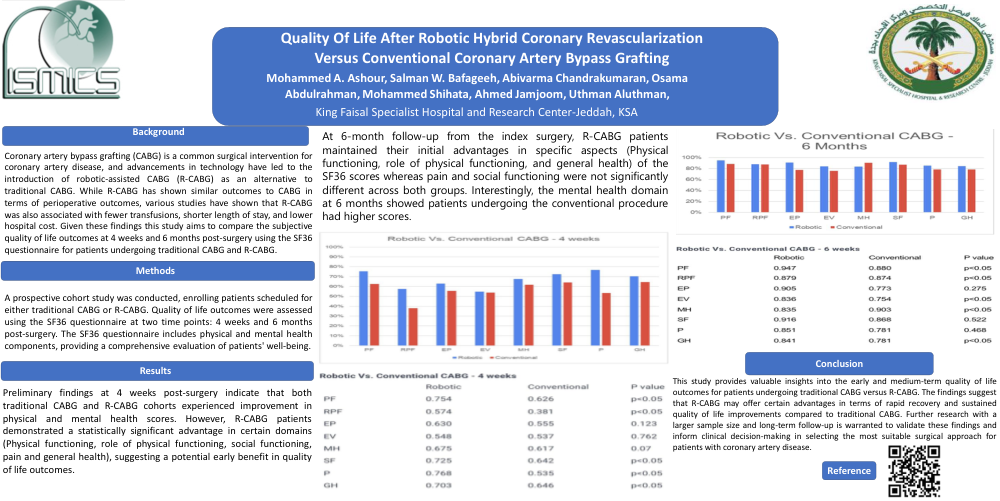
Preliminary findings at 4 weeks post-surgery indicate that both
traditional CABG and R-CABG cohorts experienced improvement in
physical and mental health scores. However, R-CABG patients
demonstrated a statistically significant advantage in certain domains
(Physical functioning, role of physical functioning, social functioning,
pain and general health), suggesting a potential early benefit in quality
of life outcomes. At 6-month follow-up from the index surgery, R-CABG patients
maintained their initial advantages in specific aspects (Physical
functioning, role of physical functioning, and general health) of the
SF36 scores whereas pain and social functioning were not significantly
different across both groups. Interestingly, the mental health domain
at 6 months showed patients undergoing the conventional procedure
had higher scores.
Conclusion:
This study provides valuable insights into the early and medium-term quality of life
outcomes for patients undergoing traditional CABG versus R-CABG. The findings suggest
that R-CABG may offer certain advantages in terms of rapid recovery and sustained
quality of life improvements compared to traditional CABG. Further research with a
larger sample size and long-term follow-up is warranted to validate these findings and
inform clinical decision-making in selecting the most suitable surgical approach for
patients with coronary artery disease.