225 posters, 34 videos, 18 topics, 14 sessions, 251 authors, 55 institutions
ePostersLive by SciGen Technologies S.A. All rights reserved.
ISMICS 2024 Annual Meeting
29 May - 1 June, 2024 | Athens, Greece

PC.33
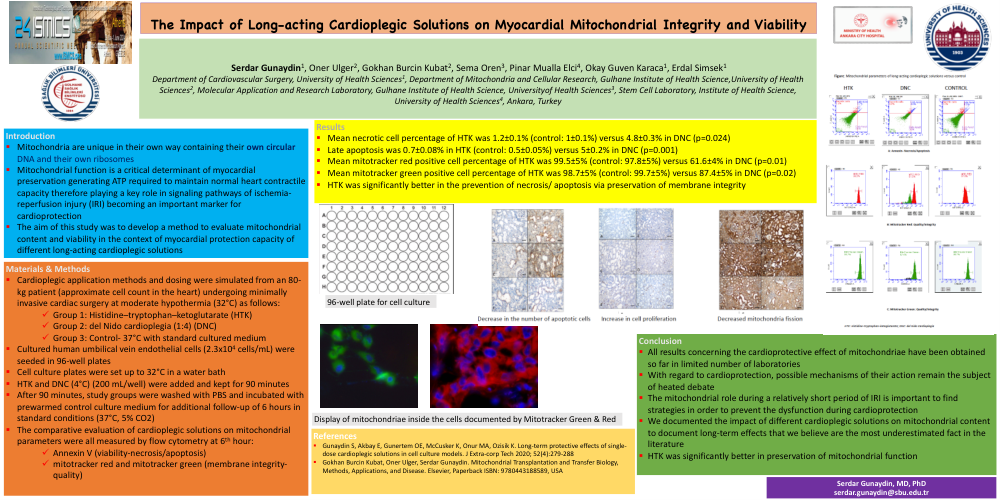
The Impact Of Long-acting Cardioplegic Solutions On Mitochondrial Integrity And Viability
Poster Presenter
Authors
Part of Topic
Cannulation, Perfusion and Congenital MICS
Background:
Mitochondrial function is a critical determinant of myocardial preservation generating ATP required to maintain normal heart contractile capacity therefore playing a key role in signaling pathways of ischemia/reperfusion injury (IRI) becoming an important marker for cardioprotection.
The aim of this study was to develop a method to evaluate mitochondrial content and viability in the context of myocardial protection capacity of different long-acting cardioplegic solutions.
Methods:
Cardioplegic application methods and dosing were simulated from an 80-kg patient (approximate cell count in the heart) undergoing minimally invasive cardiac surgery at moderate hypothermia (32°C) as follows:
Group 1: Histidine–tryptophan–ketoglutarate (HTK)
Group 2: del Nido cardioplegia (1:4) (DNC)
Group 3: Control- 37°C with standard cultured medium
Cultured human umbilical vein endothelial cells (2.3x10⁴ cells/mL) were seeded in 96-well plates. Cell culture plates were set up to 32°C in a water bath. HTK and DNC (4°C) (200 mL/well) were added and kept for 90 minutes. After 90 minutes, study groups were washed with PBS and incubated with prewarmed control culture medium for additional follow-up of 6 hours in standard conditions (37°C, 5% CO2). The comparative evaluation of cardioplegic solutions on mitochondrial parameters were all measured by flow cytometry at 6th hour: Annexin V (viability-necrosis/apoptosis), mitotracker red and mitotracker green (membrane integrity-quality).
Results: Mean necrotic cell percentage of HTK was 1.2±0.1% (control: 1±0.1%) versus 4.8±0.3% in DNC (p=0.024). Late apoptosis was 0.7±0.08% in HTK (control: 0.5±0.05%) versus 5±0.2% in DNC (p=0.001). Mean mitotracker red positive cell percentage of HTK was 99.5±5% (control: 97.8±5%) versus 61.6±4% in DNC (p=0.01). Mean mitotracker green positive cell percentage of HTK was 98.7±5% (control: 99.7±5%) versus 87.4±5% in DNC (p=0.02). HTK is significantly better in the prevention of necrosis/ apoptosis via preservation of membrane integrity. Data is represented in Figure.
Conclusion:
The mitochondrial role during a relatively short period of IRI is important to find strategies in order to prevent the dysfunction during cardioprotection. We documented the impact of different cardioplegic solutions on mitochondrial content to document long-term effects that we believe are the most underestimated fact in the literature. HTK is significantly better in preservation of mitochondrial function. Further studies are warranted.