225 posters, 34 videos, 18 topics, 14 sessions, 251 authors, 55 institutions
ePostersLive by SciGen Technologies S.A. All rights reserved.
ISMICS 2024 Annual Meeting
29 May - 1 June, 2024 | Athens, Greece

PC.25
Does The Modification Of Htk Cardioplegia Influence Hemodilution And Transfusion In Patients Undergoing Minimally Invasive Cardiac Surgery?
Poster Presenter
Authors
Part of Topic
Cannulation, Perfusion and Congenital MICS
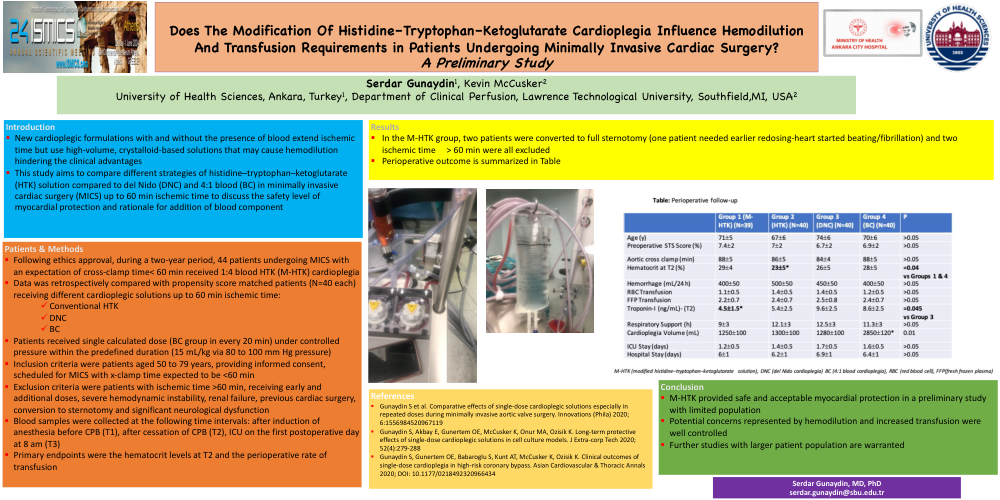
Does The Modification Of Histidine–Tryptophan–Ketoglutarate Cardioplegia Influence Hemodilution And Transfusion Requirements in Patients Undergoing Minimally Invasive Cardiac Surgery? A Preliminary Study
Objectives
New cardioplegic formulations with and without the presence of blood extend ischemic time but use high-volume, crystalloid-based solutions that may cause hemodilution hindering the clinical advantages
This study aims to compare different strategies of histidine–tryptophan–ketoglutarate (HTK) solution compared to del Nido (DNC) and 4:1 blood (BC) in minimally invasive cardiac surgery (MICS) up to 60 min ischemic time to discuss the safety level of myocardial protection and rationale for addition of blood component.
Methods:
Following ethics approval, during a two-year period, 44 patients undergoing MICS with an expectation of cross-clamp time< 60 min received 1:4 blood HTK (M-HTK) cardioplegia. Data was retrospectively compared with propensity score matched patients (N=40 each) receiving conventional HTK, DNC and BC up to 60 min ischemic time. Patients received single calculated dose (BC group in every 20 min) under controlled pressure within the predefined duration (15 mL/kg via 80 to 100 mm Hg pressure). Inclusion criteria were patients aged 50 to 79 years, providing informed consent, scheduled for MICS with x-clamp time expected to be <60 min. Exclusion criteria were patients with ischemic time >60 min, receiving early and additional doses, severe hemodynamic instability, renal failure, previous cardiac surgery, conversion to sternotomy and significant neurological dysfunction. Blood samples were collected at the following time intervals: after induction of anesthesia before CPB (T1), after cessation of CPB (T2), ICU on the first postoperative day at 8 am (T3). Primary endpoints were the hematocrit levels at T2 and the perioperative rate of transfusion.
Results: In the M-HTK group, two patients were converted to full sternotomy one patient needed earlier redosing (heart started beating/fibrillation) and two ischemic time > 60 min were all excluded. and excluded. Perioperative outcome is summarized in Table.
Conclusion
M-HTK provided safe and acceptable myocardial protection in a preliminary study with limited population. Potential concerns represented by hemodilution and increased transfusion were well controlled. Further studies with larger patient population are warranted.