225 posters, 34 videos, 18 topics, 14 sessions, 251 authors, 55 institutions
ePostersLive by SciGen Technologies S.A. All rights reserved.
ISMICS 2024 Annual Meeting
29 May - 1 June, 2024 | Athens, Greece
PC.30
Minimally Invasive Atrial Septal Defect Closure
Poster Presenter
Authors
Part of Topic
Cannulation, Perfusion and Congenital MICS
Atrial Septal Defect Correction Through Anterolateral Right Thoracotomy In Adult Patients
Abdurakhmanov A.A., Tursunov S.A., Shakarov Sh.B.
Republican research center of emergency medicine, Tashkent, Uzbekistan
Background. Minimally invasive techniques provide good visualization and access. With a number of advantages, these operations are promising and can be performed with a high degree of efficiency and safety. The goal of minimally invasive cardiac surgery is to achieve the best results for the patient with the same quality as through a complete median sternotomy.
Aim of the study
The purpose of the study was to determine the possibilities of minimally invasive and videoassisted surgery based on a retrospective analysis and comparison of the immediate results of surgical treatment of patients who underwent interventions to correct atrial septal defects using traditional and minimally invasive methods.
Materials and Methods:
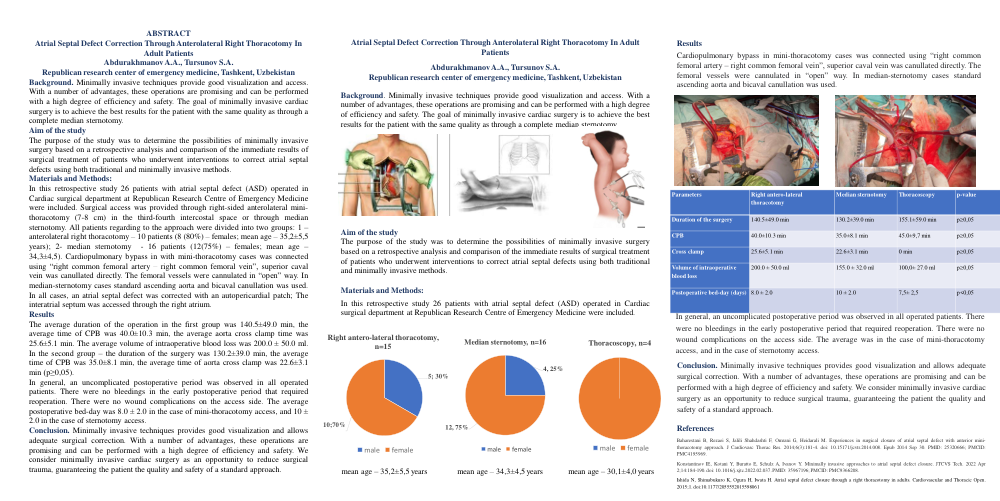
In this retrospective study 35 patients with atrial septal defect (ASD) operated in Cardiac surgical department at Republican Research Centre of Emergency Medicine were included. Surgical access was provided through right-sided anterolateral mini-thoracotomy (7-8 cm) in the third-fourth intercostal space or through median sternotomy. All patients regarding to the approach were divided into three groups: 1 – anterolateral right thoracotomy – 15 patients (10 (70%) – females; mean age – 35,2±5,5 years); 2- median sternotomy - 16 patients (12(75%) – females; mean age – 34,3±4,5) and 3 - videoassisted ASD closure (4 pts – all female). Cardiopulmonary bypass in mini-thoracotomy cases was connected using “right common femoral artery – right common femoral vein”, superior caval vein was canullated directly. The femoral vessels were cannulated in “open” way. In videoassisted casesa standard access was used, we canullated femoral artery and femoral and jugular vein for the bypass. In median-sternotomy cases standard ascending aorta and bicaval canullation was used. In all cases, an atrial septal defect was corrected with an autopericardial patch; The interatrial septum was accessed through the right atrium.
Results
The average duration of the operation in the first group was 140.5±49.0 min, the average time of CPB was 40.0±10.3 min. The average volume of intraoperative blood loss was 200.0 ± 50.0 ml. In the second group – the duration of the surgery was 130.2±39.0 min, the average time of CPB was 35.0±8.1 min, the average time of aorta cross clamp was 22.6±3.1 min (p≥0,05). In the third group – the duration of the surgery was 155.1±59.0 min, the average time of CPB was 45.0±9.7 min (p≥0,05).
In general, an uncomplicated postoperative period was observed in all operated patients. There were no bleedings in the early postoperative period that required reoperation. There were no wound complications on the access site. The average postoperative bed-day was 8.0 ± 2.0 in the case of mini-thoracotomy access, 10 ± 2.0 in the case of sternotomy access and 7.5± 2.5
Conclusion. Minimally invasive techniques provides good visualization and allows adequate surgical correction. With a number of advantages, these operations are promising and can be performed with a high degree of efficiency and safety. We consider minimally invasive cardiac surgery as an opportunity to reduce surgical trauma, guaranteeing the patient the quality and safety of a standard approach.