225 posters, 34 videos, 18 topics, 14 sessions, 251 authors, 55 institutions
ePostersLive by SciGen Technologies S.A. All rights reserved.
ISMICS 2024 Annual Meeting
29 May - 1 June, 2024 | Athens, Greece

D.149
Management Of Complex Coronary Ostium Anatomy In A TAVI Case - A Hybrid Approach
Poster Presenter
Part of Topic
Valve - Transcatheter Therapies
Management of Complex Coronary Ostium Anatomy in a TAVI Case – a Hybrid Approach
Christoph Krapf1, Guy Friedrich2, Lukas Stastny1, Michael Grimm1, Nikolaos Bonaros1
1Department of Cardiac Surgery, 2Department of Cardiology and Angiology, Medical University of Innsbruck, Innsbruck, Austria
Objective: Deep coronary ostium height may result in coronary occlusion during TAVI. To overcome this, chimney stent techniques are helpful but also technically demanding and probably not feasible in every anatomy. A hybrid strategy with additional bypass surgery is another option which we here want to discuss.
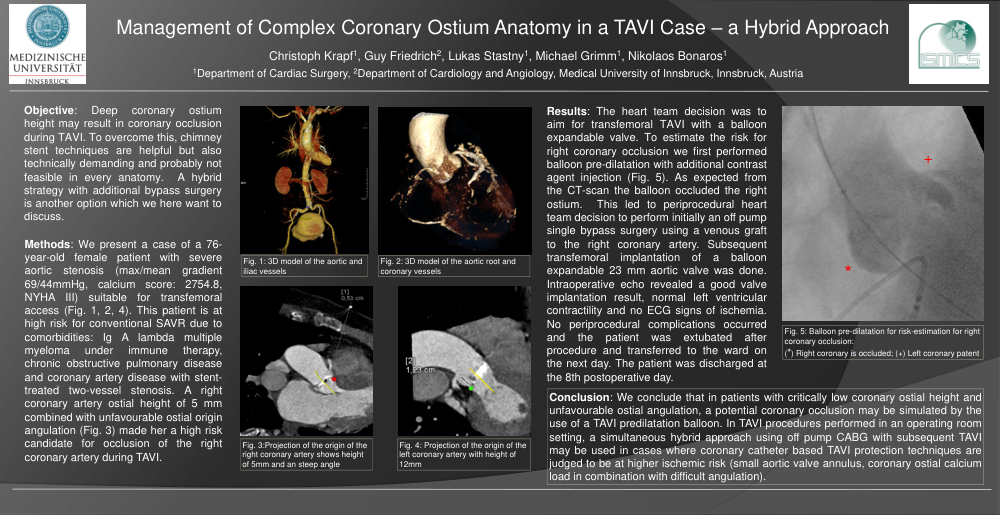
Methods: We present a case of a 76-year-old female patient with severe aortic stenosis (max/mean gradient 69/44mmHg, calcium score: 2754.8, NYHA III) suitable for transfemoral access (Fig. 1, 2, 4). This patient is at high risk for conventional SAVR due to comorbidities: Ig A lambda multiple myeloma under immune therapy, chronic obstructive pulmonary disease and coronary artery disease with stent-treated two-vessel stenosis. A right coronary artery ostial height of 5 mm combined with unfavourable ostial origin angulation (Fig. 3) made her a high risk candidate for occlusion of the right coronary artery during TAVI.
Results: The heart team decision was to aim for transfemoral TAVI with a balloon expandable valve. To estimate the risk for right coronary occlusion we first performed balloon pre-dilatation with additional contrast agent injection (Fig. 5). As expected from the CT-scan the balloon occluded the right ostium. This led to periprocedural heart team decision to perform initially an off pump single bypass surgery using a venous graft to the right coronary artery. Subsequent transfemoral implantation of a balloon expandable 23 mm aortic valve was done. Intraoperative echo revealed a good valve implantation result, normal left ventricular contractility and no ECG signs of ischemia. No periprocedural complications occurred and the patient was extubated after procedure and transferred to the ward on the next day. The patient was discharged at the 8th postoperative day.
Conclusion: We conclude that in patients with critically low coronary ostial height and unfavourable ostial angulation, a potential coronary occlusion may be simulated by the use of a TAVI predilatation balloon. In TAVI procedures performed in an operating room setting, a simultaneous hybrid approach using off pump CABG with subsequent TAVI may be used in cases where coronary catheter based TAVI protection techniques are judged to be at higher ischemic risk (small aortic valve annulus, coronary ostial calcium load in combination with difficult angulation).