225 posters, 34 videos, 18 topics, 14 sessions, 251 authors, 55 institutions
ePostersLive by SciGen Technologies S.A. All rights reserved.
ISMICS 2024 Annual Meeting
29 May - 1 June, 2024 | Athens, Greece

D.144
Special Delivery: Transeptal Transcatheter Mitral Valve-in-valve Replacement With A 65 Cm Delivery Sheath
Poster Presenter
Authors
Affiliations
Part of Topic
Valve - Transcatheter Therapies
Video
Special Delivery: Transeptal Transcatheter Mitral Valve-in-Valve Replacement with a 65 cm Delivery Sheath
Iverson E. Williams, Omar M. Sharaf, Michael R. Massoomi, Albert R. Robinson, Patrick Kohtz, Thomas M. Beaver
BACKGROUND
•Trans-septal valve-in-valve transcatheter mitral valve replacement (TMVR) is a safe intervention for severely, comorbid patients, with a history of open-sternotomy.
•However, TMVR can be compromised in patients with complicated anatomy, such as a hypertrophied interatrial septum (IAS).
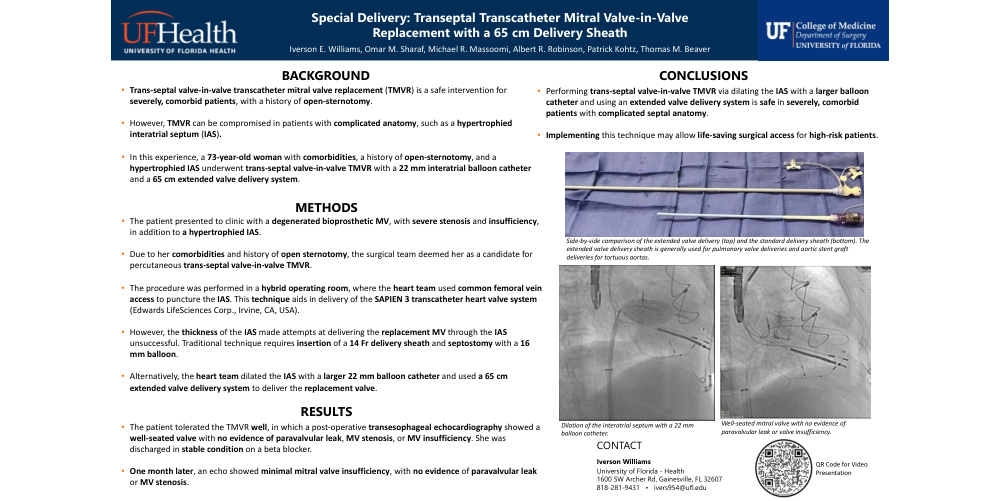
•In this experience, a 73-year-old woman with comorbidities, a history of open-sternotomy, and a hypertrophied IAS underwent trans-septal valve-in-valve TMVR with a 22 mm interatrial balloon catheter and a 65 cm extended valve delivery system.
METHODS
•The patient presented to clinic with a degenerated bioprosthetic MV, with severe stenosis and insufficiency, in addition to a hypertrophied IAS.
•Due to her comorbidities and history of open sternotomy, the surgical team deemed her as a candidate for percutaneous trans-septal valve-in-valve TMVR.
•The procedure was performed in a hybrid operating room, where the heart team used common femoral vein access to puncture the IAS. This technique aids in delivery of the SAPIEN 3 transcatheter heart valve system (Edwards LifeSciences Corp., Irvine, CA, USA).
•However, the thickness of the IAS made attempts at delivering the replacement MV through the IAS unsuccessful. Traditional technique requires insertion of a 14 Fr delivery sheath and septostomy with a 16 mm balloon.
•Alternatively, the heart team dilated the IAS with a larger 22 mm balloon catheter and used a 65 cm extended valve delivery system to deliver the replacement valve.
RESULTS
•The patient tolerated the TMVR well, in which a post-operative transesophageal echocardiography showed a well-seated valve with no evidence of paravalvular leak, MV stenosis, or MV insufficiency. She was discharged in stable condition on a beta blocker.
•One month later, an echo showed minimal mitral valve insufficiency, with no evidence of paravalvular leak or MV stenosis.
CONCLUSIONS
•Performing trans-septal valve-in-valve TMVR via dilating the IAS with a larger balloon catheter and using an extended valve delivery system is safe in severely, comorbid patients with complicated septal anatomy.
•
Implementing this technique may allow life-saving surgical access for high-risk patients