225 posters, 34 videos, 18 topics, 14 sessions, 251 authors, 55 institutions
ePostersLive by SciGen Technologies S.A. All rights reserved.
ISMICS 2024 Annual Meeting
29 May - 1 June, 2024 | Athens, Greece

D.46
Minimally Invasive Redo Coronary Artery Bypass Grafting Using Right Gastro-epiploic Artery To Pda
Poster Presenter
Authors
Part of Topic
Coronary Revascularization
Minimally Invasive Redo Coronary Artery Bypass Grafting Using Right Gastro-epiploic Artery To PDA
Chidiebere Peter Echieh, MBBCh, FRCS, Alex Ryan, BS, Abel Cherian, BS, Yash Rohilla, Kevin Wang, MD, Toshinobu Kazui, MD, PhD
•Recurrent coronary arterial disease poses challenges of patent grafts, availability of arterial conduits and surgical access. Arterial grafts have proven survival advantage but are not readily available for redo-CABG.
•Among the options for MICS, Minimally Invasive CAB (MIDCAB) remains a prevalent approach.1,2
•MIDCAB avoids use of cardiopulmonary bypass, reduces stroke incidence, decreases blood transfusion requirements, and mitigates postoperative complications.
•Provision of arterial revascularization, minimally invasive surgery while preserving patent grafts should be the goal.
•We managed a 58-year-old male who presented with complaints of severe substernal chest pain that evolved into an NSTEMI following a history of CABG (LIMA to LAD, SVG to OM2) 2.5 years ago.
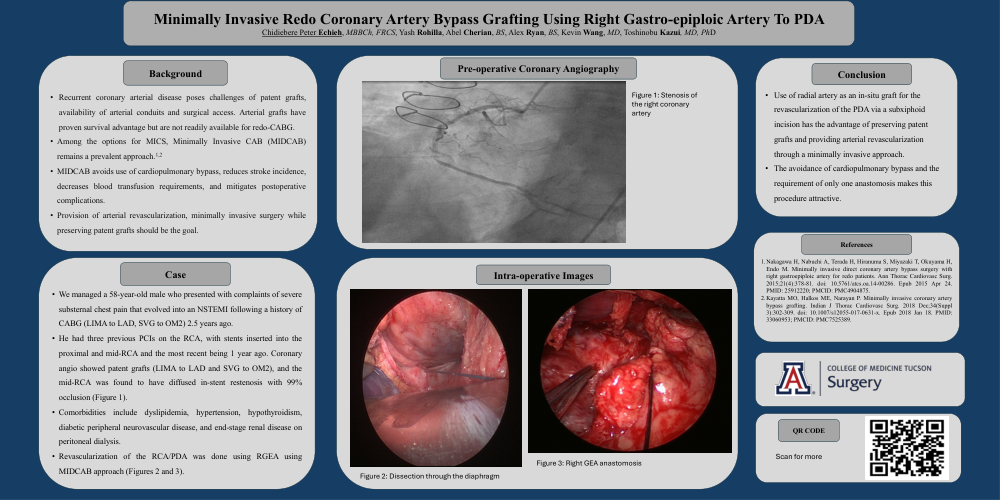
•He had three previous PCIs on the RCA, with stents inserted into the proximal and mid-RCA and the most recent being 1 year ago. Coronary angio showed patent grafts (LIMA to LAD and SVG to OM2), and the mid-RCA was found to have diffused in-stent restenosis with 99% occlusion (Figure 1).
•Comorbidities include dyslipidemia, hypertension, hypothyroidism, diabetic peripheral neurovascular disease, and end-stage renal disease on peritoneal dialysis.
•Revascularization of the RCA/PDA was done using RGEA using MIDCAB approach (Figures 2 and 3).
•Use of radial artery as an in-situ graft for the revascularization of the PDA via a subxiphoid incision has the advantage of preserving patent grafts and providing arterial revascularization through a minimally invasive approach.
•The avoidance of cardiopulmonary bypass and the requirement of only one anastomosis makes this procedure attractive.