225 posters, 34 videos, 18 topics, 14 sessions, 251 authors, 55 institutions
ePostersLive by SciGen Technologies S.A. All rights reserved.
ISMICS 2024 Annual Meeting
29 May - 1 June, 2024 | Athens, Greece
D.40
Robotic-assisted CABG Using BITA In A Frail Octogenarian Patient: A Case Report With Angiographic Follow-up
Poster Presenter
Authors
Part of Topic
Coronary Revascularization
Robotic-assisted CABG Using BITA In A Frail Octogenarian Patient: A Case Report With Angiographic Follow-up
Marco Gemelli1, Massimo Baudo2, Marwan Badri3, Gianluca Torregrossa3
1. Azienda Ospedale Università Padova, Padova, Italy; 2. Lankenau Institute of Medical Research, Wynnewood, PA, USA; 3. Lankenau Medical Center, Wynnewood, PA, USA.
Introduction
A minimally invasive CABG approach in octogenarians has been proposed to uphold the outcomes of surgical revascularization while reducing procedural complications. This method offers a secure alternative with favorable perioperative and postoperative outcomes. Nonetheless, a drawback lies in its limited revascularization, typically addressing solely the anterior heart wall, leaving the inferior and lateral walls untreated. Thus, the concept of hybrid coronary revascularization emerged, entailing surgical revascularization of the anterior wall, primarily anastomosing the LITA to the LAD, coupled with PCI utilizing stents for other coronary arteries.
Case Report
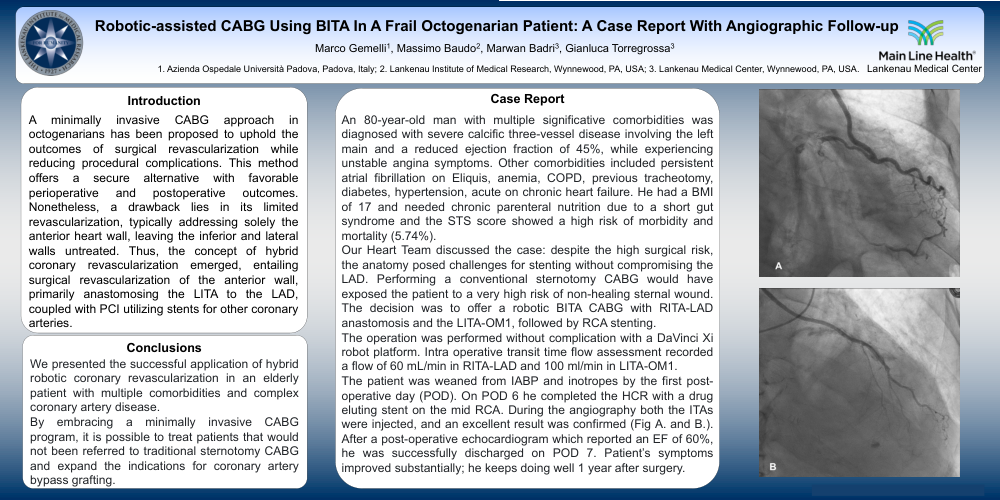
An 80-year-old man with multiple significative comorbidities was diagnosed with severe calcific three-vessel disease involving the left main and a reduced ejection fraction of 45%, while experiencing unstable angina symptoms. Other comorbidities included persistent atrial fibrillation on Eliquis, anemia, COPD, previous tracheotomy, diabetes, hypertension, acute on chronic heart failure. He had a BMI of 17 and needed chronic parenteral nutrition due to a short gut syndrome and the STS score showed a high risk of morbidity and mortality (5.74%). Our Heart Team discussed the case: despite the high surgical risk, the anatomy posed challenges for stenting without compromising the LAD. Performing a conventional sternotomy CABG would have exposed the patient to a very high risk of non-healing sternal wound. The decision was to offer a robotic BITA CABG with RITA-LAD anastomosis and the LITA-OM1, followed by RCA stenting. The operation was performed without complication with a DaVinci Xi robot platform. Intra operative transit time flow assessment recorded a flow of 60 mL/min in RITA-LAD and 100 ml/min in LITA-OM1. The patient was weaned from IABP and inotropes by the first post-operative day (POD). On POD 6 he completed the HCR with a drug eluting stent on the mid RCA. During the angiography both the ITAs were injected, and an excellent result was confirmed (Fig A. and B.). After a post-operative echocardiogram which reported an EF of 60%, he was successfully discharged on POD 7. Patient’s symptoms improved substantially; he keeps doing well 1 year after surgery.
Conclusions
We presented the successful application of hybrid robotic coronary revascularization in an elderly patient with multiple comorbidities and complex coronary artery disease. By embracing a minimally invasive CABG program, it is possible to treat patients that would not been referred to traditional sternotomy CABG and expand the indications for coronary artery bypass grafting.