225 posters, 34 videos, 18 topics, 14 sessions, 251 authors, 55 institutions
ePostersLive by SciGen Technologies S.A. All rights reserved.
ISMICS 2024 Annual Meeting
29 May - 1 June, 2024 | Athens, Greece
D.32
Piggyback Anastomotic Technique For Coronary Artery Bypass Grafting. Single Surgeon Experience
Poster Presenter
Authors
Part of Topic
Coronary Revascularization
Piggyback Anastomotic Technique For Coronary Artery Bypass Grafting. Single Surgeon Experience
Gianluca Torregrossa1, Massimo Baudo2, Serge Sicouri2, Basel Ramlawi1, Courtney Murray1, MaryAnn Wertan1, Francis Sutter1
1. Lankenau Heart Institute, Main Line Health, Wynnewood, PA, USA ; 2. Lankenau Institute for Medical Research, Main Line Health, Wynnewood, PA, USA.
Introduction
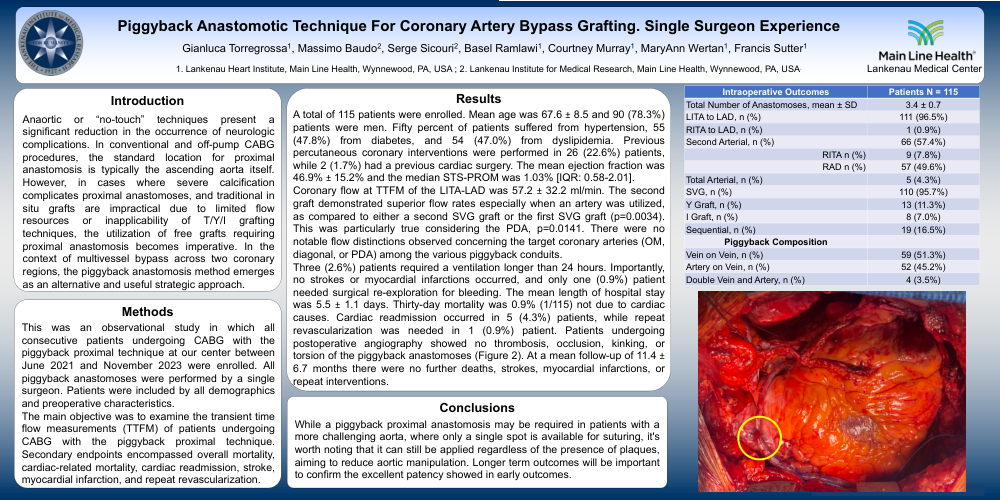
Anaortic or “no-touch” techniques present a significant reduction in the occurrence of neurologic complications. In conventional and off-pump CABG procedures, the standard location for proximal anastomosis is typically the ascending aorta itself. However, in cases where severe calcification complicates proximal anastomoses, and traditional in situ grafts are impractical due to limited flow resources or inapplicability of T/Y/I grafting techniques, the utilization of free grafts requiring proximal anastomosis becomes imperative. In the context of multivessel bypass across two coronary regions, the piggyback anastomosis method emerges as an alternative and useful strategic approach.
Methods
This was an observational study in which all consecutive patients undergoing CABG with the piggyback proximal technique at our center between June 2021 and November 2023 were enrolled. All piggyback anastomoses were performed by a single surgeon. Patients were included by all demographics and preoperative characteristics. The main objective was to examine the transient time flow measurements (TTFM) of patients undergoing CABG with the piggyback proximal technique. Secondary endpoints encompassed overall mortality, cardiac-related mortality, cardiac readmission, stroke, myocardial infarction, and repeat revascularization.
Results
A total of 115 patients were enrolled. Mean age was 67.6 ± 8.5 and 90 (78.3%) patients were men. Fifty percent of patients suffered from hypertension, 55 (47.8%) from diabetes, and 54 (47.0%) from dyslipidemia. Previous percutaneous coronary interventions were performed in 26 (22.6%) patients, while 2 (1.7%) had a previous cardiac surgery. The mean ejection fraction was 46.9% ± 15.2% and the median STS-PROM was 1.03% [IQR: 0.58-2.01]. Coronary flow at TTFM of the LITA-LAD was 57.2 ± 32.2 ml/min. The second graft demonstrated superior flow rates especially when an artery was utilized, as compared to either a second SVG graft or the first SVG graft (p=0.0034). This was particularly true considering the PDA, p=0.0141. There were no notable flow distinctions observed concerning the target coronary arteries (OM, diagonal, or PDA) among the various piggyback conduits. Three (2.6%) patients required a ventilation longer than 24 hours. Importantly, no strokes or myocardial infarctions occurred, and only one (0.9%) patient needed surgical re-exploration for bleeding. The mean length of hospital stay was 5.5 ± 1.1 days. Thirty-day mortality was 0.9% (1/115) not due to cardiac causes. Cardiac readmission occurred in 5 (4.3%) patients, while repeat revascularization was needed in 1 (0.9%) patient. Patients undergoing postoperative angiography showed no thrombosis, occlusion, kinking, or torsion of the piggyback anastomoses (Figure 2). At a mean follow-up of 11.4 ± 6.7 months there were no further deaths, strokes, myocardial infarctions, or repeat interventions.
Conclusions
While a piggyback proximal anastomosis may be required in patients with a more challenging aorta, where only a single spot is available for suturing, it's worth noting that it can still be applied regardless of the presence of plaques, aiming to reduce aortic manipulation. Longer term outcomes will be important to confirm the excellent patency showed in early outcomes.