167 posters, 28 videos, 9 topics, 12 sessions, 337 authors, 160 institutions
ePostersLive by SciGen Technologies S.A. All rights reserved.
ISMICS 2023 Annual Meeting
31 May - 3 June, 2023 | Boston, MA

PC81
Anterior Right Thoracotomy Aortic Valve Replacement For Transcatheter Aortic Valve Replacement Turndown Patients
Part of Topic
Valve - Surgical Valves
Summary: Transcatheter aortic valve intervention (TAVI) is contraindicated in several unfavorable conditions and high-risk AVR remains as the only option when guideline-directed medical therapy fails to provide symptomatic benefits1. Anterior right thoracotomy AVR (ART-AVR) is associated with less surgical trauma and inflammatory response, which hastens postoperative recovery and early return to routine activity, especially in older people.
Background: We present four successful ART-AVR in patients who were turned down by TAVI team due to unfavorable factors. All four patients were discharged within seven days without significant postoperative events. There were no conversions to sternotomies, no blood transfusion, and the mean ventilation time was 4.04 hours. We recommend that ART-AVR be offered to selected TAVI turned-down cases, and this approach is associated with good early outcomes and one-year survival.
Methodology: Transcatheter aortic valve intervention (TAVI) has evolved from treating inoperable or prohibitive risk cases of aortic stenosis since its inception in 2002 through high, intermediate, and even low-risk patients, as encouraged by clinical trials. But according to industry standards and guidelines1, there are some situations where TAVI is not an option and conservative or surgical therapy are required. Minimally invasive aortic valve replacement (MIAVR) has been shown to have benefits, including shorter hospital stays, enhanced cosmetics, lower expenses, less discomfort, less surgical trauma, less bleeding, earlier functional recovery, decreased incidence of the chest and sternal wound infections, and lower incidence of arrhythmias. 2,3
Case 1: An 82-year-old male who was on chronic renal replacement therapy for end-stage renal failure presented with severe aortic stenosis (AS), moderate to severe tricuspid regurgitation (TR), severe pulmonary artery hypertension, EF of 14% but reserved LV function demonstrated on testing and normal coronary angiogram. He underwent ART-AVR with a 23mm bioprosthetic valve.
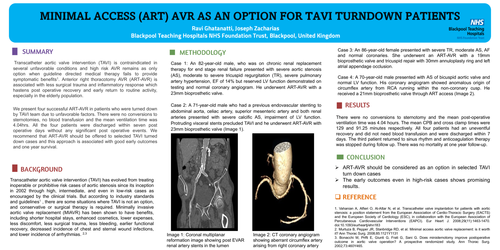
Case 2: A 71-year-old male with previous endovascular stenting to the abdominal aorta, celiac artery, superior mesenteric artery, and renal arteries presented with severe calcific AS and impairment of LV function. Protruding visceral stents precluded TAVI, and he underwent ART-AVR with a 23mm bioprosthetic valve (Image 1).
Case 3: An 86-year-old female presented with severe TR, moderate AS, AF, and normal coronaries. She underwent an ART-AVR with a 19mm bioprosthetic valve and tricuspid repair with a 30mm annuloplasty ring and left atrial appendage occlusion.
Case 4: A 70-year-old male presented with AS of the bicuspid aortic valve and normal LV function. He received a 21mm bioprosthetic valve through ART access (Image 2). His coronary angiogram showed an anomalous origin of the circumflex artery from RCA running within the non-coronary cusp.
Results: There were no conversions to sternotomy, and the mean postoperative ventilation time was 4.04 hours. The mean CPB and cross-clamp times were 129 and 91.25 minutes,s respectively. All four patients had an uneventful recovery, did not need a blood transfusion,n and were discharged withinseven7 days. The third patient returned to sinus rhythm,m, and anticoagulation therapy was stopped during follow-up. There was no mortality at the one-year follow-up.