167 posters, 28 videos, 9 topics, 12 sessions, 337 authors, 160 institutions
ePostersLive by SciGen Technologies S.A. All rights reserved.
ISMICS 2023 Annual Meeting
31 May - 3 June, 2023 | Boston, MA

PC68
Factors Influencing Pain Scores And Opioid Demand After Robotically Assisted Cardiac Surgery
Poster Presenter
Part of Topic
Valve - Surgical Valves
Factors Influencing Pain Scores and Opioid Demand after Robotically Assisted Cardiac Surgery
Hasan IS, Seese L, Deitz R, Ashraf F, Ogami T, Subramaniam K, Boisen M, Yoon P, West D, Kaczorowski DF, Sultan I, Bonatti J
Background: Introduction of minimally invasive cardiac surgery anticipated the reduction in postoperative pain. Little quantitative data, however, is available in the literature on this effect. This study investigated factors influencing pain scores and opioid demand after robotically assisted cardiac procedures.
Methods: Using prospective robotic cardiac surgery and anesthesia databases, we analyzed 75 patients undergoing robotic cardiac surgery (July 2021 to December 2022). Study endpoints were mean cumulative pain scores measured on a 0-10 scale and opioid use on postoperative days (POD) 1 to 4. Opioid utilization during this time was converted to oral morphine equivalence (OME). Patient reported pain scores and OME were correlated with preoperative and intraoperative variables. Mean age was 62 +10.1 years, 71% (53/75) were male, and mean STS risk of mortality was 0.65 ± 0.62%.
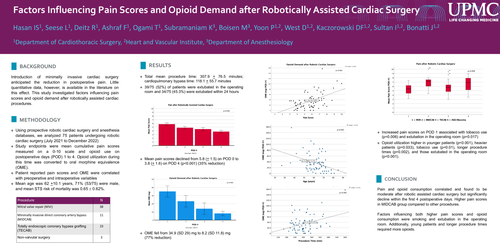
Results: Total mean procedure time: 307.9 + 76.5 minutes; cardiopulmonary bypass time: 118.1 +55.7 minutes. 39/75 (52%) of patients were extubated in the operating room and 34/75 (45.3%) were extubated within 24 hours. Mean pain scores declined from 5.8 (+ 1.5) on POD 0 to 3.8 (+1.6) on POD 4 (p<0.001) (35% reduction). OME fell from 34.9 (SD 29) mg to 8.2 (SD 11.8) mg (77% reduction). Increased pain scores on POD 1 associated with tobacco use (p=0.006) and extubation in the operating room (p=0.017). Opioid utilization higher in younger patients (p<0.001), heavier patients (p=0.033), tobacco use (p=0.01), longer procedure times (p=0.002), and those extubated in the operating room (p<0.001).
Conclusion: Pain and opioid consumption correlated and found to be moderate after robotic assisted cardiac surgery but significantly decline within the first 4 postoperative days. Higher pain scores in MIDCAB group compared to other procedures.
Factors influencing both higher pain scores and opioid consumption were smoking and extubation in the operating room. Additionally, young patients and longer procedure times required more opioids.