167 posters, 28 videos, 9 topics, 12 sessions, 337 authors, 160 institutions
ePostersLive by SciGen Technologies S.A. All rights reserved.
ISMICS 2023 Annual Meeting
31 May - 3 June, 2023 | Boston, MA

PC05
Robotic Aortic Valve Replacement: A New Approach To An Old Problem
Poster Presenter
Authors
Affiliations
Part of Topic
Valve - Surgical Valves
Robotic Aortic Valve Replacement: New Approach to An Old Problem
Khaliel.FH, Fallatah.FA
Background
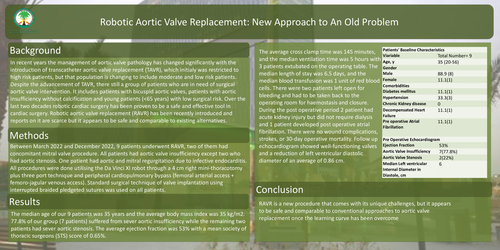
In recent years the management of aortic valve pathology has changed significantly with the introduction of transcatheter aortic valve replacement (TAVR), which initialy was restricted to high risk patients, but that population is changing to include moderate and low risk patients (1-2). Despite the advancement of TAVR, there still a group of patients who are in need of surgical aortic valve intervention. It includes patients with bicuspid aortic valves, patients with aortic insufficiency without calcification and young patients (<65 years) with low surgical risk. (3) Over the last two decades robotic cardiac surgery has been proven to be a safe and effective tool in cardiac surgery. (4-5) Robotic aortic valve replacement (RAVR) has been recently introduced and reports on it are scarce but it appears to be safe and comparable to existing alternatives. (6)
Methods
Between March 2022 and December 2022, 9 patients underwent RAVR, two of them had concomitant mitral valve procedure. All patients had aortic valve insufficiency exept one who has aortic stenosis. One patient has aortic and mitral regurgitation due to infective endocarditis. All procedures were done utilising the Da Vinci XI robot through a 4 cm right mini-thoracotomy plus three port technique and peripheral cardiopulmonary bypass (femoral arterial access + femoro-jagular venous access). Standard surgical technique of valve implantation using interrupted braided pledgeted sutures was used on all patients.
Results
The median age of our 9 patients was 35 years and the average body mass index was 35 kg/m2. 77.8% of our group (7 patients) suffered from sever aortic insufficiency while the remaining two patients had sever aortic stenosis. The average ejection fraction was 53% with a mean society of thoracic surgeons (STS) score of 0.65%.
The average cross clamp time was 145 minutes, and the median ventilation time was 5 hours with 3 patients extubated on the operating table. The median length of stay was 6.5 days, and the median blood transfusion was 1 unit of red blood cells. There were two patients left open for bleeding and had to be taken back to the operating room for haemostasis and closure. During the post operative period 2 patient had acute kidney injury but did not require dialysis and 1 patient developed post operative atrial fibrillation. There were no wound complications, strokes, or 30-day operative mortality. Follow up echocardiogram showed well-functioning valves and a reduction of left ventricular diastolic diameter of an average of 0.86 cm.
Conclusion
RAVR is a new procedure that comes with its unique challenges, but it appears to be safe and comparable to conventional approaches to aortic valve replacement once the learning curve has been overcome
References
- 1-Leon MB, Smith CR, Mack M, Miller DC, Moses JW, Svensson LG, Tuzcu EM, Webb JG, Fontana GP, Makkar RR, Brown DL, Block PC, Guyton RA, Pichard AD, Bavaria JE, Herrmann HC, Douglas PS, Petersen JL, Akin JJ, Anderson WN, Wang D, Pocock S; PARTNER Trial Investigators. Transcatheter aortic-valve implantation for aortic stenosis in patients who cannot undergo surgery. N Engl J Med. 2010 Oct 21;363(17):1597-607. doi: 10.1056/NEJMoa1008232. Epub 2010 Sep 22. PMID: 20961243.
- Mack MJ, Leon MB, Thourani VH, Makkar R, Kodali SK, Russo M, Kapadia SR, Malaisrie SC, Cohen DJ, Pibarot P, Leipsic J, Hahn RT, Blanke P, Williams MR, McCabe JM, Brown DL, Babaliaros V, Goldman S, Szeto WY, Genereux P, Pershad A, Pocock SJ, Alu MC, Webb JG, Smith CR; PARTNER 3 Investigators. Transcatheter Aortic-Valve Replacement with a Balloon-Expandable Valve in Low-Risk Patients. N Engl J Med. 2019 May 2;380(18):1695-1705. doi: 10.1056/NEJMoa1814052. Epub 2019 Mar 16. PMID: 30883058.
- Badhwar V, Wei LM, Cook CC, Hayanga JWA, Daggubati R, Sengupta PP, Rankin JS. Robotic aortic valve replacement. J Thorac Cardiovasc Surg. 2021 May;161(5):1753-1759. doi: 10.1016/j.jtcvs.2020.10.078. Epub 2020 Nov 16. PMID: 33323195.
- Balkhy HH, Lewis CTP, Kitahara H. Robot-assisted aortic valve surgery: State of the art and challenges for the future. Int J Med Robot. 2018 Aug;14(4):e1913. doi: 10.1002/rcs.1913. Epub 2018 Apr 27. PMID: 29700926.
- Lehr EJ, Rodriguez E, Chitwood WR. Robotic cardiac surgery. Curr Opin Anaesthesiol. 2011 Feb;24(1):77-85. doi: 10.1097/ACO.0b013e328342052d. PMID: 21157307.
- Wei LM, Cook CC, Hayanga JWA, Rankin JS, Mascio CE, Badhwar V. Robotic Aortic Valve Replacement: First 50 Cases. Ann Thorac Surg. 2022 Sep;114(3):720-726. doi: 10.1016/j.athoracsur.2021.08.036. Epub 2021 Sep 22. PMID: 34560044.