167 posters, 28 videos, 9 topics, 12 sessions, 337 authors, 160 institutions
ePostersLive by SciGen Technologies S.A. All rights reserved.
ISMICS 2023 Annual Meeting
31 May - 3 June, 2023 | Boston, MA

PC51
Totally Endoscopic Surgical Repair Of A Partial Atrioventricular Canal Defect In Adult Patients Using A 3d High Definition Endoscopic System
Poster Presenter
Authors
Affiliations
Part of Topic
Pediatric - Cardiac, Cardiovascular & Thoracic
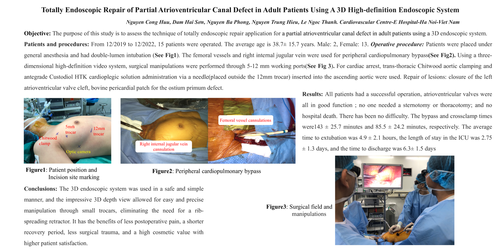
Totally endoscopic repair of a partial atrioventricular canal defect in adult patients using a 3d high-definition endoscopic system.
Nguyen Cong Huu, Dam Hai Sơn, Nguyen Ba Phong, Nguyen Trung Hieu, Le Ngoc Thanh. Cardiovascular Centre-E Hospital-Ha Noi-Viet Nam
ABSTRACT
BACKGROUND: When a partial atrioventricular canal defect is discovered in childhood, it must be repaired. However, some patients are discovered much later in life. The majority of previous studies used conventional sternotomies. Minimally invasive cardiothoracic surgery (MICS) has recently gained popularity. The purpose of this study is to assess the technique of Totally endoscopic Repair application of the 3D endoscopic system at our hospital for these patients.
METHODS: Patients and procedures: From 12/2019 to 12/2022, 15 patients were operated. The average age is 38.7± 15.7 years. Male: 2, Female: 13
Operative procedure: Patients were placed under general anesthesia and had double-lumen intubation. The femoral vessels and right internal jugular vein were used for peripheral cardiopulmonary bypass. Using a three-dimensional high-definition video system, surgical manipulations were performed through 5-12 mm working ports. For cardiac arrest, trans-thoracic Chitwood aortic clamping and antegrade Custodiol HTK cardioplegic solution administration via a needle(placed outside the 12mm trocar) inserted into the ascending aortic were used. Repair of lesions: closure of the left atrioventricular valve cleft, bovine pericardial patch for the ostium primum defect.
RESULTS: All patients had a successful operation, atrioventricular valves were all in good function ; no one needed a sternotomy or thoracotomy; and no hospital death. There has been no difficulty, . The bypass and crossclamp times were143 ± 25.7 minutes and 85.5 ± 24.2 minutes, respectively. The average time to extubation was 4.9 ± 2.1 hours, the length of stay in the ICU was 2.75 ± 1.3 days, and the time to discharge was 6.3± 1.5 days
CONCLUSION: The 3D endoscopic system was used in a safe and simple manner, and the impressive 3D depth view allowed for easy and precise manipulation through small trocars, eliminating the need for a rib-spreading retractor. It has the benefits of less postoperative pain, a shorter recovery period, less surgical trauma, and a high cosmetic value with higher patient satisfaction.