167 posters, 28 videos, 9 topics, 12 sessions, 337 authors, 160 institutions
ePostersLive by SciGen Technologies S.A. All rights reserved.
ISMICS 2023 Annual Meeting
31 May - 3 June, 2023 | Boston, MA

PC46
Long-term Outcomes Of Video Aided Thoracoscopic Mitral Valve Repair For Barlow Disease
Poster Presenter
Authors
Affiliations
Part of Topic
Valve - Surgical Valves
Video
Long-term outcomes of Video Aided Thoracoscopic mitral valve repair for Barlow’s disease
Lishan Zhong,Yanyin Huang,Zhenzhong Wang,Shuo Xiao,Dou Fang,Yuxin Li,Qiuji Wang,Chaolong Zhang,Huanlei Huang
Guangdong Cardiovascular Institution, Guangdong Provincial People’s Hospital, Guangdong Academy of Medical Sciences
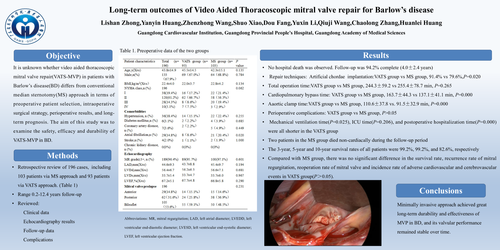
Objective: It is unknown whether video aided thoracoscopic mitral valve repair(VATS-MVP) in patients with Barlow’s disease(BD) differs from conventional median sternotomy(MS) approach in terms of preoperative patient selection, intraoperative surgical strategy, perioperative results, and long-term prognosis. The aim of this study was to examine the safety, efficacy and durability of VATS-MVP in BD.
Methods: A retrospective collection with clinical data, echocardiography results, and follow-up data was used to identify 196 patients underwent MVP for BD from September 2006 through June 2022, including 103 patients via MS approach and 93 patients via VATS approach(Table 1). A comparison between the MS group and the VATS group was conducted.
Results: No hospital death was observed. Follow-up was 94.2% complete (range, 0.2-12.4 years). There was a higher percentage of artificial chordae implantation in the VATS group compared to the MS group(P=0.020), but there was no difference between the two groups using other repair techniques(P>0.05). Although the total operation time between the two groups was not statistical different(244.3±59.2 vs 255.4±78.7 min, P=0.265), the VATS group had longer cardiopulmonary bypass time(163.7±44.3 vs 137.1±41.1 min, P=0.000) and aortic clamp time(110.6±37.8 vs. 91.5±32.9 min, P=0.000). No significant difference between the two groups in adverse perioperative complications(P>0.05). Mechanical ventilation time(P=0.025), ICU time(P=0.206), and postoperative hospitalization time(P=0.000) were all shorter in the VATS group. Two patients in the MS group died non-cardiacally during the follow-up period. The 3-year, 5-year and 10-year survival rates of all patients were 99.2%, 99.2%, and 82.6%, respectively. Compared with MS group, there was no significant difference in the survival rate, recurrence rate of mitral regurgitation, reoperation rate of mitral valve and incidence rate of adverse cardiovascular and cerebrovascular events in VATS group(P>0.05).
Conclusion: Minimally invasive approach achieved great long-term durability and effectiveness of MVP in BD, and its valvular performance remained stable over time.