167 posters, 28 videos, 9 topics, 12 sessions, 337 authors, 160 institutions
ePostersLive by SciGen Technologies S.A. All rights reserved.
ISMICS 2023 Annual Meeting
31 May - 3 June, 2023 | Boston, MA

D39
Right Anterior Thoracotomy Aortic Valve Replacement In A Patient With Cold Agglutinin Disease
Poster Presenter
Authors
Muhammad Ibrahim Azmi, Ashvin Krishna Nair, Shahrul Amry Hashim
Affiliations
Part of Topic
Valve - Surgical Valves
Right Anterior Thoracotomy Aortic Valve Replacement In A Patient With Cold Agglutinin Disease
Introduction
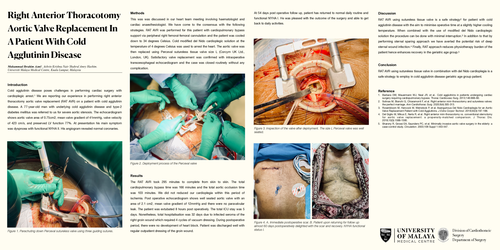
Cold agglutinin disease poses challenges in performing cardiac surgery with cardioplegic arrest.1 We are reporting our experience in performing right anterior thoracotomy aortic valve replacement (RAT AVR) on a patient with cold agglutinin disease. A 77-year-old man with underlying cold agglutinin disease and type-2 diabetes mellitus was referred to us for severe aortic stenosis. The echocardiogram shows aortic valve area of 0.75cm2, mean valve gradient of 41mmHg, valve velocity of 423 cm/s, and preserved LV function 77%. At presentation his main symptom was dyspnoea with functional NYHA II. His angiogram revealed normal coronaries.
Methods
This was was discussed in our heart team meeting involving haematologist and cardiac anaesthesiologist. We have come to the consensus with the following strategies. RAT AVR was performed for this patient with cardiopulmonary bypass support via peripheral right femoral-femoral cannulation and the patient was cooled down to 34 degrees Celsius. Cold modified del Nido cardioplegic solution at the temperature of 4 degrees Celsius was used to arrest the heart. The aortic valve was then replaced using Perceval sutureless tissue valve size L (Corcym UK Ltd., London, UK). Satisfactory valve replacement was confirmed with intraoperative transoesophageal echocardiogram and the case was closed routinely without any complication.
Results
The RAT AVR took 295 minutes to complete from skin to skin. The total cardiopulmonary bypass time was 166 minutes and the total aortic occlusion time was 103 minutes. We did not reduced our cardioplegia within this period of ischemia. Post operative echocardiogram shows well seated aortic valve with an area of 2.1 cm2, mean valve gradient of 12mmHg and there were no paravalvular leak. The patient was extubated 8 hours post operatively. The total ICU stay was 5 days. Nonetheless, total hospitalisation was 32 days due to infected seroma of the right groin wound which required 4 cycles of vacuum dressing. During postoperative period, there were no development of heart block. Patient was discharged well with regular outpatient dressing of the groin wound.
Discussion
RAT AVR using sutureless tissue valve is a safe strategy2 for patient with cold agglutinin disease with the aim to minimise operative time at a slightly higher cooling temperature. When combined with the use of modified del Nido cardioplegic solution the procedure can be done with minimal interruption.3 In addition to that by performing sternal sparing approach we have averted the potential risk of deep sternal wound infection.4 Finally, RAT approach reduces physiotherapy burden of the patient hence enhances recovery in the geriatric age group.5
Conclusion
RAT AVR using sutureless tissue valve in combination with del Nido cardioplegia is a safe strategy to employ in cold agglutinin disease geriatric age group patient.