167 posters, 28 videos, 9 topics, 12 sessions, 337 authors, 160 institutions
ePostersLive by SciGen Technologies S.A. All rights reserved.
ISMICS 2023 Annual Meeting
31 May - 3 June, 2023 | Boston, MA

D28
Robot-assisted Totally-endoscopic Mitral Valve Repair And Coronary Artery Bypass Grafting
Poster Presenter
Authors
Affiliations
Part of Topic
Valve - Surgical Valves
Robot-assisted totally-endoscopic mitral valve repair and coronary artery bypass grafting
Norihiko Ishikawa, Go Watanabe, Takafumi Horikawa, RyutaSeguchi, Shigeyuki Tomita, Toshiya Ohtsuka
Department of Cardiovascular Surgery, NewHeart Watanabe Institute, Tokyo JAPAN
Introduction:
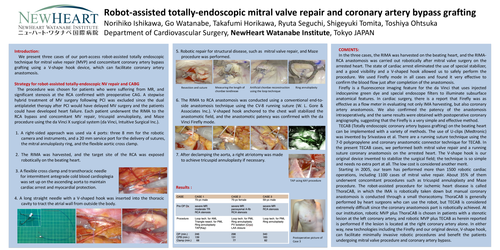
We present three cases of our port-access robot-assisted totally endoscopic technique for mitral valve repair (MVP) and concomitant coronary artery bypass grafting using a V-shape hook device, which can facilitate coronary artery anastomosis.
Strategy for robot-assisted totally-endoscopic NV repair and CABG
The procedure was chosen for patients who were suffering from MR, and significant stenosis at the RCA was confirmed with preoperative CAG. A stepwise hybrid treatment of MV surgery following PCI was excluded since the dual antiplatelet therapy after PCI would have delayed MV surgery and the patients could have developed heart failure. Each patient underwent the RIMA to the RCA bypass and concomitant MV repair, tricuspid annuloplasty, and Maze procedure using the da Vinci X surgical system (da Vinci, Intuitive Surgical Inc.).
1. A right-sided approach was used via 4 ports: three 8 mm for the robotic camera and instruments, and a 20 mm service port for the delivery of sutures, the mitral annuloplasty ring, and the flexible aortic cross-clamp.
2. The RIMA was harvested, and the target site of the RCA was exposed robotically on the beating heart.
3. A flexible cross-clamp and transthoracic needle for intermittent antegrade cold blood cardioplegia was set up on the ascending aorta to maintain cardiac arrest and myocardial protection.
4. A long straight needle with a V-shaped hook was inserted into the thoracic cavity to tract the atrial wall from outside the body.
5. Robotic repair for structural diseases, such as mitral valve repair, and Maze procedure was performed.
6. The RIMA to RCA anastomosis was conducted using a conventional end-to-side anastomosis technique using the CV-8 running suture (W. L. Gore & Associates Inc.). V-shaped hook anchored to the chest wall stabilized the anastomotic field, and the anastomotic patency was confirmed with the da Vinci Firefly mode.
7. After declamping the aorta, a right atriotomy was madeto achieve tricuspid annuloplasty if necessary.
CO MENTS:
In the three cases, the RIMA was harvested on the beating heart, and the RIMA-RCA anastomosis was carried out robotically after mitral valve surgery on the arrested heart. The state of cardiac arrest eliminated the use of special stabilizer, and a good visibility and a V-shaped hook allowed us to safely perform the procedure. We used Firefly mode in all cases and found it very effective to confirm the blood flow just after completion of the anastomosis.
Firefly is a fluorescence imaging feature for the da Vinci that uses injected indocyanine green dye and special endoscope filters to illuminate subsurface anatomical features. In cardiac surgery, there is a report that Firefly was as effective as a flow meter in evaluating not only IMA harvesting, but also coronary artery anastomosis. We also confirmed the patency of the anastomosis intraoperatively, and the same results were obtained with postoperative coronary angiography, suggesting that the Firefly is a very simple and effective method.
TECAB (Totally endoscopic coronary artery bypass grafting) on the beating heart can be implemented with a variety of methods. The use of U-clips (Medtronic) was invented by Srivastava et al. There are a running suture technique using the 7-0 polypropylene and coronary anastomotic connector technique for TECAB. In the present TECAB cases, we performed both mitral valve repair and a running suture coronary anastomosis on the arrested heart. The V-shape hook is our original device invented to stabilize the surgical field; the technique is so simple and needs no extra port at all. The low cost is considered another merit.
Starting in 2005, our team has performed more than 1500 robotic cardiac operations, including 1100 cases of mitral valve repair. About 35% of them underwent concomitant procedures such as tricuspid annuloplasty and Maze procedure. The robot-assisted procedure for ischemic heart disease is called ThoraCAB, in which the IMA is robotically taken down but manual coronary anastomosis is conducted through a small thoracotomy. ThoraCAB is generally performed by heart surgeons who can use the robot, but TECAB is considered extremely difficult since the coronary anastomosis part is robotically achieved. At our institution, robotic MVP plus ThoraCAB is chosen in patients with a stenotic lesion at the left coronary artery, and robotic MVP plus TECAB as herein reported is performed if the lesion is located at the right coronary artery alone. In either way, new technologies including the Firefly and our original device, V-shape hook, can facilitate minimally invasive robotic procedures and benefit the patients undergoing mitral valve procedure and coronary artery bypass.