167 posters, 28 videos, 9 topics, 12 sessions, 337 authors, 160 institutions
ePostersLive by SciGen Technologies S.A. All rights reserved.
ISMICS 2023 Annual Meeting
31 May - 3 June, 2023 | Boston, MA

D14
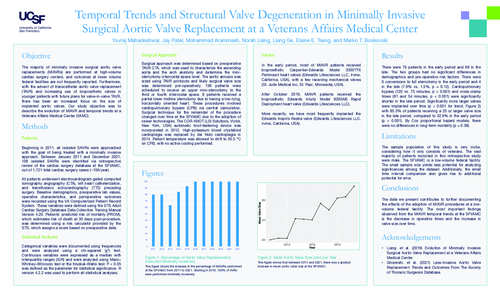
Temporal Trends And Structural Valve Degeneration In Minimally Invasive Surgical Aortic Valve Replacements At A Veterans Affairs Medical Center
Poster Presenter
Authors
Affiliations
Part of Topic
Valve - Surgical Valves
Temporal Trends and Structural Valve Degeneration in Minimally Invasive Surgical Aortic Valve Replacement at a Veterans Affairs Medical Center
Yuvraj Mahadeshwar, Jay Patel, Mohammad Arammash, Norah Liang, Liang Ge, Elaine E. Tseng, and Marko T. Boskovski
Objective
The majority of minimally invasive surgical aortic valve replacements (MIAVRs) are performed at high-volume cardiac surgery centers, and outcomes at lower volume federal facilities are not frequently reported. Furthermore, with the advent of transcatheter aortic valve replacement (TAVR) and increasing use of bioprosthetic valves in younger patients with future plans for valve-in-valve TAVR, there has been an increased focus on the size of implanted aortic valves. Our study objective was to describe the evolution of MIAVR and temporal trends at a Veterans Affairs Medical Center (VAMC).
Methods
Patients
Beginning in 2011, all isolated SAVRs were approached with the goal of being treated with a minimally invasive approach. Between January 2011 and December 2021, 158 isolated SAVRs were identified via retrospective review of the cardiac surgery database at the SFVAMC, out of 1,721 total cardiac surgery cases (~156/year).
All patients underwent electrocardiogram-gated computed tomography angiography (CTA), left heart catheterization, and transthoracic echocardiography (TTE) preceding surgery. Baseline demographics, preoperative lab values, operative characteristics, and perioperative outcomes were recorded using the VA Computerized Patient Record System. These variables were defined using the STS Adult Cardiac Surgery Database Data Collection Training Manual Version 4.20. Patients’ predicted risk of mortality (PROM), which estimates risk of death at 30 days post-procedure, was determined using a risk calculator provided by the STS, which assigns a score based on preoperative data.
Statistical Analysis
Categorical variables were documented using frequencies and were analyzed using a chi-squared (χ2) test. Continuous variables were expressed as a median with interquartile ranges (IQR) and were analyzed using Mann–Whitney–Wilcoxon test or the Kruskal–Wallis test. P < 0.05 was defined as the parameter for statistical significance. R version 4.2.2 was used to perform all statistical analyses.
Surgical Approach
Surgical approach was determined based on preoperative TAVR CTA, which was used to characterize the ascending aorta and the arch anatomy and determine the mini-sternotomy intercostal space level. The aortic annulus was sized using TAVR protocols and likely surgical valve size was determined pre-operatively. 136 patients were scheduled to receive an upper mini-sternotomy to the third or fourth intercostal space. 8 patients received a partial lower midline sternotomy due to having a low-lying, horizontally oriented heart. These procedures involved cardiopulmonary bypass (CPB) via central cannulation. Surgical technique for the remainder of the procedure changed over time at the SFVAMC due to the adoption of newer technologies. The COR-KNOT (LSI Solutions, Victor, New York, USA) automatic knot-fastening device was incorporated in 2012. High-potassium blood crystalloid cardioplegia was replaced by del Nido cardioplegia in 2014. Patient temperature was allowed to drift to 35.5 °C on CPB, with no active cooling performed.
Valves
In the early period, most of MIAVR patients received bioprosthetic Carpentier-Edwards Model 3300TFX Perimount heart valves (Edwards Lifesciences LLC, Irvine, California, USA), with a few receiving mechanical valves (St. Jude Medical Inc, St. Paul, Minnesota, USA).
After October 2016, MIAVR patients received the bioprosthetic Edwards Intuity Model 8300AB Rapid Deployment heart valve (Edwards Lifesciences LLC).
More recently, we have most frequently implanted the Edwards Inspiris Resilia valve (Edwards Lifesciences LLC, Irvine, California, USA).
Results
There were 76 patients in the early period and 68 in the late. The two groups had no significant differences in demographics and pre-operative risk factors. There were 6 conversions to full sternotomy in the early period and 4 in the late (7.9% vs. 1.5%, p = 0.12). Cardiopulmonary bypass (120 vs. 75 minutes, p < 0.001) and cross-clamp times (81 and 54 minutes, p < 0.001) were significantly shorter in the late period. Significantly more larger valves were implanted over time (p < 0.001 for trend, Figure 2) with 85.3% of patients receiving a 25 or larger valve size in the late period, compared to 32.9% in the early period (p < 0.001). By Cox proportional hazard models, there were no differences in long-term mortality (p = 0.38).
Limitations
The sample population of this study is very niche, considering how it only consists of veterans. The vast majority of patients recruited in this retrospective study were male. The SFVAMC is a low-volume federal facility. The small sample size yields less potential for analyzing significances among the dataset. Additionally, the small time interval comparison also gives rise to additional potential for error.
Conclusions
The data we present contributes to further documenting the effects of the adoption of MIAVR procedures at a low-volume federal facility. The most important findings observed from the MIAVR temporal trends at the SFVAMC is the decrease in operative times and the increase in valve size over time.
Acknowledgements
Figure 1: Percentage of Aortic Valve Replacements Executed Minimally Invasively
This figure shows the increase in the percentage of MIAVRs performed at the SFVAMC from 2011 to 2021. Starting in 2016, 100% of AVRs were performed minimally invasively.
Figure 2: Mean Aortic Valve Size (mm) per Year
This figure shows that between 2011 and 2021, there was a gradual increase in mean aortic valve size at the SFVAMC.