167 posters, 28 videos, 9 topics, 12 sessions, 337 authors, 160 institutions
ePostersLive by SciGen Technologies S.A. All rights reserved.
ISMICS 2023 Annual Meeting
31 May - 3 June, 2023 | Boston, MA

PC109
Does Triscore Predict The Outcomes Of Endoscopic Minimal Invasive Isolated Tricuspid Valvular Disease?
Poster Presenter
Part of Topic
Valve - Surgical Valves
Objective:
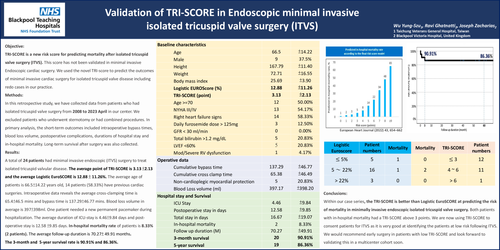
TRI-SCORE is a new risk score for predicting mortality after isolated tricuspid valve surgery (ITVS). This score has not been validated in minimal invasive Endoscopic cardiac surgery. We used the novel TRI-score to predict the outcomes of minimal invasive cardiac surgery for isolated tricuspid valve disease including redo cases in our practice.
Methods:
In this retrospective study, we have collected data from patients who had isolated tricuspid valve surgery from 2008 to 2023 April in our center. We excluded patients who underwent sternotomy or had combined procedures. In primary analysis, the short-term outcomes included intraoperative bypass times, blood loss volume, postoperative complications, durations of hospital stay and in-hospital mortality. Long-term survival after surgery was also collected.
Results:
A total of 24 patients had minimal invasive endoscopic (ITVS) surgery to treat isolated tricuspid valvular disease. The average point of TRI-SCORE is 3.13 ±2.13 and the average Logistic EuroSCORE is 12.88 ± 11.26%. The average age of patients is 66.5±14.22 years old, 14 patients (58.33%) have previous cardiac surgeries. Intraoperative data reveals the average cross-clamping time is 65.4±46.5 mins and bypass time is 137.29±46.77 mins. Blood loss volume in average is 397±398ml. One patient needed a new permanent pacemaker during hospitalization. The average duration of ICU-stay is 4.46±9.84 days and post-operative stay is 12.58 ±9.85 days. In-hospital mortality rate of patients is 8.33% (2 patients). The average follow-up duration is 70.27± 49.91 months. The 3-month and 5-year survival rate is 90.91% and 86.36%.
Conclusions:
Within our case series, the TRI-SCORE is better than Logistic EuroSCORE at predicting the risk of mortality in minimally invasive endoscopic isolated tricuspid valve surgery. Both patients with in-hospital mortality had a TRI-SCORE above 3 points. We are now using TRI-SCORE to consent patients for ITVS as it is very good at identifying the patients at low risk following ITVS. We would recommend early surgery in patients with low TRI-SCORE and look forward to validating this in a multicenter cohort soon.