167 posters, 28 videos, 9 topics, 12 sessions, 337 authors, 160 institutions
ePostersLive by SciGen Technologies S.A. All rights reserved.
ISMICS 2023 Annual Meeting
31 May - 3 June, 2023 | Boston, MA

PC102
Minimally Invasive And Robotic Approaches To Mitral And Tricuspid Endocarditis Are Safe And Effective
Poster Presenter
Authors
George Comas, J Hunter Mehaffey, Elwin Tham, Ali Darehzereshki, Lawrence Wei, Vinay Badhwar
Affiliations
Part of Topic
Valve - Surgical Valves
Minimally Invasive and Robotic Approaches to Mitral and Tricuspid Endocarditis are Safe and Effective
George Comas MD, J Hunter Mehaffey MD MSc, Elwin Tham MD, Ali Darehzereshki MD, Lawrence Wei MD, Vinay Badhwar MD
Department of Cardiovascular and Thoracic Surgery, West Virginia University
Introduction
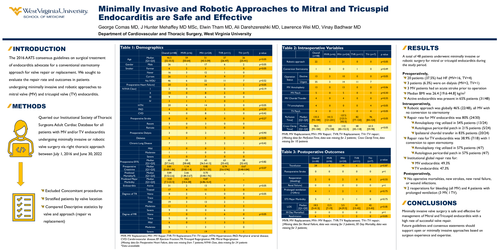
The 2016 AATS consensus guidelines on surgical treatment of endocarditis advocate for a conventional sternotomy approach for valve repair or replacement. We sought to evaluate the repair rate and outcomes in patients undergoing minimally invasive and robotic approaches to mitral valve (MV) and tricuspid valve (TV) endocarditis.
Methods
Queried our Institutional Society of Thoracic Surgeons Adult Cardiac Database for all patients with MV and/or TV endocarditis undergoing minimally invasive or robotic valve surgery via right thoracic approach between July 1, 2016 and June 30, 2022
A total of 48 patients underwent minimally invasive or robotic surgery for mitral or tricuspid endocarditis during the study period.
Preoperatively,
Intraoperatively,
Postoperatively,
Minimally invasive valve surgery is safe and effective for management of Mitral and Tricuspid endocarditis with a high rate of successful valve repair.
Future guidelines and consensus statements should support open or minimally invasive approaches based on surgeon experience and expertise.