477 posters, 14 topics, 2,065 authors, 1,055 institutions
ePostersLive by SciGen Technologies S.A. All rights reserved.
The Joint EBJIS-MSIS 2026 Conference
17 - 19 September, 2026 | Porto, Portugal

EP072
Recurrent Periprosthetic Joint Infection Revealing Extensive Chronic Tibial Osteomyelitis After Total Knee Arthroplasty
Poster Presenter
Part of Topic
Case Report
Introduction & Aim
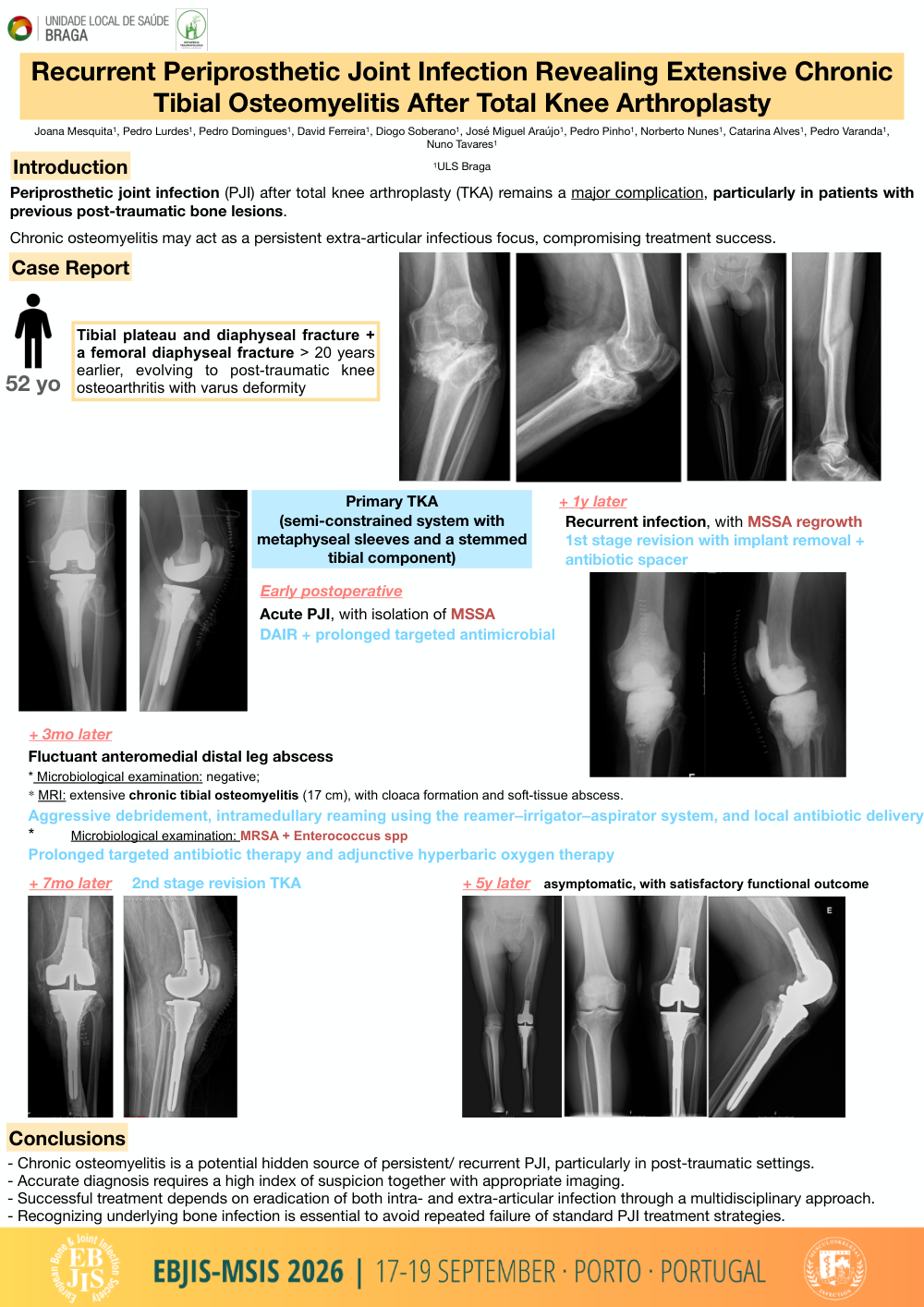
Periprosthetic joint infection (PJI) after total knee arthroplasty (TKA)remains a majorcomplication, particularly in patients with previous post-traumatic bonelesions.Chronic osteomyelitis may act as a persistent extra-articularinfectious focus, compromising treatment success. We aim to report a complex case of recurrent PJI associated with tibial osteomyelitis and to highlight diagnostic and therapeutic challenges.
Methods
Wereport the case of a 52-year-old malewith a history of tibial plateauand diaphysealfracturemore than 20 years earlier, evolving to secondary osteoarthritis with severe varus deformity.
The patient underwent primary TKA using a semi-constrained system with metaphyseal sleeves and a stemmed tibial component.
Early postoperative evolution was complicated by acute PJI, with isolation of methicillin-sensitive Staphylococcus aureus (MSSA).Debridement, antibiotics, and implant retention (DAIR) was performed, followed by prolonged targeted antimicrobial therapy.
Results
Despite initial improvement, infection relapsed with elevated inflammatory markers,joint effusion, and repeat isolation of MSSA. First-stage revision with implant removal and antibiotic spacer placement was performed. Three months later, the patient developed a distal leg abscess. Although microbiology was negative, magnetic resonance imaging revealed extensive chronic tibial osteomyelitis involving approximately 17 cm of the diaphysis, with intramedullary involvement, cloaca formation, and soft tissue abscess. Further surgical management included aggressive debridement, intramedullary reaming using the reamer–irrigator–aspirator (RIA) system, and local antibiotic delivery. Microbiological findings evolved from MSSA tomethicillin-resistantStaphylococcus aureus (MRSA)andadditional organisms, including Enterococcus spp. identified by sonication. Prolonged targeted antibiotic therapy and adjunctive hyperbaric oxygen therapy were administered. After infection control, second-stage revision TKA was performed. At5-year follow-up, the patient is asymptomatic, with normal inflammatory markers, no radiological signs of infection, and satisfactoryfunctional outcome.
Conclusions
This case highlights chronic osteomyelitis as a potential hidden source of persistent or recurrent PJI, particularly in post-traumatic settings. Accurate diagnosis requires a high index of suspicion and appropriate imaging. Successful treatment depends on eradication of both intra-articular and extra-articular infection through a staged approach and multidisciplinary management. Recognition of underlying bone infection is critical to avoid repeated failure of standard PJI strategies.