477 posters, 14 topics, 2,065 authors, 1,055 institutions
ePostersLive by SciGen Technologies S.A. All rights reserved.
The Joint EBJIS-MSIS 2026 Conference
17 - 19 September, 2026 | Porto, Portugal

EP025
Septic Polyarthritis in a Pediatric Patient, A Case Report
Poster Presenter
Authors
Affiliations
Hospital Joan XXIII, Tarragona, Spain, Hospital Joan XXIII, null
Part of Topic
Case Report
Paediatric septic polyarthritis is a serious and uncommon joint infection that can affect multiple joints simultaneously. Early diagnosis
and treatment are essential to prevent serious complications. The most common pathogen is Staphylococcus aureus, especially its
methicillin-resistant variant (MRSA) associated with the Panton–Valentine leukocidin (PVL) gene, which increases virulence.
CASE PRESENTATION:
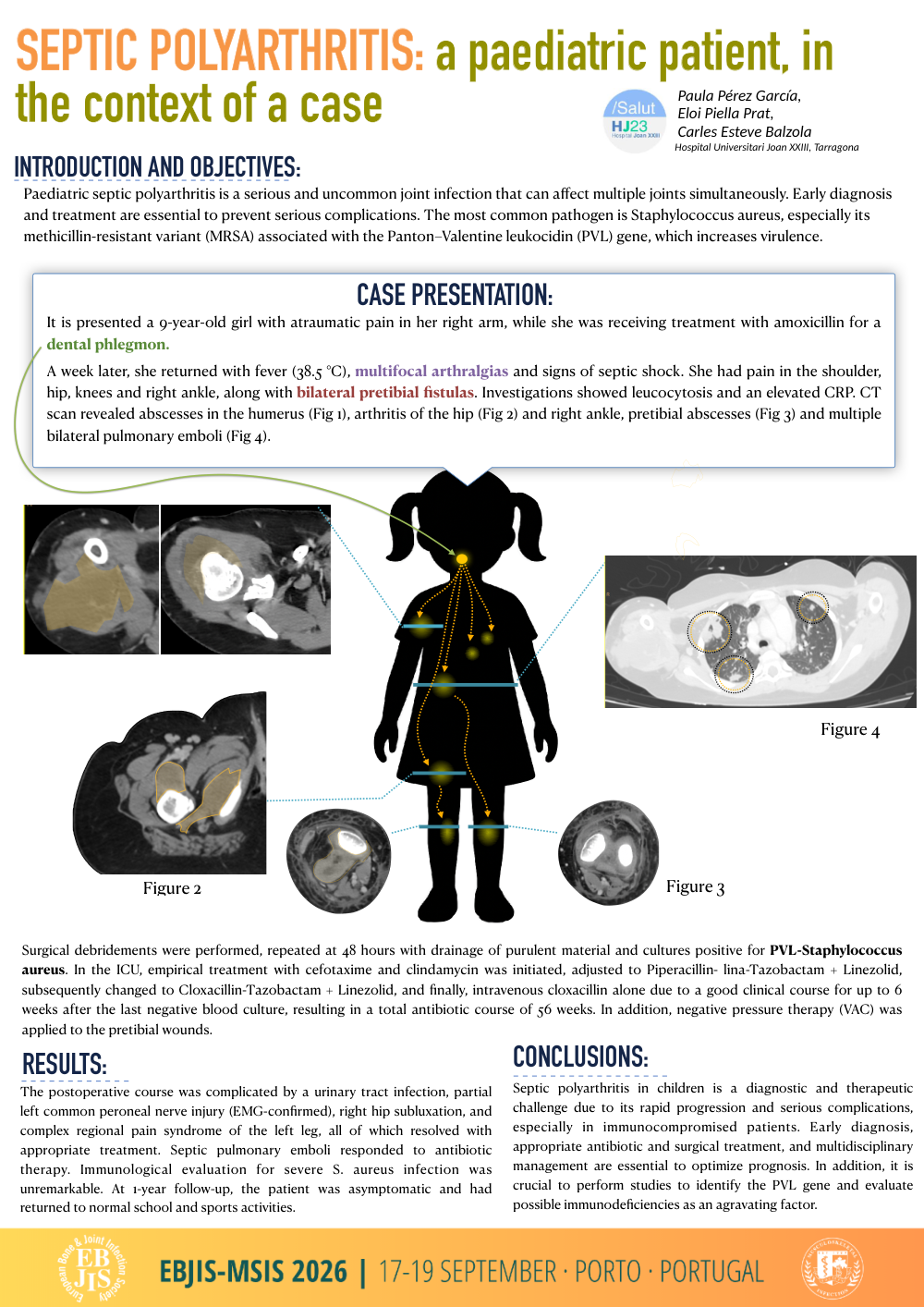
It is presented a 9-year-old girl with atraumatic pain in her right arm, while she was receiving treatment with amoxicillin for a
dental phlegmon.
A week later, she returned with fever (38.5 °C), multifocal arthralgias and signs of septic shock. She had pain in the shoulder,
hip, knees and right ankle, along with bilateral pretibial fistulas. Investigations showed leucocytosis and an elevated CRP. CT
scan revealed abscesses in the humerus (Fig 1), arthritis of the hip (Fig 2) and right ankle, pretibial abscesses (Fig 3) and multiple
bilateral pulmonary emboli (Fig 4).
Surgical debridements were performed, repeated at 48 hours with drainage of purulent material and cultures positive for PVL-Staphylococcus
aureus. In the ICU, empirical treatment with cefotaxime and clindamycin was initiated, adjusted to Piperacillin- lina-Tazobactam + Linezolid,
subsequently changed to Cloxacillin-Tazobactam + Linezolid, and finally, intravenous cloxacillin alone due to a good clinical course for up to 6
weeks after the last negative blood culture, resulting in a total antibiotic course of 56 weeks. In addition, negative pressure therapy (VAC) was
applied to the pretibial wounds.
RESULTS:
The postoperative course was complicated by a urinary tract infection, partial left common peroneal nerve injury (EMG-confirmed), right hip subluxation, and complex regional pain syndrome of the left leg, all of which resolved with appropriate treatment. Septic pulmonary emboli responded to antibiotic therapy. Immunological evaluation for severe S. aureus infection was unremarkable. At 1-year follow-up, the patient was asymptomatic and had returned to normal school and sports activities.
CONCLUSIONS:
Septic polyarthritis in children is a diagnostic and therapeutic challenge due to its rapid progression and serious complications, especially in immunocompromised patients. Early diagnosis, appropriate antibiotic and surgical treatment, and multidisciplinary management are essential to optimize prognosis. In addition, it is crucial to perform studies to identify the PVL gene and evaluate possible immunodeficiencies as an agravating factor.