477 posters, 14 topics, 2,065 authors, 1,055 institutions
ePostersLive by SciGen Technologies S.A. All rights reserved.
The Joint EBJIS-MSIS 2026 Conference
17 - 19 September, 2026 | Porto, Portugal

EP071
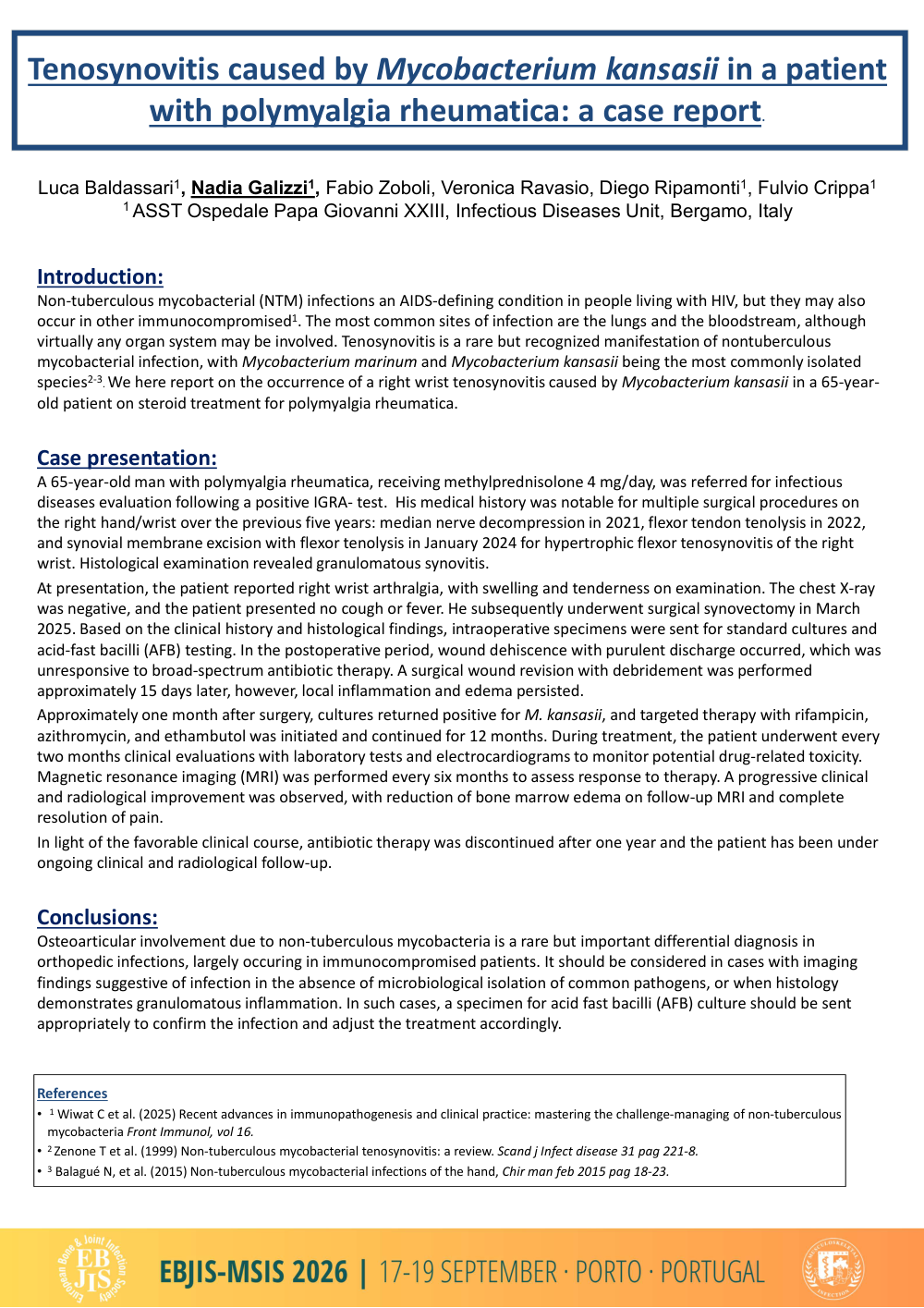
Tenosynovitis caused by Mycobacterium kansasii in a patient with polymyalgia rheumatica: a case report
Poster Presenter
Part of Topic
Case Report
Introduction:
Non-tuberculous mycobacterial (NTM) infections an AIDS-defining condition in people living with HIV, but they may alsooccur in other immunocompromised1 . The most common sites of infection are the lungs and the bloodstream, althoughvirtually any organ system may be involved. Tenosynovitis is a rare but recognized manifestation of nontuberculousmycobacterial infection, with Mycobacterium marinum and Mycobacterium kansasii being the most commonly isolatedspecies2-3 . We here report on the occurrence of a right wrist tenosynovitis caused by Mycobacterium kansasii in a 65-yearold patient on steroid treatment for polymyalgia rheumatica.
Case presentation:
A 65-year-old man with polymyalgia rheumatica, receiving methylprednisolone 4 mg/day, was referred for infectiousdiseases evaluation following a positive IGRA- test. His medical history was notable for multiple surgical procedures on the right hand/wrist over the previous five years: median nerve decompression in 2021, flexor tendon tenolysis in 2022, and synovial membrane excision with flexor tenolysis in January 2024 for hypertrophic flexor tenosynovitis of the right wrist. Histological examination revealed granulomatous synovitis. At presentation, the patient reported right wrist arthralgia, with swelling and tenderness on examination. The chest X-raywas negative, and the patient presented no cough or fever. He subsequently underwent surgical synovectomy in March 2025. Based on the clinical history and histological findings, intraoperative specimens were sent for standard cultures and acid-fast bacilli (AFB) testing. In the postoperative period, wound dehiscence with purulent discharge occurred, which wasunresponsive to broad-spectrum antibiotic therapy. A surgical wound revision with debridement was performedapproximately 15 days later, however, local inflammation and edema persisted. Approximately one month after surgery, cultures returned positive for M. kansasii, and targeted therapy with rifampicin, azithromycin, and ethambutol was initiated and continued for 12 months. During treatment, the patient underwent everytwo months clinical evaluations with laboratory tests and electrocardiograms to monitor potential drug-related toxicity. Magnetic resonance imaging (MRI) was performed every six months to assess response to therapy. A progressive clinicaland radiological improvement was observed, with reduction of bone marrow edema on follow-up MRI and complete resolution of pain. In light of the favorable clinical course, antibiotic therapy was discontinued after one year and the patient has been under ongoing clinical and radiological follow-up.
Conclusions: Osteoarticular involvement due to non-tuberculous mycobacteria is a rare but important differential diagnosis in orthopedic infections, largely occuring in immunocompromised patients. It should be considered in cases with imagingfindings suggestive of infection in the absence of microbiological isolation of common pathogens, or when histologydemonstrates granulomatous inflammation. In such cases, a specimen for acid fast bacilli (AFB) culture should be sentappropriately to confirm the infection and adjust the treatment accordingly.
References
• 1 Wiwat C et al. (2025) Recent advances in immunopathogenesis and clinical practice: mastering the challenge-managing of non-tuberculous mycobacteria Front Immunol, vol 16.
• 2 Zenone T et al. (1999) Non-tuberculous mycobacterial tenosynovitis: a review. Scand j Infect disease 31 pag 221-8.
• 3 Balagué N, et al. (2015) Non-tuberculous mycobacterial infections of the hand, Chir man feb 2015 pag 18-23.