477 posters, 14 topics, 2,065 authors, 1,055 institutions
ePostersLive by SciGen Technologies S.A. All rights reserved.
The Joint EBJIS-MSIS 2026 Conference
17 - 19 September, 2026 | Porto, Portugal

EP057
Concordance of Dermal Needle Aspiration Culture (DNAc) with the microbiological agent isolated in sterile fluids.
Poster Presenter
Authors
Erika Carvalho De Sousa, Ana Carolina Oliveira Filhiolino, Adriana Macedo Dell Aquila
Affiliations
Hospital do Servidor P?blico Estadual (HSPE) /Instituto de Assist?ncia M?dica ao Servidor P?blico Estadual (IAMSPE) - SP, S?o Paulo, Brazil, Hospital do Servidor P?blico Estadual (HSPE) /Instituto de Assist?ncia M?dica ao Servidor P?blico Estadual (IAMSPE) - SP
Part of Topic
Case Report
Concordance of Dermal Needle Aspiration Culture (DNAc) with Microbiological Agents Isolated in Sterile Fluids
Background: Musculoskeletal infections are challenging due to clinical severity and the difficulty of precise microbiological isolation, which is crucial for therapeutic success. While the diagnostic "gold standard" typically involves invasive surgical procedures to collect tissue or biological samples, Dermal Needle Aspiration Culture (DNAc) emerges as a strategic, easy-to-perform tool that can aid in isolating the etiologic agent.
Aim: To analyze the concordance between positive cultures obtained by DNAc and biological sterile samples in a specific patient population.
Methods: A retrospective and prospective case report study involving nine patients previously approved by the institutional IRB. All patients underwent DNAc, with samples stored in culture flasks and processed using an automated method.
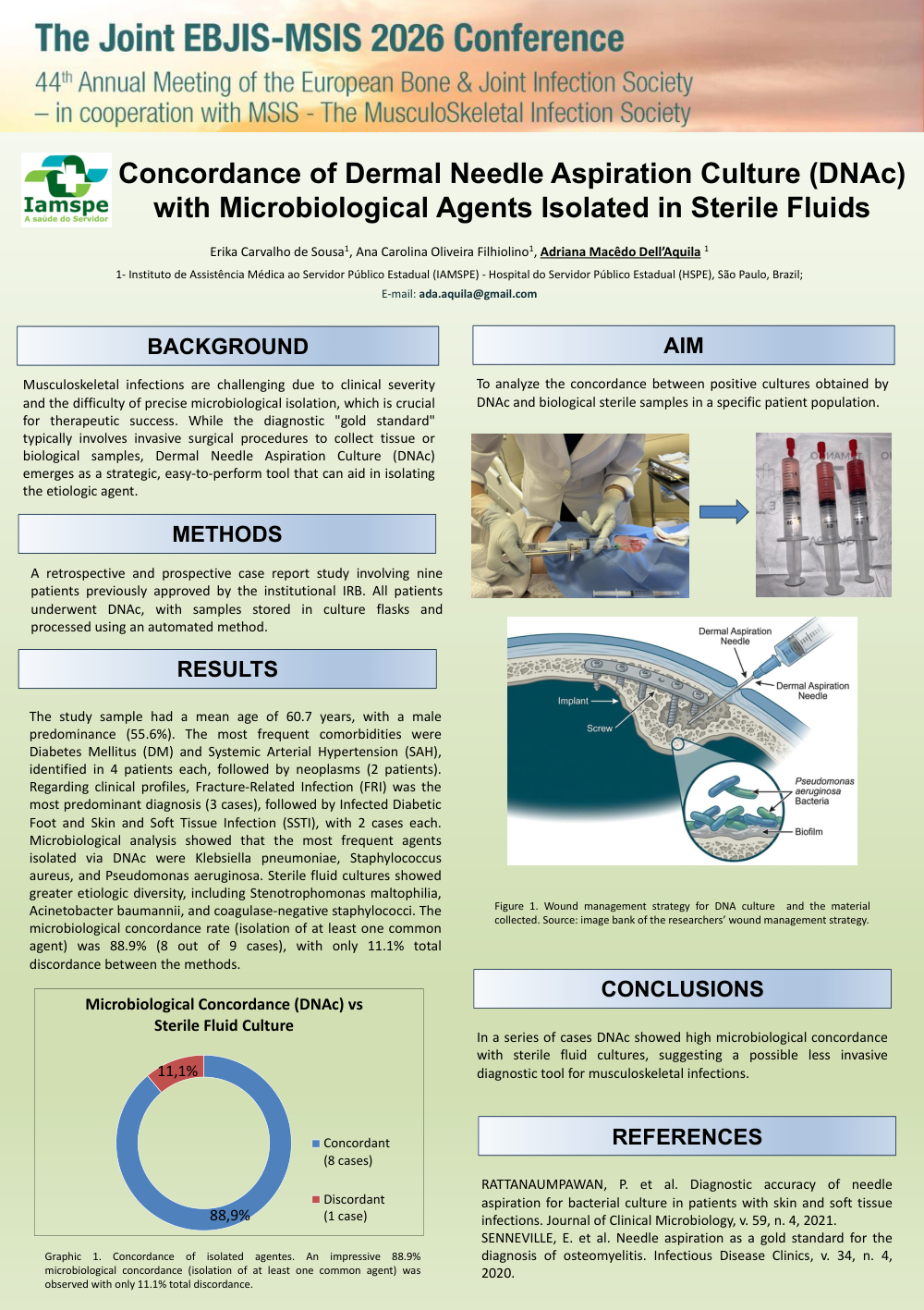
Results: The study sample had a mean age of 60.7 years, with a male predominance (55.6%). The most frequent comorbidities were Diabetes Mellitus (DM) and Systemic Arterial Hypertension (SAH), identified in 4 patients each, followed by neoplasms (2 patients). Regarding clinical profiles, Fracture-Related Infection (FRI) was the most predominant diagnosis (3 cases), followed by Infected Diabetic Foot and Skin and Soft Tissue Infection (SSTI), with 2 cases each. Microbiological analysis showed that the most frequent agents isolated via DNAc were Klebsiella pneumoniae, Staphylococcus aureus, and Pseudomonas aeruginosa. Sterile fluid cultures showed greater etiologic diversity, including Stenotrophomonas maltophilia, Acinetobacter baumannii, and coagulase-negative staphylococci. The microbiological concordance rate (isolation of at least one common agent) was 88.9% (8 out of 9 cases), with only 11.1% total discordance between the methods.
Conclusions: In a series of cases DNAc showed high microbiological concordance with sterile fluid cultures, suggesting a possible less invasive diagnostic tool for musculoskeletal infections.
References
RATTANAUMPAWAN, P. et al. Diagnostic accuracy of needle aspiration for bacterial culture in patients with skin and soft tissue infections. Journal of Clinical Microbiology, v. 59, n. 4, 2021.
SENNEVILLE, E. et al. Needle aspiration as a gold standard for the diagnosis of osteomyelitis. Infectious Disease Clinics, v. 34, n. 4, 2020.