477 posters, 14 topics, 2,065 authors, 1,055 institutions
ePostersLive by SciGen Technologies S.A. All rights reserved.
The Joint EBJIS-MSIS 2026 Conference
17 - 19 September, 2026 | Porto, Portugal

EP055
EASIER MICROBIOLOGICAL IDENTIFICATION IN WOUND INFECTION THROUGH NEEDLE ASPIRATION GUIDED BY FLUORESCENCE: AN PILOT STUDY OF ACCURACY
Poster Presenter
Authors
Adriana Macedo Dell Aquila, Juliana Freitas de Oliveira Maeda, Sergio Roberto Tiossi, Douglas de Oliveira Paggi, Alexandre Inacio Cruz de Paula, Neusa Yuriko Sakai Valente, Paula Cristina Nogueira, Vera Lucia Conceicao de Gouveia Santos
Affiliations
Hospital do Servidor P?blico Estadual (HSPE) /Instituto de Assist?ncia M?dica ao Servidor P?blico Estadual (IAMSPE) - SP, Hospital do Servidor Publico Estadual (HSPE) /Instituto de Assistencia Medica ao Servidor Publico Estadual (IAMSPE) - SP, Sao Paulo, Brazil, Department of Medical-Surgical Nursing, School of Nursing, University of Sao Paulo. Escola de Enfermagem da Universidade de Sao Paulo (EE USP), Sao Paulo, Brazil
Part of Topic
Case Report
EASIER MICROBIOLOGICAL IDENTIFICATION IN WOUND INFECTION THROUGH NEEDLE ASPIRATION GUIDED BY FLUORESCENCE: A PILOT STUDY OF ACCURACY
Adriana Macêdo Dell’Aquila1, Juliana Freitas de Oliveira Maeda2, Sergio Roberto Tiossi1, Douglas de Oliveira Paggi1, Alexandre Inácio Cruz de Paula1, Neusa Yuriko Sakai Valente1, Paula Cristina Nogueira2, Vera Lucia Conceição de Gouveia Santos2
1- Instituto de Assistência Médica ao Servidor Público Estadual (IAMSPE) - Hospital do Servidor Público Estadual (HSPE), São Paulo, Brazil
2- School of Nursing, University of São Paulo, Medical Surgical Nursing Department, São Paulo, Brazil.
Introduction: Wound infection is the invasion and multiplication of microorganisms in tissues, resulting in cellular damage. For the etiological diagnosis, swab collection does not necessarily represent the microbiological agent. For wound infection, quantitative or qualitative biopsy, curettage, or needle puncture can be performed. The diagnosis of wound infection remains a challenge and has been a topic of interest in world literature for the last thirty years.
Aim: Pilot study to demonstrate Dermal Needle Aspiration Culture (DNAc) and Quantitative Culture Biopsy (QCB) as methods for wound infection.
Methods: Report a case series as a pilot study of the accuracy of DNAc.
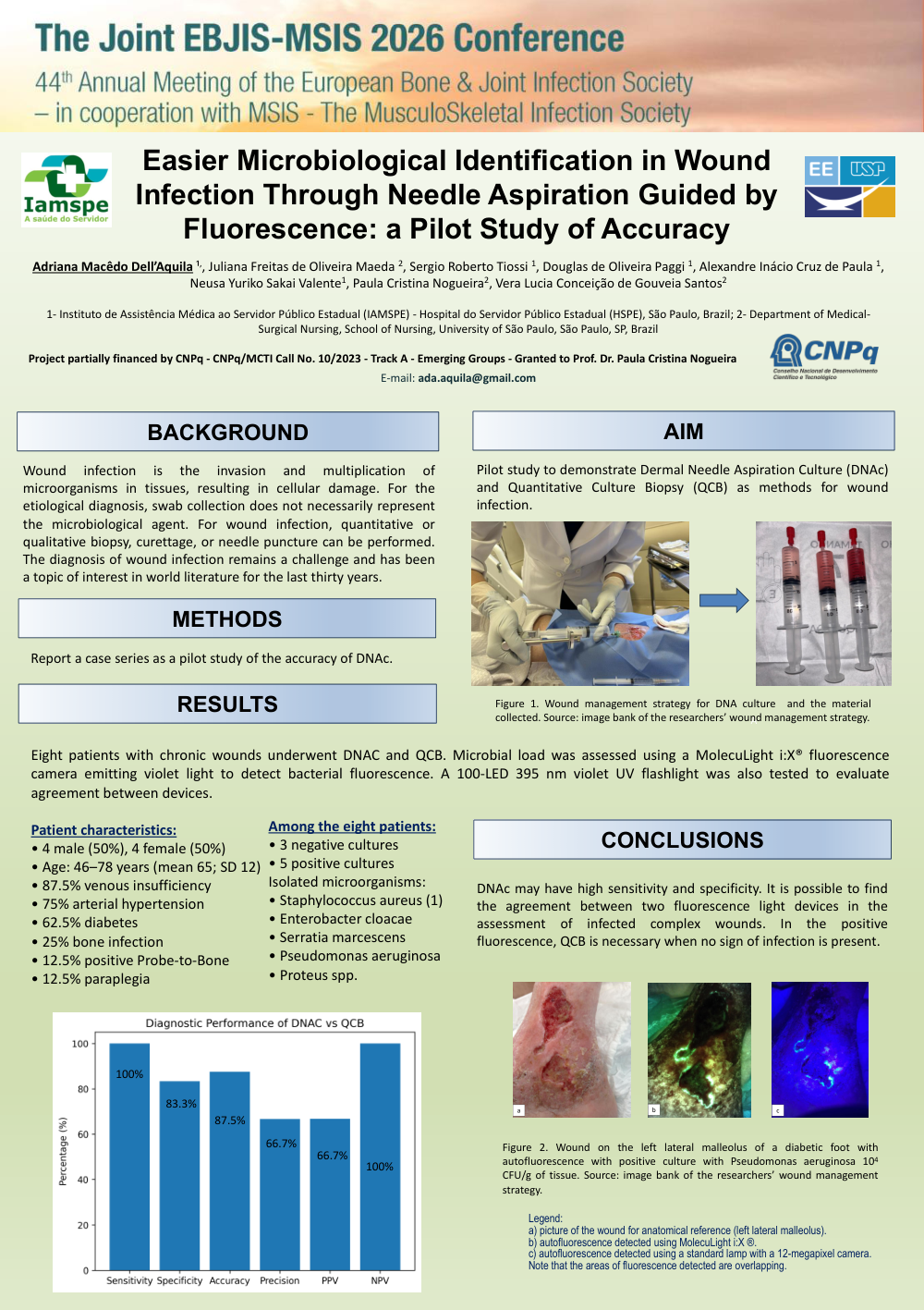
Results: Eight patients with chronic wounds were submitted to DNAc and QCB. Patients enrolled in the study were assessed for wound microbial load using a camera, which emits violet light, allowing microorganisms to be identified by their fluorescence. Additionally, the fluorescence of a 100-LED, 395nm Violet Light UV Flashlight was assessed to assess the fluorescence agreement between the two instruments. Half male (4 - 50%) and half female (4 - 50%); Minimum age of 46, maximum of 78 years, with an average of 65 years (SD:12); 87.5% with venous insufficiency, 75% with arterial hypertension, 62.5% diabetic, 25% with bone infection, 12.5% with positive Probe-to-Bone and 12.5% paraplegia. 100% Sensitivity; 83,3% Specificity; 87,5% Accuracy; 66,67% Precision; 66,7% Positive Predictive Value and 100% Negative Predictive Value. Among the eight patients, three with negative cultures, five with positive cultures, with only one Staphylococcus aureus and four with gram-negative bacilli – Enterobacter cloacae, Serratia marcescens, Pseudomonas aeruginosa and Proteus spp.
Conclusions: DNAc may have high sensitivity and specificity. It is possible to find the agreement between two fluorescence light devices in the assessment of infected complex wounds. In the positive fluorescence, QCB is necessary when no sign of infection is present.
References:
Lee PC, et al. Fine-Needle Aspiration Biopsy in Diagnosis of Soft Tissue Infections. J Clin Microb 1985;22(1):80-83.
Rennie MY, et al. Understanding Real-Time Fluorescence Signals from Bacteria and Wound Tissues Observed with the MolecuLight i:XTM. Diagnostics. (Basel) 2019; 9(1):22
Acknowledgements: Project partially financed by CNPq - CNPq/MCTI Call No. 10/2023 - Track A - Emerging Groups - Granted to Prof. Dr. Paula Cristina Nogueira