477 posters, 14 topics, 2,065 authors, 1,055 institutions
ePostersLive by SciGen Technologies S.A. All rights reserved.
The Joint EBJIS-MSIS 2026 Conference
17 - 19 September, 2026 | Porto, Portugal

EP054
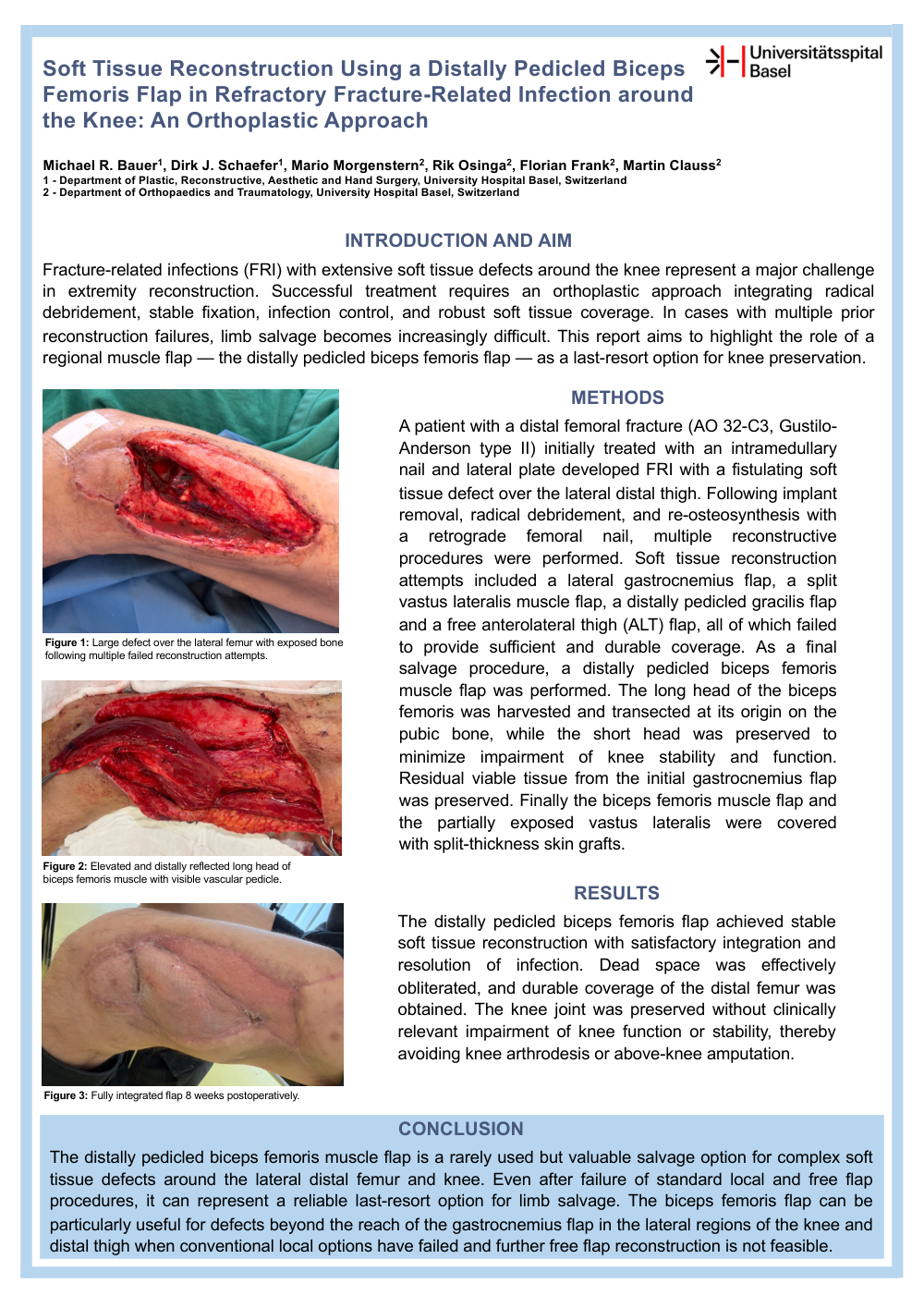
Soft Tissue Reconstruction Using a Distally Pedicled Biceps Femoris Flap in Refractory Fracture-Related Infection around the Knee: An Orthoplastic Approach
Poster Presenter
Part of Topic
Case Report
Soft Tissue Reconstruction Using a Distally Pedicled Biceps Femoris Flap in Refractory Fracture-Related Infection around the Knee: An Orthoplastic Approach
Michael R. Bauer1, Dirk J. Schaefer1, Mario Morgenstern2, Rik Osinga2, Florian Frank2, Martin Clauss2
1 - Department of Plastic, Reconstructive, Aesthetic and Hand Surgery, University Hospital Basel, Switzerland
2 - Department of Orthopaedics and Traumatology, University Hospital Basel, Switzerland
INTRODUCTION AND AIM
Fracture-related infections (FRI) with extensive soft tissue defects around the knee represent a major challenge
in extremity reconstruction. Successful treatment requires an orthoplastic approach integrating radical
debridement, stable fixation, infection control, and robust soft tissue coverage. In cases with multiple prior
reconstruction failures, limb salvage becomes increasingly difficult. This report aims to highlight the role of a
regional muscle flap — the distally pedicled biceps femoris flap — as a last-resort option for knee preservation.
METHODS
A patient with a distal femoral fracture (AO 32-C3, Gustilo-
Anderson type II) initially treated with an intramedullary
nail and lateral plate developed FRI with a fistulating soft
tissue defect over the lateral distal thigh. Following implant
removal, radical debridement, and re-osteosynthesis with
a retrograde femoral nail, multiple reconstructive
procedures were performed. Soft tissue reconstruction
attempts included a lateral gastrocnemius flap, a split
vastus lateralis muscle flap, a distally pedicled gracilis flap
and a free anterolateral thigh (ALT) flap, all of which failed
to provide sufficient and durable coverage. As a final
salvage procedure, a distally pedicled biceps femoris
muscle flap was performed. The long head of the biceps
femoris was harvested and transected at its origin on the
pubic bone, while the short head was preserved to
minimize impairment of knee stability and function.
Residual viable tissue from the initial gastrocnemius flap
was preserved. Finally the biceps femoris muscle flap and
the partially exposed vastus lateralis were covered
with split-thickness skin grafts.
RESULTS
The distally pedicled biceps femoris flap achieved stable
soft tissue reconstruction with satisfactory integration and
resolution of infection. Dead space was effectively
obliterated, and durable coverage of the distal femur was
obtained. The knee joint was preserved without clinically
relevant impairment of knee function or stability, thereby
avoiding knee arthrodesis or above-knee amputation.
CONCLUSION
The distally pedicled biceps femoris muscle flap is a rarely used but valuable salvage option for complex soft
tissue defects around the lateral distal femur and knee. Even after failure of standard local and free flap
procedures, it can represent a reliable last-resort option for limb salvage. The biceps femoris flap can be
particularly useful for defects beyond the reach of the gastrocnemius flap in the lateral regions of the knee and
distal thigh when conventional local options have failed and further free flap reconstruction is not feasible.