477 posters, 14 topics, 2,065 authors, 1,055 institutions
ePostersLive by SciGen Technologies S.A. All rights reserved.
The Joint EBJIS-MSIS 2026 Conference
17 - 19 September, 2026 | Porto, Portugal

EP052
Uncommon Presentation of Native Shoulder Septic Arthritis by Cutibacterium acnes: Case Report and Literature Review
Poster Presenter
Authors
Isabelle C.F. Brasil Tannus, Mayara Muniz de Andrade Silva, Mariana Neri Lucas Kurihara, Beatriz De Santana Soares, Stef?nia Bazanelli Prebianchi, Beatriz Navarro Pinedo, Mauro J. Costa Salles
Affiliations
Universidade Federal De S?o Paulo (UNIFESP), S?o Paulo, Brazil; Laborat?rio Especial de Microbiologia Cl?nica (LEMC), S?o Paulo, Brazil; Hospital S?o Paulo da Escola Paulista de Medicina da UNIFESP, S?o Paulo, Brazil, Universidade Federal De S?o Paulo (UNIFESP), S?o Paulo, Brazil; Laborat?rio Especial de Microbiologia Cl?nica (LEMC), S?o Paulo, Brazil, Universidade Federal De S?o Paulo (UNIFESP), S?o Paulo, Brazil; Hospital S?o Paulo da Escola Paulista de Medicina da UNIFESP, S?o Paulo, Brazil, Universidade Federal De S?o Paulo (UNIFESP))
Part of Topic
Case Report
Uncommon Presentation of Native Shoulder Septic Arthritis by Cutibacterium acnes: Case Report and Literature Review
Abstract
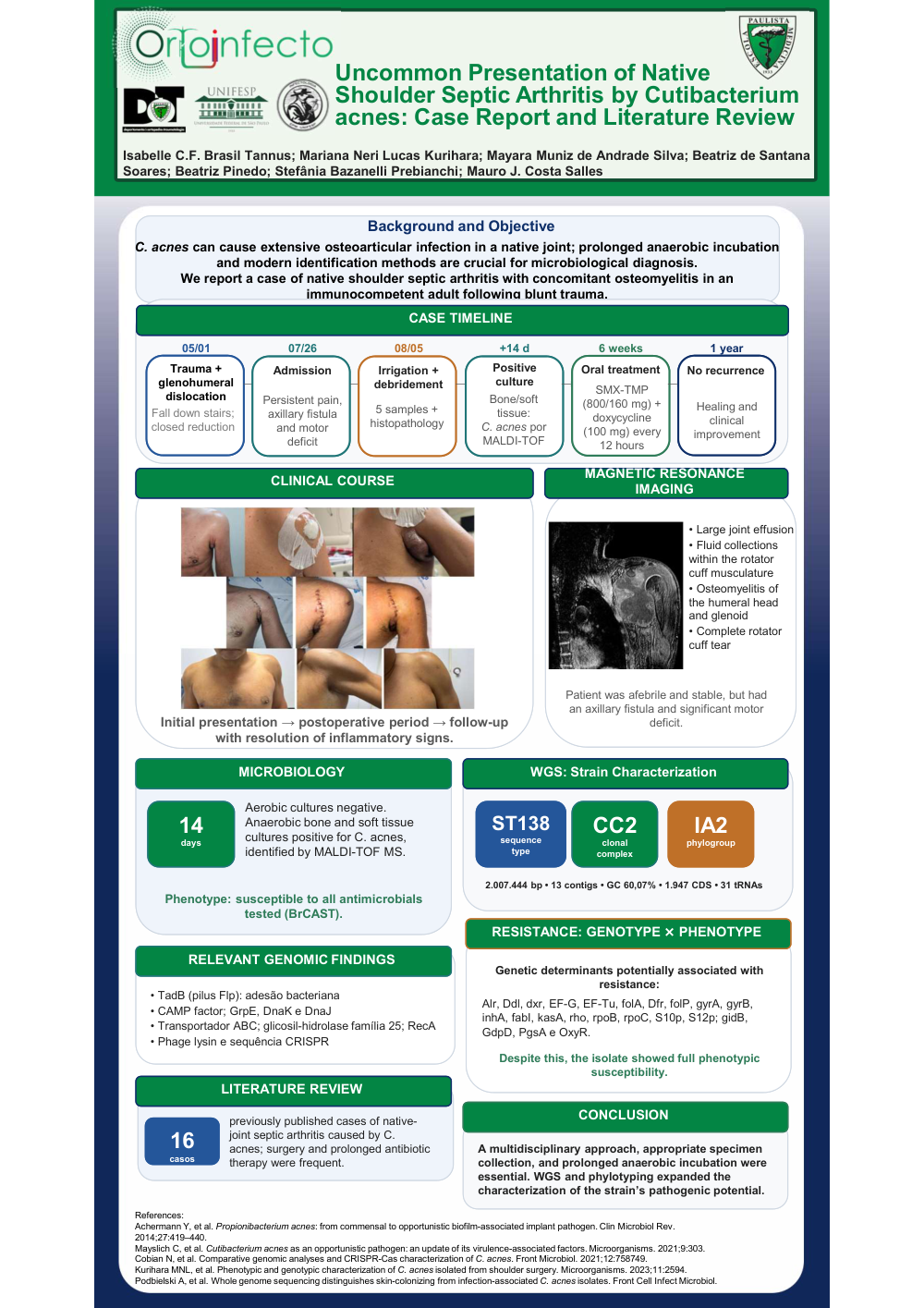
Background: Cutibacterium acnes is commonly considered a skin commensal but can cause significant osteoarticular infections, including infections of native joints. Diagnosis may be challenging due to its slow growth and the need for prolonged anaerobic incubation.
Case Presentation: We report a case of native shoulder septic arthritis with concomitant osteomyelitis caused by C. acnes in an immunocompetent adult following blunt trauma. The patient initially sustained a glenohumeral dislocation after a fall from stairs, treated with closed reduction. Persistent pain, an axillary fistula, and significant motor deficit subsequently developed. Magnetic resonance imaging demonstrated a large joint effusion, rotator cuff muscle collections, osteomyelitis of the humeral head and glenoid, and a complete rotator cuff tear. The patient underwent irrigation and debridement, with five intraoperative samples collected for microbiological and histopathological analysis. Aerobic cultures were negative, while anaerobic cultures from bone and soft tissue became positive for C. acnes after 14 days and were identified by MALDI-TOF MS. The isolate was phenotypically susceptible to all antimicrobials tested. Whole-genome sequencing identified ST138, CC2, and IA2 phylogroup, along with genomic features potentially associated with adhesion, virulence, and antimicrobial resistance.
Treatment and Outcome: The patient received prolonged antimicrobial therapy, including oral trimethoprim-sulfamethoxazole and doxycycline. After one year of follow-up, there was no recurrence, with wound healing and clinical improvement.
Conclusion: This case highlights the potential of C. acnes to cause extensive infection in native joints, even in immunocompetent patients without typical systemic manifestations. Appropriate specimen collection, prolonged anaerobic incubation, and modern identification techniques are essential for diagnosis. Whole-genome sequencing and phylogroup analysis may further contribute to understanding the pathogenic potential of C. acnes strains.