477 posters, 14 topics, 2,065 authors, 1,055 institutions
ePostersLive by SciGen Technologies S.A. All rights reserved.
The Joint EBJIS-MSIS 2026 Conference
17 - 19 September, 2026 | Porto, Portugal

EP050
Fusarium osteomyelitis in a complex oncology patient: a rare case report and literature review
Poster Presenter
Authors
Marco Zugnoni, Marianna Faggiani, Ilaria De Benedetto, Silvia Scabini, Stefano Artiaco, Francesco Giuseppe De Rosa, Alessandro Massè
Affiliations
Universit? degli Studi di Torino, Università degli Studi di Torino, Italy, Department of Orthopedic Surgery and Traumatology, Trauma Center of Turin, Città Della Salute e DellaScienza, Turin, Italy, Infectious Diseases, Department of General and Specialistic Medicine, Azienda Ospedaliera Universitaria Città della Salute e della Scienza, Torino, Italy
Part of Topic
Case Report
FUSARIUM OSTEOMYELITIS IN A COMPLEX ONCOLOGY PATIENTS: A RARE CASE REPORT AND LITERATURE REVIEW
Poster number: EP050
Marco ZUGNONI1, Marianna FAGGIANI1, Ilaria DE BENEDETTO2, Silvia SCABINI2, StefanoARTIACO1, Francesco Giuseppe DE ROSA2, Alessandro MASSE’1
Introduction. Fungal osteomyelitis and prosthetic joint infections have been increasingly recognized over the past decades, particularly in immunocompromised patients and those undergoing multiple surgical procedures[1]. Fusarium spp. are ubiquitous filamentous fungi typically associated with superficial infections which can cause invasive and disseminated disease[2]. Bone involvement is exceedingly uncommon; however, cases of Fusariumosteomyelitis have been reported, often in patients with underlying immunodeficiency or severe comorbidities, and are associated with variable outcomes and high therapeutic complexity [1,2]. A recent systematic review by Asperges et al. showed that while Aspergillus (26.5%), Candida spp. (20.7%), and Mucorales (16.8%) are the most frequent etiologies, Fusarium spp. among fungal osteomyelitis remains a rare entity (1.9%) frequently requiring prolonged antifungal therapy and combined surgical management[3]. The aim of this report is to describe a rare case of chronic Fusarium osteomyelitis of the tibia in a patient with a decades-long history of orthopedic trauma and multiple comorbidities.
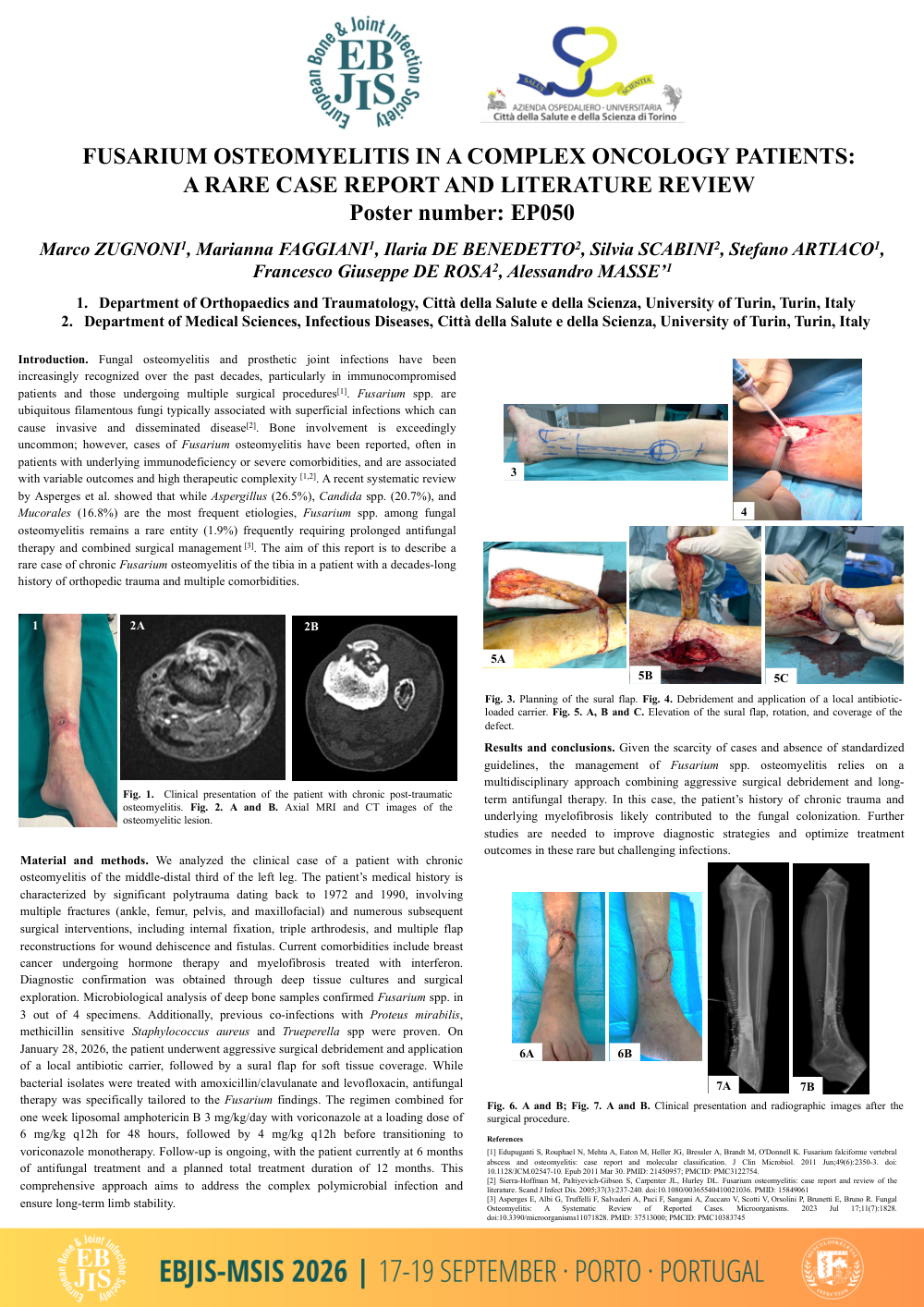
Material and methods. We analyzed the clinical case of a patient with chronic osteomyelitis of the middle-distal third of the left leg. The patient’s medical history is characterized by significant polytrauma dating back to 1972 and 1990, involving multiple fractures (ankle, femur, pelvis, and maxillofacial) and numerous subsequent surgical interventions, including internal fixation, triple arthrodesis, and multiple flap reconstructions for wound dehiscence and fistulas. Current comorbidities include breast cancer undergoing hormone therapy and myelofibrosis treated with interferon. Diagnostic confirmation was obtained through deep tissue cultures and surgical exploration. Microbiological analysis of deep bone samples confirmed Fusarium spp. in 3 out of 4 specimens. Additionally, previous co-infections with Proteus mirabilis, methicillin sensitive Staphylococcus aureusand Trueperella spp were proven. On January 28, 2026, the patient underwent aggressive surgical debridement and application of a local antibiotic carrier, followed by a sural flap for soft tissue coverage. While bacterial isolates were treated with amoxicillin/clavulanate and levofloxacin, antifungal therapy was specifically tailored to the Fusarium findings. The regimen combined for one week liposomal amphotericin B 3 mg/kg/day with voriconazole at a loading dose of 6 mg/kg q12h for 48 hours, followed by 4 mg/kg q12h before transitioning to voriconazole monotherapy. Follow-up is ongoing, with the patient currently at 6 months of antifungaltreatment and a planned total treatment duration of 12 months. This comprehensive approach aims to address the complex polymicrobial infection and ensure long-term limb stability.
Results and conclusions. Given the scarcity of cases and absence of standardized guidelines, the management of Fusarium spp. osteomyelitis relies on a multidisciplinary approach combining aggressive surgical debridement and long-term antifungal therapy. In this case, the patient’s history of chronic trauma and underlying myelofibrosis likely contributed to the fungal colonization. Further studies are needed to improve diagnostic strategies and optimize treatment outcomes in these rare but challenging infections.