477 posters, 14 topics, 2,065 authors, 1,055 institutions
ePostersLive by SciGen Technologies S.A. All rights reserved.
The Joint EBJIS-MSIS 2026 Conference
17 - 19 September, 2026 | Porto, Portugal

EP049
PVL-producing MRSA multifocal chronic osteomyelitis in a 14-year-old boy
Poster Presenter
Authors
Costanza Tripiciano, Sarah Barni, Alice La Mendola, Stefania Mercadante, Venere Cortazzo, Martina Di Giuseppe, Stefania Bernardi, Laura Lancella, Carlo Federico Perno, Andrzej Krzysztofiak
Affiliations
Bambino Ges? Children's Hospital, Rome, Italy, Buzzi Children's Hospital, Milan, Italy, Bambino Ges? Children's Hospital
Part of Topic
Case Report
Background
Panton–Valentine-Leukocidin (PVL) producing Staphylococcus aureus (SA) is typically associated with acute, severe and rapidly progressive infections, including necrotising pneumonia, sepsis, aggressive skin and soft tissue infections and osteomyelitis. In children, PVL-producing SA infections are uncommon but usually present with abrupt onset and early systemic involvement, often requiring surgical intervention and prolonged antimicrobial therapy.1 Here, we report an unusual case of pediatric chronic multifocal osteomyelitis caused by PVL-producing MRSA.
Case-report
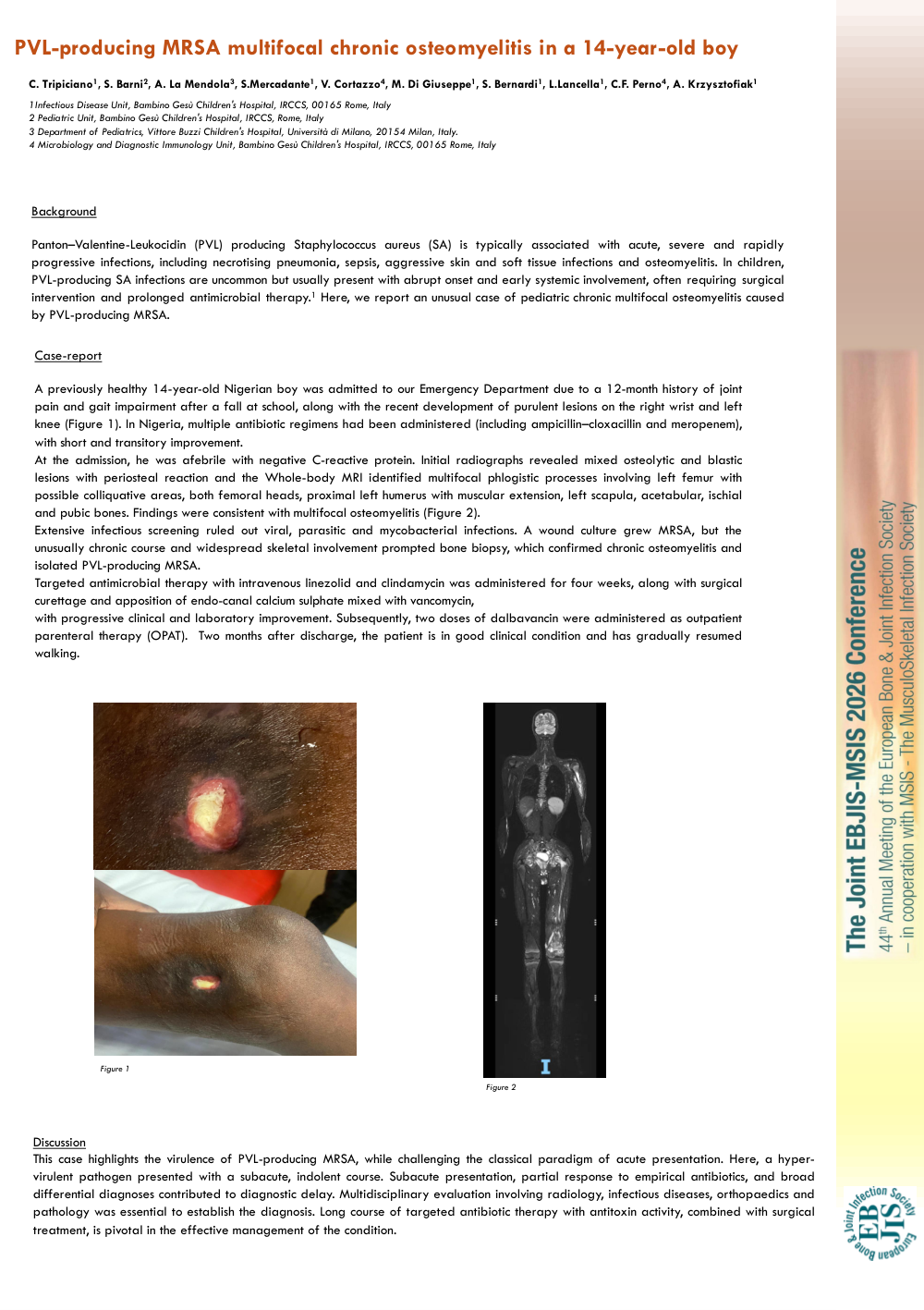
A previously healthy 14-year-old Nigerian boy was admitted to our Emergency Department due to a 12-month history of joint pain and gait impairment after a fall at school, along with the recent development of purulent lesions on the right wrist and left knee (Figure 1). In Nigeria, multiple antibiotic regimens had been administered (including ampicillin–cloxacillin and meropenem), with short and transitory improvement.
At the admission, he was afebrile with negative C-reactive protein. Initial radiographs revealed mixed osteolytic and blastic lesions with periosteal reaction and the Whole-body MRI identified multifocal phlogistic processes involving left femur with possible colliquative areas, both femoral heads, proximal left humerus with muscular extension, left scapula, acetabular, ischial and pubic bones. Findings were consistent with multifocal osteomyelitis (Figure 2).
Extensive infectious screening ruled out viral, parasitic and mycobacterial infections. A wound culture grew MRSA, but the unusually chronic course and widespread skeletal involvement prompted bone biopsy, which confirmed chronic osteomyelitis and isolated PVL-producing MRSA.
Targeted antimicrobial therapy with intravenous linezolid and clindamycin was administered for four weeks, along with surgical curettage and apposition of endo-canal calcium sulphate mixed with vancomycin,
with progressive clinical and laboratory improvement. Subsequently, two doses of dalbavancin were administered as outpatient parenteral therapy (OPAT). Two months after discharge, the patient is in good clinical condition and has gradually resumed walking.
Discussion
This case highlights the virulence of PVL-producing MRSA, while challenging the classical paradigm of acute presentation. Here, a hyper-virulent pathogen presented with a subacute, indolent course. Subacute presentation, partial response to empirical antibiotics, and broad differential diagnoses contributed to diagnostic delay. Multidisciplinary evaluation involving radiology, infectious diseases, orthopaedics and pathology was essential to establish the diagnosis. Long course of targeted antibiotic therapy with antitoxin activity, combined with surgical treatment, is pivotal in the effective management of the condition.