477 posters, 14 topics, 2,065 authors, 1,055 institutions
ePostersLive by SciGen Technologies S.A. All rights reserved.
The Joint EBJIS-MSIS 2026 Conference
17 - 19 September, 2026 | Porto, Portugal

EP048
Precise Intraoperative Debridement of Osteomyelitis and Fracture-Related Infections under fiber bronchoscope Guidance: A Pilot Study
Poster Presenter
Authors
Affiliations
West China Hospital of Sichuan University, Chengdu, China, West China Hospital
Part of Topic
Case Report
Precise Intraoperative Debridement of Osteomyelitis and Fracture-Related Infections Under Fiber Bronchoscope Guidance: A Pilot Study
Zheng-Yu Luo, MD, Yang Liu, MD.
Division of Microsurgery and Orthopedic Infection, Department of Orthopedic Surgery,
West China Hospital of Sichuan University, Chengdu, China.
Purpose
Residual necrotic and infected tissue within the intramedullary canal and metaphysis remains the primary cause of infection recurrence in osteomyelitis and fracture-related infections. In this pilot study, we hypothesized that intraoperative debridement under fiber bronchoscope guidance facilitates precise excision of necrotic and infected tissue from the intramedullary canal and metaphysis.
Methods
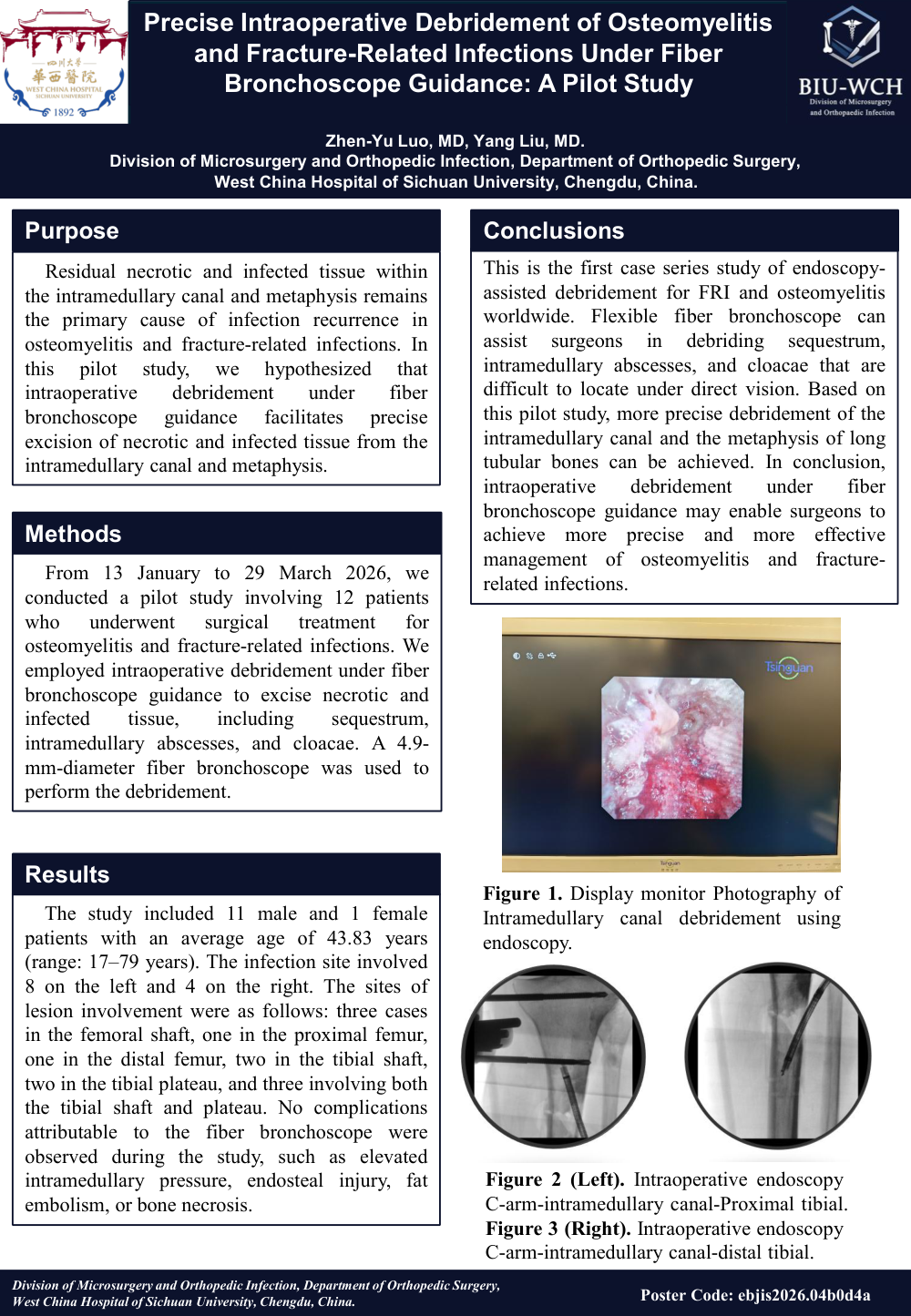
From 13 January to 29 March 2026, we conducted a pilot study involving 12 patients who underwent surgical treatment for osteomyelitis and fracture-related infections. We employed intraoperative debridement under fiber bronchoscope guidance to excise necrotic and infected tissue, including sequestrum, intramedullary abscesses, and cloacae. A 4.9-mm-diameter fiber bronchoscope was used to perform the debridement.
Result
The study included 11 male and 1 female patients with an average age of 43.83 years (range: 17–79 years). The infection site involved 8 on the left and 4 on the right. The sites of lesion involvement were as follows: three cases in the femoral shaft, one in the proximal femur, one in the distal femur, two in the tibial shaft, two in the tibial plateau, and three involving both the tibial shaft and plateau. No complications attributable to the fiber bronchoscope were observed during the study, such as elevated intramedullary pressure, endosteal injury, fat embolism, or bone necrosis.
Conclusions
This is the first case series study of endoscopy-assisted debridement for FRI and osteomyelitis worldwide. Flexible fiber bronchoscope can assist surgeons in debriding sequestrum, intramedullary abscesses, and cloacae that are difficult to locate under direct vision. Based on this pilot study, more precise debridement of the intramedullary canal and the metaphysis of long tubular bones can be achieved. In conclusion, intraoperative debridement under fiber bronchoscope guidance may enable surgeons to achieve more precise and more effective management of osteomyelitis and fracture-related infections.