Loading...

477 posters, 14 topics, 2,065 authors, 1,055 institutions

ePostersLive by SciGen Technologies S.A. All rights reserved.

The Joint EBJIS-MSIS 2026 Conference

17 - 19 September, 2026 | Porto, Portugal

The Joint EBJIS-MSIS 2026 Conference banner

EP041

When Bacteria Arent the Culprit: Candida Septic Arthritis After Polytrauma
Part of Topic

Case Report

Introduction

•Candida species are the leading cause of native-joint fungal septic arthritis, with C. albicans the most common pathogen. [1-2]
•Typically arises de novo in patients with major comorbidities, prolonged hospitalization, broad-spectrum antibiotics, or indwelling devices — the knee is most often affected. [1][3]
•Indolent presentation and frequently negative candidaemia often delay diagnosis. [1][4]
•We report a case of persistent C. albicans knee septic arthritis during prolonged hospitalization for polytrauma.


Case Presentation

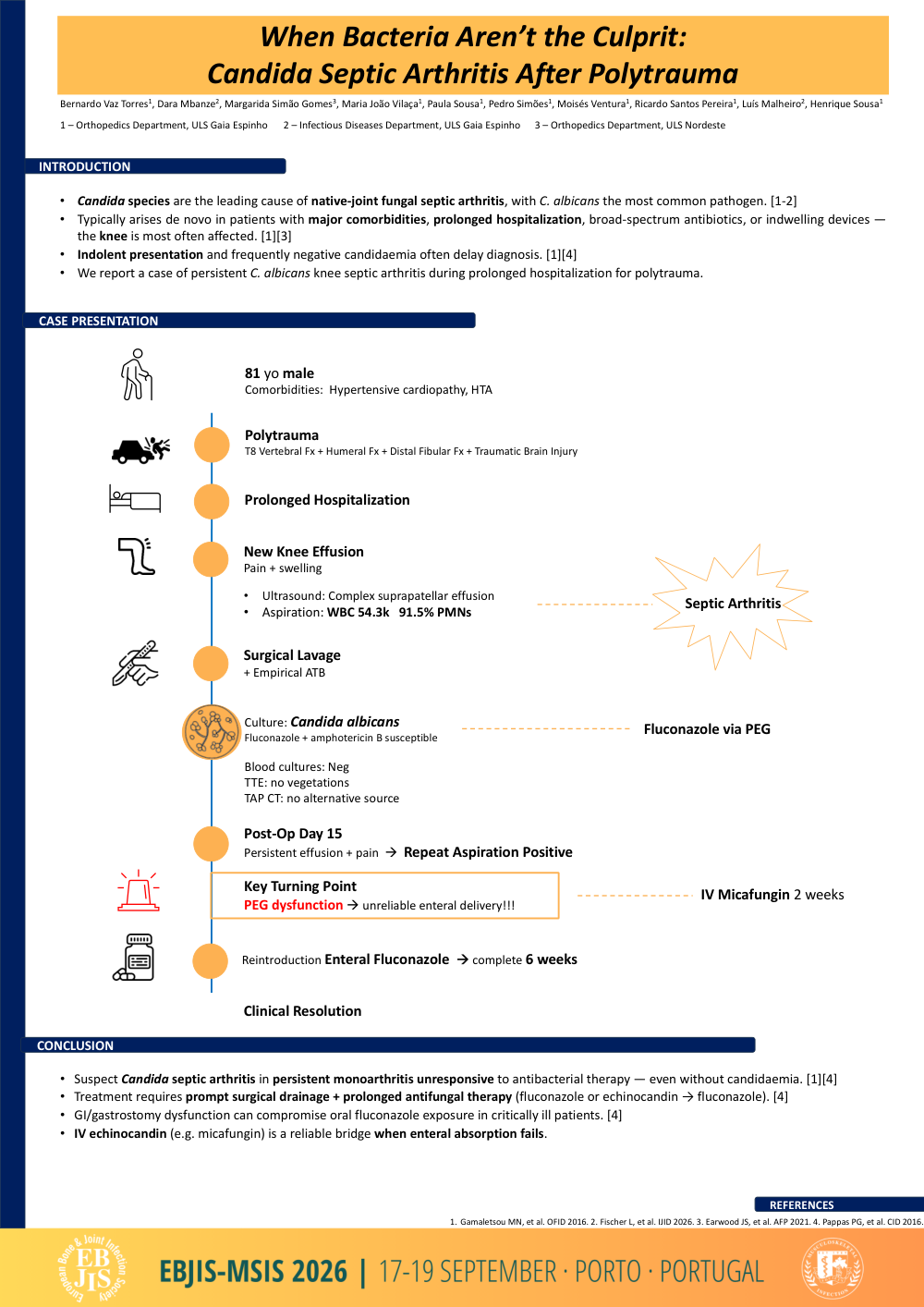
An 81-year-old male was admitted following polytrauma.

After prolonged hospitalization, he developed a new knee effusion with pain and swelling. Ultrasound revealed a complex suprapatellar effusion. Aspiration showed 54,300 WBC/µL with 91.5% PMNs, consistent with septic arthritis.

The patient underwent surgical lavage and empirical antibiotic therapy. Synovial fluid culture unexpectedly grew Candida albicans, susceptible to fluconazole and amphotericin B. 

Fluconazole was administered via PEG. On postoperative day 15, persistent effusion and pain prompted repeat aspiration, which remained positive.PEG dysfunction was subsequently identified, raising concern for unreliable enteral antifungal delivery. Intravenous micafungin was therefore administered for 2 weeks, followed by reintroduction of enteral fluconazole to complete a 6-week antifungal course, with clinical resolution.


Conclusion
•Suspect Candida septic arthritis inpersistent monoarthritisunresponsive to antibacterial therapy — even without candidaemia. [1][4]
•Treatment requires prompt surgical drainage + prolonged antifungal therapy (fluconazole or echinocandin → fluconazole). [4]
•GI/gastrostomy dysfunction can compromise oral fluconazole exposure in critically ill patients. [4]
•IV echinocandin (e.g. micafungin) is a reliable bridge when enteral absorption fails.
ebjis-msis2026 banner
Copyright © 2015-2026, ePostersLive® SciGen is a registered trademark of SciGen Technologies S.A. Patent pending.

This website and third-party tools we use rely on cookies for the best user experience. By selecting "I agree", you agree to cookie usage as described in our Privacy Policy.