477 posters, 14 topics, 2,065 authors, 1,055 institutions
ePostersLive by SciGen Technologies S.A. All rights reserved.
The Joint EBJIS-MSIS 2026 Conference
17 - 19 September, 2026 | Porto, Portugal

EP040
Management of Large Infected Bone Defects around the Ankle with Bone Transport over a Retrograde Nail
Part of Topic
Case Report
Management of Large Infected Bone Defects around the Ankle with
Bone Transport over a Retrograde Nail
Martin McNally1 and Erik Formanek2
1The Oxford Bone Infection Unit, Nuffield Orthopaedic Centre, Oxford, United Kingdom
2Department of Orthopaedic Surgery, Oslo University Hospital, Oslo, Norway
Background
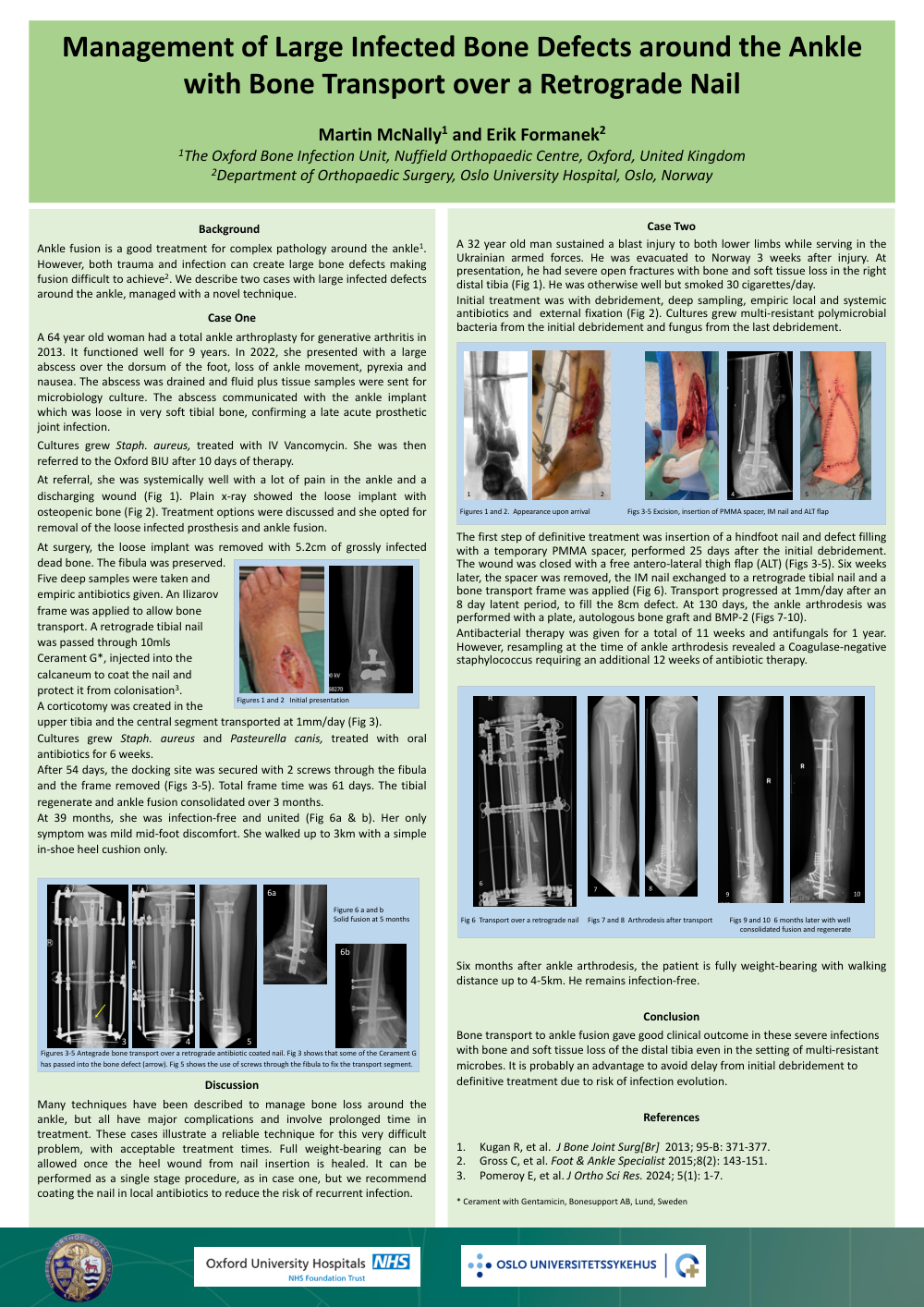
Ankle fusion is a good treatment for complex pathology around the ankle1. However, both trauma and infection can create large bone defects making fusion difficult2. We describe two cases with large, infected defects around the ankle, managed with a novel technique. One had severe infection of a total ankle replacement (PJI) and the other sustained major open trauma of the distal tibia and ankle joint with infection (FRI), while serving in the Ukrainian armed forces.
Method
Both patients had excision of the dead and compromised tissues around the ankle, creating major segmental bone defects (5 and 8cm respectively). Deep tissue sampling and local and systemic antimicrobial therapy were performed. The defect was stabilized by a retrograde intramedullary nail and an Ilizarov circular fixator. The soft tissue defects were closed at the time of nail insertion, including an ALT flap in the FRI case. The bone defect was managed with bone transport over the IM nail. Cultures revealed complex polymicrobial infections with multi-resistant organisms.
Once the bone transport had reached docking, the ‘ankle’ was fused with internal fixation and the Ilizarov frame removed. Both cases united with eradication of infection at final review. Function was good with comfortable walking for several kilometres.
Discussion
This technique, combining retrograde nailing, antegrade bone transport and local antimicrobials was effective in these difficult cases. It can be performed in one or two stages. We recommend avoiding delays in definitive treatment and antibiotic-coating of the IM nail to avoid colonisation of the implant3.
- Kugan R, et al. J Bone Joint Surg[Br] 2013; 95-B: 371-377.
- Gross C, et al. Foot & Ankle Specialist 2015;8(2): 143-151.
- Pomeroy E, et al. J Ortho Sci Res. 2024; 5(1): 1-7.