477 posters, 14 topics, 2,065 authors, 1,055 institutions
ePostersLive by SciGen Technologies S.A. All rights reserved.
The Joint EBJIS-MSIS 2026 Conference
17 - 19 September, 2026 | Porto, Portugal

EP038
Candida Prosthetic Joint Infection During Two-Stage Revision: The Role of Antifungal-Loaded Spacer Exchange
Part of Topic
Case Report
INTRODUCTION
Prosthetic joint infection (PJI) caused by Candida species is a rare but severe complication, often associated with multiple surgeries, prolonged antibiotic exposure, and host-related risk factors (1).
Two-stage revision is the standard of care; however, optimal management when Candida spp. is unexpectedly isolated remains unclear (2). We describe a case of Candida albicans PJI diagnosed during a two-stage revision and propose a management strategy emphasizing antifungal-loaded spacers.
CASE PRESENTATION
An 81-year-old male underwent left total knee arthroplasty (TKA), complicated in 2019 by PJI due to methicillin-resistant Staphylococcus aureus (MRSA), treated with debridement, antibiotics, and implant retention (DAIR), followed by two-stage revision.
In April 2025, a new PJI due to methicillin-sensitive Staphylococcus aureus (MSSA) required prosthesis removal and implantation of an antibiotic-loaded (gentamicin and vancomycin, GV) articulating spacer, followed by intravenous antibiotics.
Due to clinical worsening, spacer exchange with a static GV spacer and V–Y flap was performed.
Cultures yielded Enterococcus faecalis, Klebsiella pneumoniae, and Candida albicans.
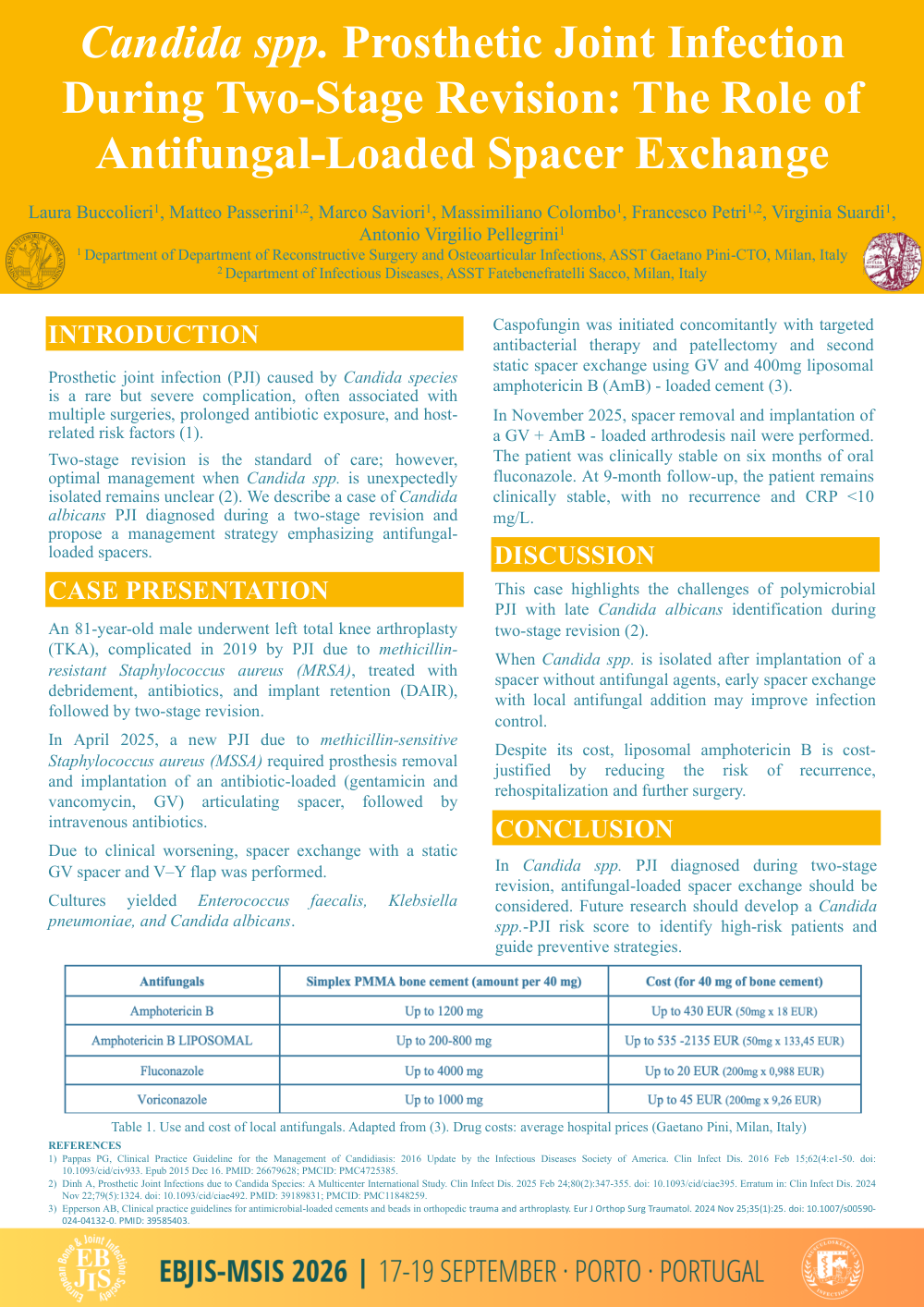
Caspofungin was initiated concomitantly with targeted antibacterial therapy and patellectomy and second static spacer exchange using GV and 400mg liposomal amphotericin B (AmB) - loaded cement (3).
In November 2025, spacer removal and implantation of a GV + AmB - loaded arthrodesis nail were performed. The patient was clinically stable on six months of oral fluconazole. At 9-month follow-up, the patient remains clinically stable, with no recurrence and CRP <10 mg/L.
DISCUSSION
This case highlights the challenges of polymicrobial PJI with late Candida albicans identification during two-stage revision (2).
When Candida spp. is isolated after implantation of a spacer without antifungal agents, early spacer exchange with local antifungal addition may improve infection control.
Despite its cost, liposomal amphotericin B is cost-justified by reducing the risk of recurrence, rehospitalization and further surgery.
CONCLUSION
In Candida spp. PJI diagnosed during two-stage revision, antifungal-loaded spacer exchange should be considered. Future research should develop a Candida spp.-PJI risk score to identify high-risk patients and guide preventive strategies.
REFERENCES
1) Pappas PG, Clinical Practice Guideline for the Management of Candidiasis: 2016 Update by the Infectious Diseases Society of America. Clin Infect Dis. 2016 Feb 15;62(4:e1-50. doi: 10.1093/cid/civ933. Epub 2015 Dec 16. PMID: 26679628; PMCID: PMC4725385.
2) Dinh A, Prosthetic Joint Infections due to Candida Species: A Multicenter International Study. Clin Infect Dis. 2025 Feb 24;80(2):347-355. doi: 10.1093/cid/ciae395. Erratum in: Clin Infect Dis. 2024 Nov 22;79(5):1324. doi: 10.1093/cid/ciae492. PMID: 39189831; PMCID: PMC11848259.
3) Epperson AB, Clinical practice guidelines for antimicrobial-loaded cements and beads in orthopedic trauma and arthroplasty. Eur J Orthop Surg Traumatol. 2024 Nov 25;35(1):25. doi: 10.1007/s00590-024-04132-0. PMID: 39585403.