477 posters, 14 topics, 2,065 authors, 1,055 institutions
ePostersLive by SciGen Technologies S.A. All rights reserved.
The Joint EBJIS-MSIS 2026 Conference
17 - 19 September, 2026 | Porto, Portugal

EP035
Debatable DAIR in PJI associated to a primary complex TKR in a patient with known PRA - Discussions
Poster Presenter
Part of Topic
Case Report
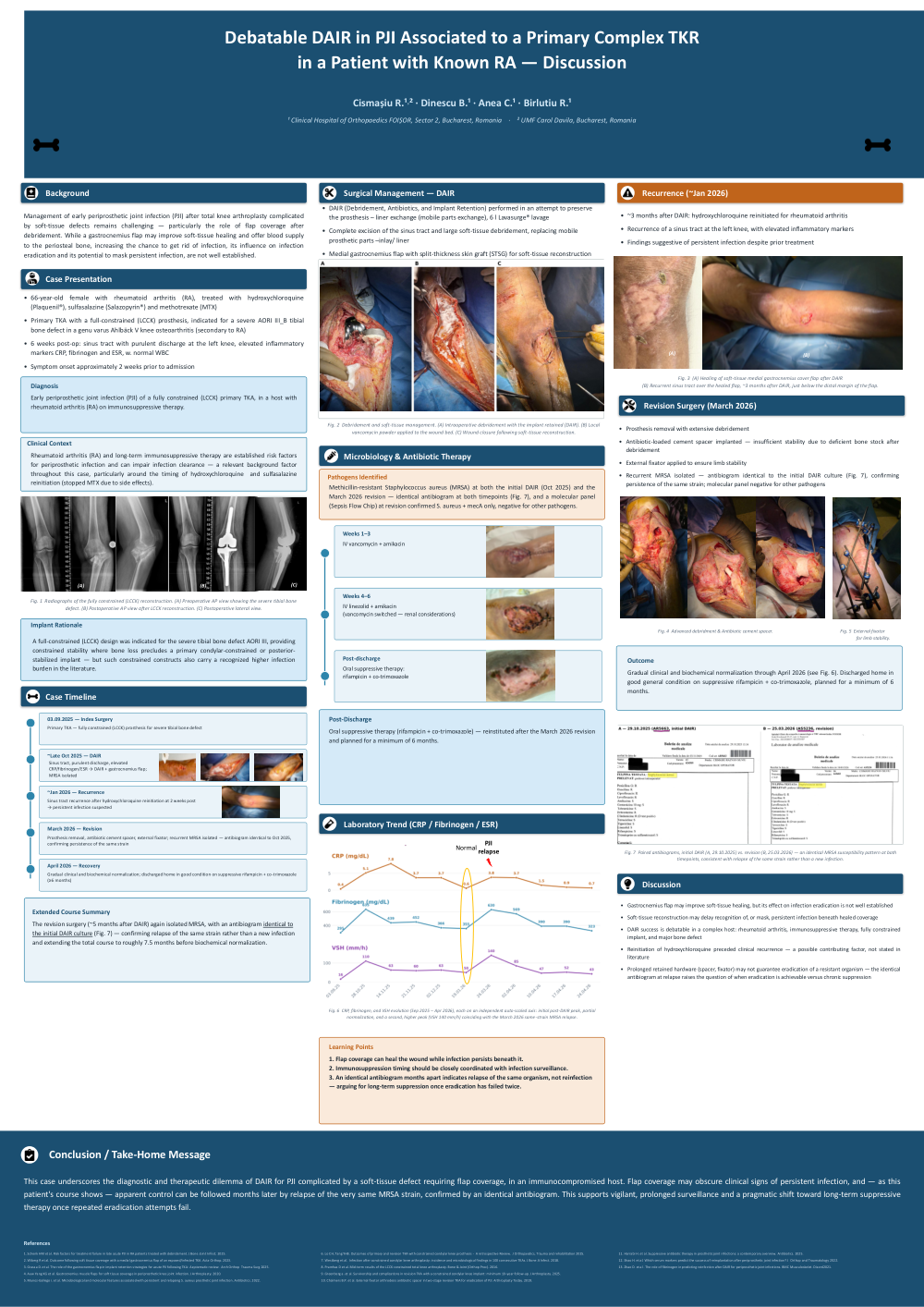
Management of early periprosthetic joint infection (PJI) after total knee arthroplasty complicated by soft-tissue defects remains challenging — particularly the role of flap coverage after debridement. While a gastrocnemius flap may improve soft-tissue healing and offer blood supply to the periosteal bone, increasing the chance to get rid of infection, its influence on infection eradication and its potential to mask persistent infection, are not well established.
CASE PRESENTATION
Early periprosthetic joint infection (PJI) of a fully constrained (LCCK) primary TKA, in a host with rheumatoid arthritis (RA) on immunosuppressive therapy.
CLINICAL CONTEXT
Rheumatoid arthritis (RA) and long-term immunosuppressive therapy are established risk factors for periprosthetic infection and can impair infection clearance — a relevant background factor throughout this case, particularly around the timing of hydroxychloroquine and sulfasalazine reinitiation (stopped MTX due to side effects).
IMPLANT RATIONALE
A full-constrained (LCCK) design was indicated for the severe tibial bone defect AORI III, providing constrained stability where bone loss precludes a primary condylar-constrained or posterior-stabilized implant — but such constrained constructs also carry a recognized higher infection burden in the literature.
CASE TIMLINE
03.09.2025 - Index Surgery
late oct. 2025 - Sinus tract, purulent discharge, elevated CRP/fibrinogen/ESR → DAIR + gastrocnemius flap; MRSA isolated
Jan. 2026 - Sinus tract recurrence after hydroxychloroquine reinitiation at 2 weeks post → persistent infection suspected
March 2026 - Prosthesis removal, antibiotic cement spacer, external fixator; recurrent MRSA isolated — antibiogram identical to Oct 2025, confirming persistence of the same strain
Apr. 2026 - Gradual clinical and biochemical normalization; discharged home in good condition on suppressive rifampicin + co-trimoxazole (≥6 months)
SURGICAL MANAGEMENT - DAIR 1st
Methicillin-resistant Staphylococcus aureus (MRSA) at both the initial DAIR (Oct 2025) and the March 2026 revision — identical antibiogram at both timepoints (Fig. 7), and a molecular panel (Sepsis Flow Chip) at revision confirmed S. aureus + mecA only, negative for other pathogens.
POST-DISCHARGE
Oral suppressive therapy (rifampicin + co-trimoxazole) — reinstituted after the March 2026 revision and planned for a minimum of 6 months.
REVISION SURGERY - prosthetic explantation 2nd
Gradual clinical and biochemical normalization through April 2026 (see Fig. 6). Discharged home in good general condition on suppressive rifampicin + co-trimoxazole, planned for a minimum of 6 months.
DISCUSSIONS
Learning pearls:
1. Flap coverage can heal the wound while infection persists beneath it.
2. Immunosuppression timing should be closely coordinated with infection surveillance.
3. An identical antibiogram months apart indicates relapse of the same organism, not reinfection — arguing for long-term suppression once eradication has failed
twice.
CONCLUSION:
This case underscores the diagnostic and therapeutic dilemma of DAIR for PJI complicated by a soft-tissue defect requiring flap coverage, in an immunocompromised host. Flap coverage may obscure clinical signs of persistent infection, and — as this patient's course shows — apparent control can be followed months later by relapse of the very same MRSA strain, confirmed by an identical antibiogram. This supports vigilant, prolonged surveillance and a pragmatic shift toward long-term suppressive therapy once repeated eradication attempts fail.
REFERENCES:
1. Schenk HM et al. Risk factors for treatment failure in late acute PJI in RA patients treated with debridement. J Bone Joint Infect. 2025.
2. Wiberg R et al. Outcome following soft tissue coverage with a medial gastrocnemius flap of an exposed/infected TKA. Acta Orthop. 2023.
3. Grassa D. et al. The role of the gastrocnemius flap in implant retention strategies for acute PJI following TKA: Asystematic review. Arch Orthop Trauma Surg 2025.
4. Auw Yang KG et al. Gastrocnemius muscle flaps for soft tissue coverage in periprosthetic knee joint infection. J Arthroplasty. 2020.
5. Munoz-Gallego i. et al. Microbiological and molecular features associated with persistent and relapsing S. aureus prosthetic joint infection. Antibiotics. 2022.
6. Lo CH, Tang YHB. Outcomes of primary and revision TKA with constrained condylar knee prosthesis - A retrospective Review. J Orthopaedics, Trauma and rehabilitation 2025.
7. Westberg et al. Infection after constrained condylar knee arthroplasty: incidence and microbiological findings in 100 consecutive TKAs. J Bone Jt Infect. 2018.
8. Pramhas D et al. Mid-term results of the LCCK constrained total knee arthroplasty. Bone & Joint (Orthop Proc). 2016.
9. Greenberg a. et al. Survivorship and complications in revision TKA with a constrained condylar knee implant: minimum 10-year follow-up. J Arthroplasty. 2025.
10. Chalmers B.P. et al. External fixator arthrodesis antibiotic spacer in two-stage revision TKA for eradication of PJI. Arthroplasty Today. 2019.
11. Harrabi H. et al. Suppressive antibiotic therapy in prosthetic joint infections: a contemporary overview. Antibiotics. 2025.
12. Shao H. et al. Which serum markers predict the success of reimplantation after periprosthetic joint infection? J Orthop and Traumatology 2022.
13. Zhao D. et al . The role of fibrinogen in predicting reinfection after DAIR for periprosthetic joint infections. BMC Musculoskelet. Disord2021.