477 posters, 14 topics, 2,065 authors, 1,055 institutions
ePostersLive by SciGen Technologies S.A. All rights reserved.
The Joint EBJIS-MSIS 2026 Conference
17 - 19 September, 2026 | Porto, Portugal

EP034
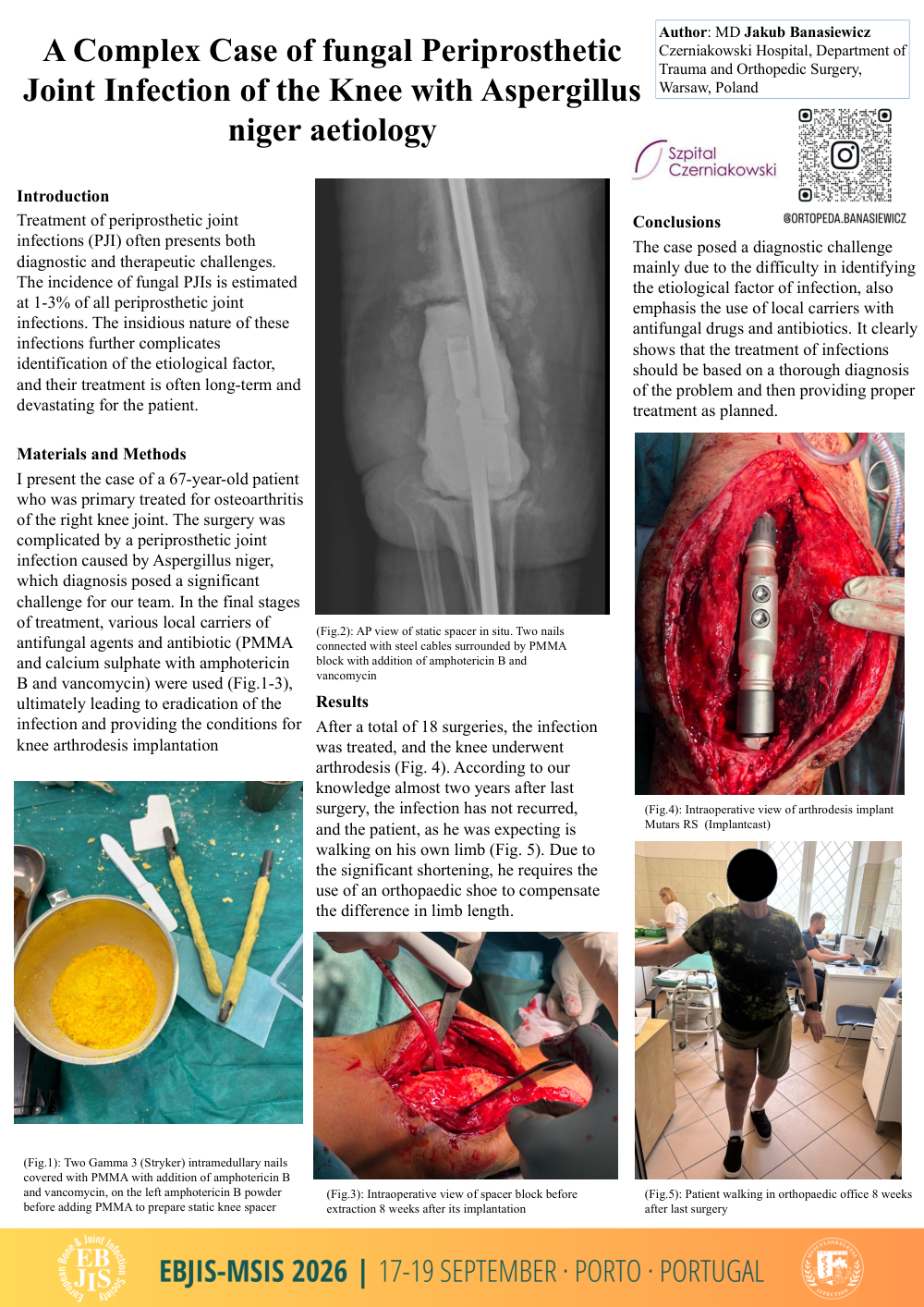
A Complex Case of fungal Periprosthetic Joint Infection of the Knee with Aspergillus niger aetiology
Poster Presenter
Authors
Affiliations
Part of Topic
Case Report
A Complex Case of fungal Periprosthetic Joint Infection of the Knee with Aspergillus niger aetiology
Abstract
Introduction
Treatment of periprosthetic joint infections (PJI) often presents both diagnostic and therapeutic challenges. The incidence of fungal PJIs is estimated at 1-3% of all periprosthetic joint infections. The insidious nature of these infections further complicates identification of the etiological factor, and their treatment is often long-term and devastating for the patient.
Materials and Methods
I present the case of a 67-year-old patient who was primary treated for osteoarthritis in the right knee joint. The surgery was complicated by a periprosthetic joint infection caused by Aspergillus niger, which diagnosis posed a significant challenge for our team. In the final stages of treatment, various local carriers of antifungal agents and antibiotic (PMMA and calcium sulphate with amphotericin B and vancomycin) were used, ultimately leading to eradication of the infection and providing the conditions for knee arthrodesis implantation.
Results
After a total of 18 surgeries, the infection was cured and the knee underwent arthrodesis. According to our knowledge almost two years after last surgery, the infection has not recurred, and the patient, as he was expecting is walking on his own limb. Due to the significant shortening, he requires the use of an orthopaedic shoe to compensate the difference in limb length.
Conclusions
The case posed a diagnostic challenge mainly due to the difficulty in identifying the etiological factor of infection, also emphasis the use of local carriers with antifungal drugs and antibiotics. It clearly shows that the treatment of infections should be based on a thorough diagnosis of the problem and then providing proper treatment as planned.