477 posters, 14 topics, 2,065 authors, 1,055 institutions
ePostersLive by SciGen Technologies S.A. All rights reserved.
The Joint EBJIS-MSIS 2026 Conference
17 - 19 September, 2026 | Porto, Portugal

PP80
Risk Factors for Treatment Failure After Debridement and Implant Retention in Early Postoperative Spinal Implant Infection: A Multicenter Cohort Study
Poster Presenter
Authors
Jessica C. O'Neil, Emily Poehlein, Daisuke Furukawa, Sandra B. Nelson, Aaron J. Tande, Daniela De Lima Corvin, Alaina Ritter, Jenny Aronson, Laura Certain, Alexander M. Tatara, Cynthia Green, Tarek Abdalla, Molly Fleece, Brian A. Karamian, Daniel Tobert, Melissa Erickson, Jessica Seidelman, Don Bambino Geno Tai
Affiliations
Division of Infectious Diseases, University of Pennsylvania, Philadelphia, United States, Department of Biostatistics and Bioinformatics, Duke University School of Medicine, Durham, United States, Division of Infectious Diseases and Geographic Medicine, Stanford University, Stanford, United States, Division of Infectious Diseases, Massachusetts General Hospital, Boston, United States; Department of Medicine; Harvard Medical School, Boston, United States, Division of Public Health, Infectious Diseases and Occupational Medicine, Mayo Clinic, Rochester, United States, Division of Infectious Diseases, University of Alabama at Birmingham, Birmingham, United States, Division of Infectious Diseases and Global Medicine, University of Florida College of Medicine, Gainesville, United States, Division of Infectious Diseases, University of Utah, Salt Lake City, United States, Division of Infectious Diseases and Geographic Medicine, The University of Texas Southwestern Medical Center, Dallas, United States, Department of Orthopedic Surgery, University of Utah, Salt Lake City, United States, Department of Orthopedic Surgery, Massachusetts General Hospital and Harvard Medical School, Boston, United States, Department of Orthopedic Surgery, Duke University School of Medicine, Durham, United States, Division of Infectious Diseases, Duke University Hospital, Durham, United States, Division of Infectious Diseases and International Medicine, University of Minnesota School of Medicine, Minneapolis, United States, University Of Pennsylvania
Part of Topic
Spinal Infections
Title: Risk Factors for Failure After Debridement and Implant Retention in Early Spinal Instrumentation Infection: A Multicenter Cohort Study
Spinal instrumentation infection (SII) is a serious complication of instrumented spinal fusion. For early infections, debridement and implant retention (DAIR) is commonly performed to preserve spinal stability; however, predictors of failure are not well established. Prior studies are limited by small sample sizes and single-center designs. The aim of this study was to identify factors associated with failure.
This retrospective cohort study included adults with early SII from 10 academic medical centers, defined as infection occurring within 90 days of spinal fusion, who underwent DAIR and received at least two weeks of systemic antimicrobial therapy. Patients were excluded if spinal fusion was performed for infectious or oncologic indications. Patients were also excluded if hardware was removed. The primary outcome was treatment failure, defined as return to the operating room, reinfection, or death due to infection. The cumulative incidence of failure was estimated. Factors associated with failure were evaluated using a Least Absolute Shrinkage and Selection Operator penalized Cox proportional hazards model.
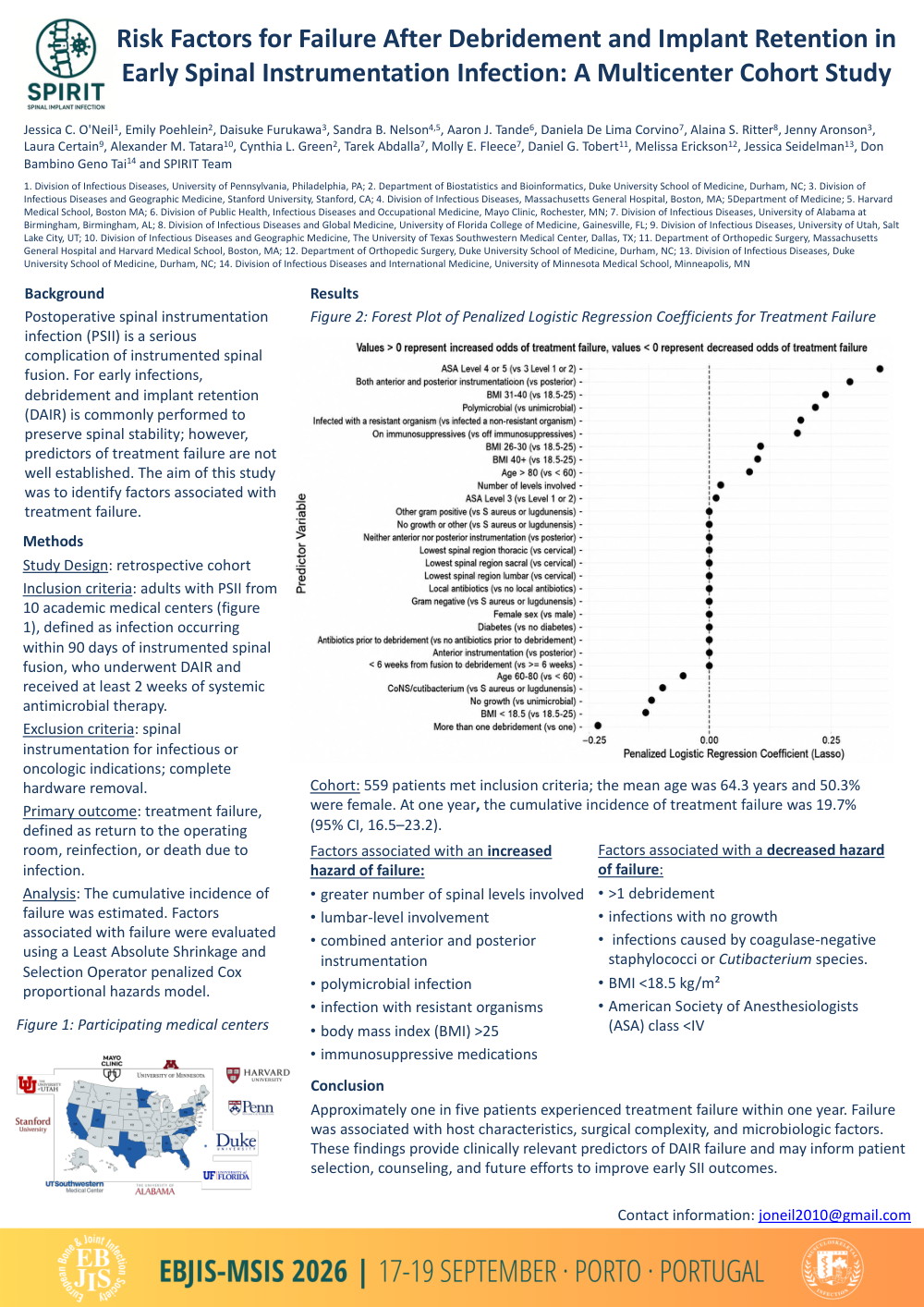
A total of 559 patients met inclusion criteria; the mean age was 64.3 years and 50.3% were female. At one year, the cumulative incidence of treatment failure was 19.7% (95% CI, 16.5–23.2). Factors associated with an increased hazard of failure included higher body mass index (BMI), immunosuppressive medication use, greater number of spinal levels involved, combined anterior and posterior instrumentation, polymicrobial infection, lumbar-level involvement and infection with resistant organisms. Factors associated with a decreased hazard of failure included older age, BMI <18.5 kg/m², American Society of Anesthesiologists (ASA) class <IV, >1 debridement, infections with no growth, and infections caused by coagulase‑negative staphylococci or Cutibacterium species (Figure 2).
In this multicenter study of early SII treated with DAIR, approximately one in five patients experienced treatment failure within one year. Failure was associated with host characteristics, surgical complexity, and microbiologic factors. These findings provide clinically relevant predictors of DAIR failure and may inform patient selection, counseling, and future efforts to improve early SII outcomes.