477 posters, 14 topics, 2,065 authors, 1,055 institutions
ePostersLive by SciGen Technologies S.A. All rights reserved.
The Joint EBJIS-MSIS 2026 Conference
17 - 19 September, 2026 | Porto, Portugal

EP465
Incidence and Surgical Management of Secondary Spine Infections: A Case Series Study of 4,921 Consecutive Patients
Poster Presenter
Part of Topic
Spinal Infections
INTRODUCTION
• Secondary spine infections: surgical site infections (SSI) that develop because of a spine procedure, are among the most common and feared complications in orthopaedic spine surgery.
• Incidence in the literature has been noted between 0 – 18%1-3 .
• Associated with increased morbidity, mortality, hospital stays, and medical and surgical management1-3 .
• Results in excessive cost to the patient and healthcare system, in some cases a 4x or $100,000 increase2 .
• Historically linked with obesity4 , diabetes5 , tobacco use6 , longer and more invasive procedures7 , implants8 , and trauma9.
METHODS
• We reviewed our institutional database of 4,921 consecutive patients undergoing spine surgeries between 2015-2025.
• Patients with SSI requiring operative management were included. Primary spine infections, non-operative SSI, and non-infectious surgical site complications (ex. hematomas) were excluded.
• Incidence of SSI, demographics, primary and revision surgical characteristics, spine related healthcare utilization (ED visits, readmissions, subsequent reoperations, antibiotics), intraoperative culture and infection data, and clinical outcomes were assessed.
RESULTS
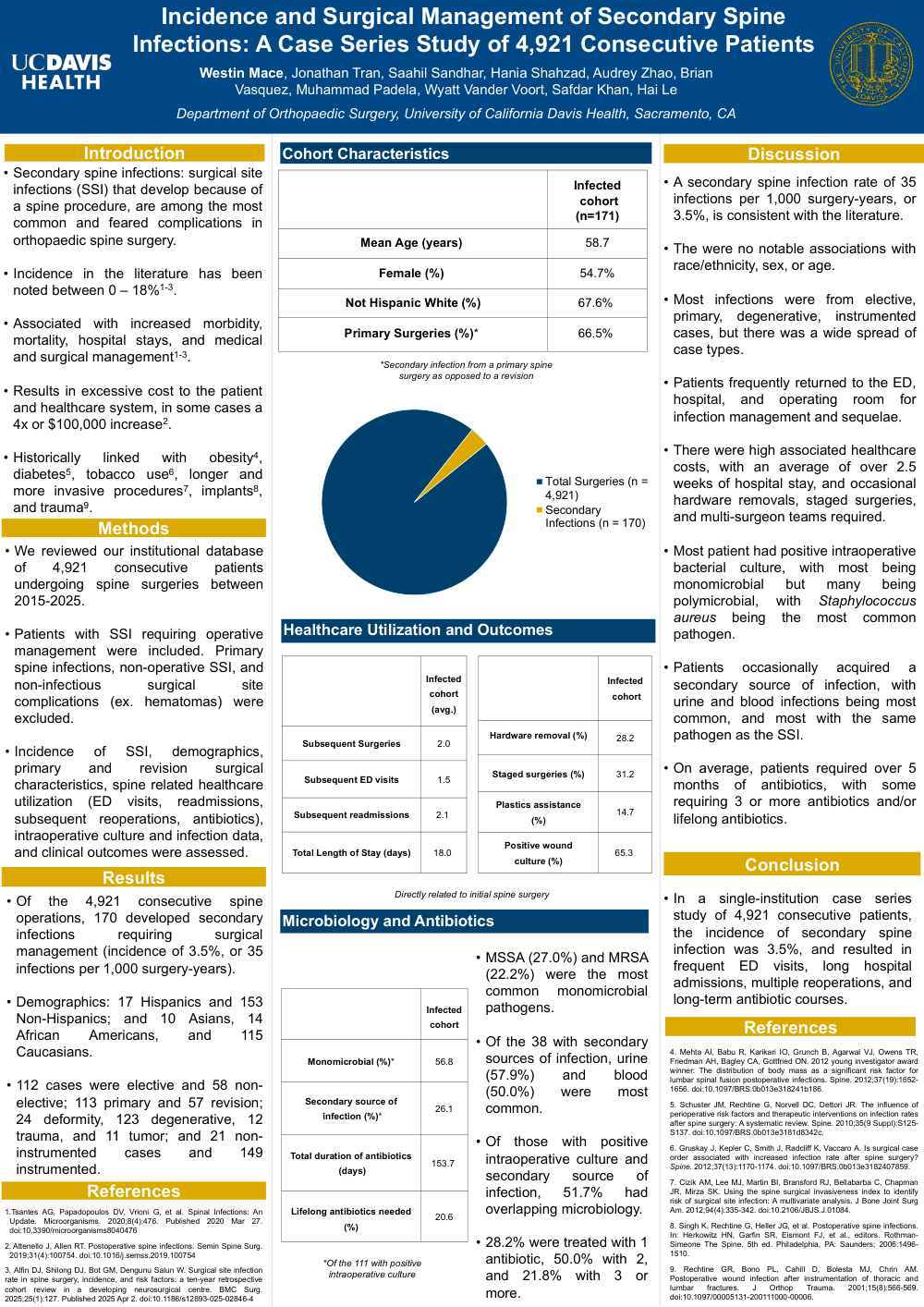
• Of the 4,921 consecutive spine operations, 170 developed secondary infections requiring surgical management (incidence of 3.5%, or 35 infections per 1,000 surgery-years).
• Demographics: 17 Hispanics and 153 Non-Hispanics; and 10 Asians, 14 African Americans, and 115 Caucasians.
• 112 cases were elective and 58 nonelective; 113 primary and 57 revision; 24 deformity, 123 degenerative, 12 trauma, and 11 tumor; and 21 noninstrumented cases and 149 instrumented.
DISCUSSION
• A secondary spine infection rate of 35 infections per 1,000 surgery-years, or 3.5%, is consistent with the literature.
• The were no notable associations with race/ethnicity, sex, or age.
• Most infections were from elective, primary, degenerative, instrumented cases, but there was a wide spread of case types.
• Patients frequently returned to the ED, hospital, and operating room for infection management and sequelae.
• There were high associated healthcare costs, with an average of over 2.5 weeks of hospital stay, and occasional hardware removals, staged surgeries, and multi-surgeon teams required.
• Most patient had positive intraoperative bacterial culture, with most being monomicrobial but many being polymicrobial, with Staphylococcus aureus being the most common pathogen.
• Patients occasionally acquired a secondary source of infection, with urine and blood infections being most common, and most with the same pathogen as the SSI.
• On average, patients required over 5 months of antibiotics, with some requiring 3 or more antibiotics and/or lifelong antibiotics.
CONCLUSION
• In a single-institution case series study of 4,921 consecutive patients, the incidence of secondary spine infection was 3.5%, and resulted in frequent ED visits, long hospital admissions, multiple reoperations, and long-term antibiotic courses.