477 posters, 14 topics, 2,065 authors, 1,055 institutions
ePostersLive by SciGen Technologies S.A. All rights reserved.
The Joint EBJIS-MSIS 2026 Conference
17 - 19 September, 2026 | Porto, Portugal

PP41
Phage-Loaded Hydrogel Combined with Systemic and Intra-Articular Phage Therapy for Chronic Staphylococcus epidermidis Periprosthetic Hip Infection: A Case Report
Poster Presenter
Authors
Felix-Antoine Garneau-Picard, Tariq Azamgarhi, John Skinner, Natasha Karunaharan, Simon Warren, Joe Brierley, Katy Crick, Chin Swee, Antonia Scobie
Affiliations
Bone Infection Unit, Royal National Orthopaedic Hospital NHS Trust, United Kingdom, Bone Infection Unit, Royal National Orthopaedic Hospital NHS Trust, United Kingdom; CHU de Qu?bec - Universit? Laval, Canada; ESCMID Study Group for Non-Traditional Antibacterial Therapy (ESGNTA), Bone Infection Unit, Royal National Orthopaedic Hospital NHS Trust, United Kingdom; ESCMID Study Group for Non-Traditional Antibacterial Therapy (ESGNTA), Bone Infection Unit, Royal National Orthopaedic Hospital NHS Trust, United Kingdom; Department of Infection, Royal Free London NHS Foundation Trust, United Kingdom, Great Ormond Street Hospital for Children NHS Foundation Trust, United Kingdom, Bone Infection Unit, Royal National Orthopaedic Hospital NHS Trust, United Kingdom; Department of Infection, Royal Free London NHS Foundation Trust, United Kingdom, CHU De Qu?bec - Universit? Laval
Part of Topic
Phage Therapy
Phage-Loaded Hydrogel Combined with Systemic and Intra-Articular Phage Therapy for Chronic Staphylococcus epidermidis Periprosthetic Hip Infection: A Case Report
Félix-Antoine Garneau-Picard1,2,3, Tariq Azamgarhi1,3, John Skinner1, Simon Warren1,4, Natasha Karunaharan1,4
, Joe Brierley5, Katy Crick1
, Swee Chin1 & Antonia Scobie1,3,4,6
1. Bone Infection Unit, Royal National Orthopaedic Hospital NHS Trust, Stanmore, UK; 2. CHU de Québec-Université Laval, Québec, Canada; 3. ESGNTA – ESCMID Study Group for Non-
Traditional Antibacterials, Basel, Switzerland; 4. Department of Infection, Royal Free London NHS Foundation Trust, London, UK; 5. Great Ormond Street Hospital for Children NHS Foundation
Trust, London, UK; 6. Division of Infection and Immunity, University College London, London, UK.
Introduction
Chronic, multi-revised periprosthetic joint infections (PJI) remain challenging. Phage therapy (PT) is a promising adjunctive strategy given its ability to target biofilm-embedded bacteria. We describe salvage PT combined with Debridement Antibiotics and Implant Retention (DAIR) for chronic left hip PJI caused by multi-drug resistant (MDR) Staphylococcus epidermidis.
Methods
A 65-year-old female with thalidomide-related upper limb phocomelia and congenital bilateral hip dysplasia underwent primary left total hip replacement in 2018. She experienced multiple dislocations requiring open reduction and subsequently developed Staphylococcus epidermidis PJI. Seven surgical procedures were performed to eradicate infection including DAIR and washout. Complete revision was deemed too high risk due to complex pelvic metalwork and prosthesis stability. Antibiotic suppression with pristinamycin and doxycycline failed, and she also developed linezolid-related optic neuritis. The isolate (2020–2024) remained sensitive to Teicoplanin, Linezolid and Daptomycin only. Pre-treatment, she had intermittent fevers, fatigue, a painful left hip mass, and declining mobility.
The case was discussed at a national orthopaedic phage multidisciplinary team (MDT) meeting. Due to lack of oral suppressive options and high revision risk, salvage DAIR with adjunctive PT was recommended.
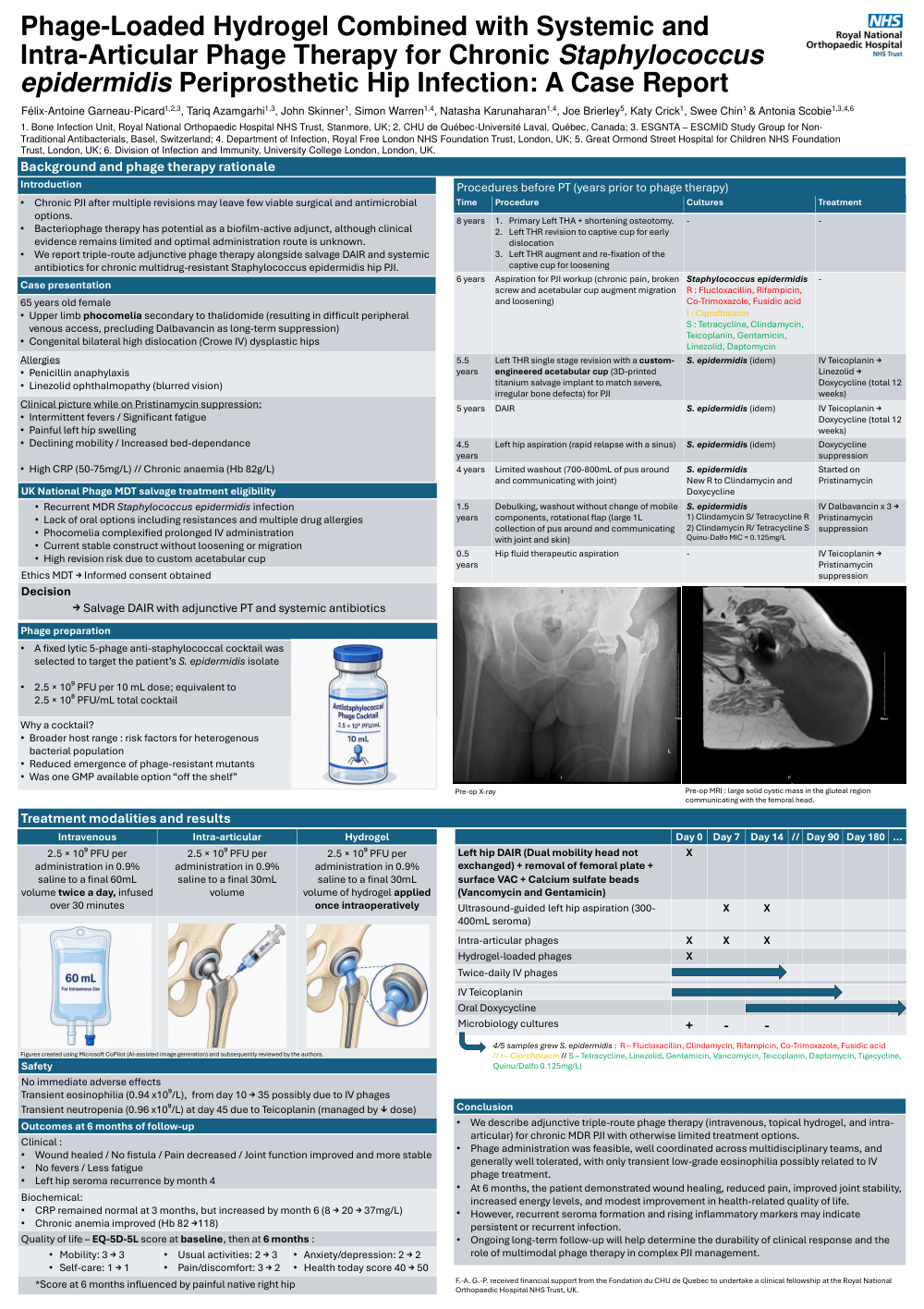
Following phage susceptibility testing and local ethics and regulatory approvals, a fixed lytic 5-phage anti-staphylococcal cocktail was selected (1 × 10⁹ PFU per 10 mL dose; equivalent to 1 × 10⁸ PFU/mL total cocktail). Treatment comprised extensive DAIR with phage-loaded hydrogel applied to the prosthesis, intra-articular and intravenous (IV) phage on day 0, twice-daily IV phages for 7 days, and ultrasound-guided intra-articular injections on days 7 and 14 (with microbiological sampling and seroma aspiration). Concurrent antibiotics included IV Teicoplanin and oral Doxycycline for 12 weeks, then Doxycycline monotherapy.
Results
The combination of topical, IV and intra-articular PT was well tolerated with no serious adverse events. Transient asymptomatic eosinophilia occurred from day 10–45. At 8 weeks, the wound had healed and pain decreased significantly. Left hip swelling persisted, but she regained mobility and autonomy. CRP normalised (<10 mg/L) by day 20 and chronic anaemia improved (haemoglobin 82 to 106 g/L). Intraoperative cultures grew the same S. epidermidis (now Doxycycline-sensitive). Day 7 and 14 aspiration cultures demonstrated no bacterial growth.
Conclusions
We describe the first combined triple-route (IV, topical hydrogel, and intra-articular) adjunctive PT for chronic MDR PJI. This regimen was well tolerated, with encouraging early clinical, biochemical, and microbiological responses at 8 weeks. Longer follow-up is ongoing to assess infection eradication.