477 posters, 14 topics, 2,065 authors, 1,055 institutions
ePostersLive by SciGen Technologies S.A. All rights reserved.
The Joint EBJIS-MSIS 2026 Conference
17 - 19 September, 2026 | Porto, Portugal

EP233
A Multicenter Prospective Registry to Standardize and Evaluate Personalized Bacteriophage Therapy in Difficult-to-Treat Infections
Poster Presenter
Authors
Louise Sykora, Laura Bessems, Melissa Depypere, Yves Debaveye, Isabel Spriet, David Devolder, Paul De Munter, Liesbet Henckaerts, Laura Van Gerven, Saartje Uyttebroek, Natalie Lorent, Lieven Dupont, An Van Laethem, Sabrina Van Ierssel, Diana Huis in 't Veld, Johan Van Laethem, Katelijne Flore, Louise Doyen, Le?la Belkhir, Jean-Paul Pirnay, Pieter-Jan Ceyssens
Affiliations
Department of Development and Regeneration, KU Leuven, Leuven, Belgium; Department of Trauma Surgery, University Hospitals Leuven, Leuven, Belgium, Department of Laboratory Medicine, University Hospitals Leuven, Leuven, Belgium; Laboratory of Clinical Microbiology, Department of Microbiology, Immunology and Transplantation, KU Leuven, Leuven, Belgium, Department of Intensive Care Medicine, University Hospitals Leuven, Leuven, Belgium, Pharmacy Department, University Hospitals Leuven, Leuven, Belgium; Department of Pharmaceutical and Pharmacological Sciences, Clinical Pharmacology and Pharmacotherapy, KU Leuven, Leuven, Belgium, Pharmacy Department, University Hospitals Leuven, Leuven, Belgium, Laboratory for Clinical Infectious and Inflammatory Disorders, Department of Microbiology, Immunology and Transplantation, KU Leuven, Leuven, Belgium; Department of Internal Medicine, University Hospitals Leuven, Leuven, Belgium, Laboratory of Clinical Microbiology, Department of Microbiology, Immunology and Transplantation, KU Leuven, Leuven, Belgium; Department of Internal Medicine, University Hospitals Leuven, Leuven, Belgium, Department of otorhinolaryngology, University Hospitals Leuven, Leuven, Belgium, Department of Respiratory Diseases, University Hospitals Leuven, Leuven, Belgium, Department of Dermatology, University Hospitals Leuven, Leuven, Belgium, Department of General Internal Medicine, Infectious Diseases and Tropical Medicin, University Hospital Antwerp, Edegem, Belgium, Department of Internal Medicine and Infectious Diseases, Ghent University Hospital, Ghent, Belgium, Internal Medicine Research Group, Vrije Universiteit Brussel (VUB), UZ Brussel, Department of Internal Medicine and Infectious Diseases,, Brussels, Belgium, Department of Laboratory Medicine, General Hospital Sint Jan Bruges, Bruges, Belgium, Service of Internal Medicine, Clinique Saint-Pierre, Ottignies, Belgium, UCLouvain [Bruxelles-Woluwe], Institut de Recherche Exp?rimentale et Clinique (IREC),Louvain Center for Toxicology and Applied Pharmacology (LTAP), Woluwe-Saint-Lambert, Belgium; Department of Internal Medicine and Infectious Diseases, Laboratory for Molecular and Cellular Technology, Queen Astrid Military Hospital, Brussels, Belgium; European Society of Clinical Microbiology and Infectious Diseases (ESCMID), Unit of Human Bacterial Diseases, Sciensano, Elsene, Belgium, Katholieke Universiteit Leuven
Part of Topic
Phage Therapy
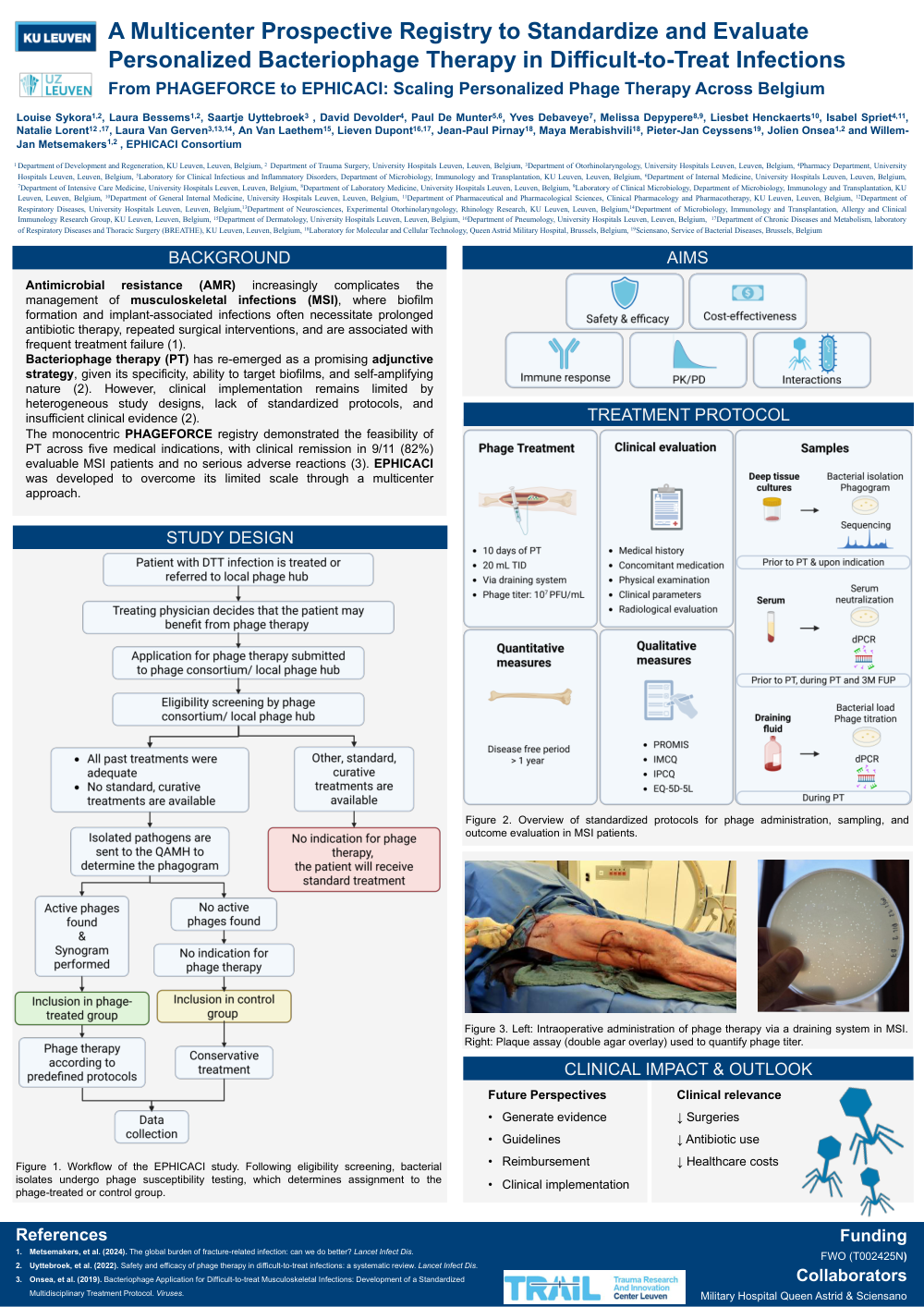
Antimicrobial resistance (AMR) increasingly complicates the management of musculoskeletal infections (MSI), where biofilm formation and implant-associated infections often necessitate prolonged antibiotic therapy, repeated surgical interventions, and are associated with frequent treatment failure (1). Bacteriophage therapy (PT) has re-emerged as a promising adjunctive strategy, given its specificity, ability to target biofilms, and self-amplifying nature (2). However, clinical implementation remains limited by heterogeneous study designs, lack of standardized protocols, and insufficient clinical evidence (2). The monocentric PHAGEFORCE registry demonstrated the feasibility of PT across five medical indications, with clinical remission in 9/11 (82%) evaluable MSI patients and no serious adverse reactions (3). EPHICACI was developed to overcome its limited scale through a multicenter approach.